The CUW clinical placement process, from first ask to first patient
At Concordia University Wisconsin, a graduate NP clinical starts with you: you line up the clinician and the practice, CUW's graduate faculty decide whether the match is appropriate, and the Graduate Clinical Coordinator can assist. After approval come the contract check, your clearance and the site's own onboarding. Your first clinical day is set by whichever of those finishes last.
Get your placement plan
Tell us your CUW program and where you live. A placement advisor replies with the preceptor and site options that fit your course.
CUW's model: you secure, faculty approve
Concordia University Wisconsin's 2026-27 academic catalog assigns the search to the student and the verdict to graduate faculty, with a coordinator on hand for support; the guide to finding your own preceptor unpacks that sentence. It applies across the graduate NP menu: all three MSN tracks, both CAGE certificates, the MBA and MPH pairings with the FNP, and the two practice doctorates that include NP clinicals.
The Post-MSN DNP follows the same logic: residency hours happen "in areas of their choice" with an agency mentor the student lines up. School-arranged sites exist at CUW, but only in its two pre-licensure routes, and the online RN to BSN folds its clinical work into the nurse's own job.
So the path below has one owner from the first phone call to the last signed hours form: you. CUW's part is to review what you bring, approve it and, in the archived handbooks, sort out the contract and tell you when patient care may begin.
The path from search to first clinical day
Here is the sequence as CUW's current catalog and its archived NP documents describe it. Today's public pages confirm the search, the approval and the clearance steps; the rest comes from dated CUW handbooks and forms, so check the present version with your course faculty.
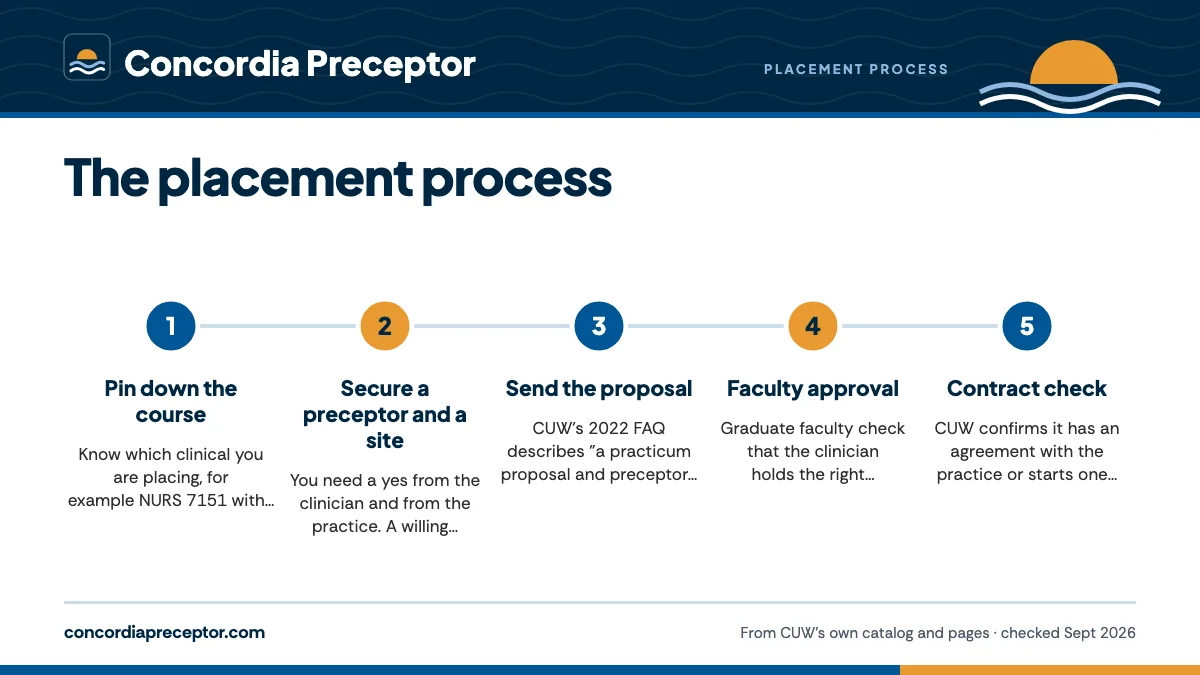
- Pin down the courseKnow which clinical you are placing, for example
NURS 7151with 250 hours of family primary care, orNURS 7510, the first PMHNP practicum. The course fixes the setting, the patient ages and the hours your preceptor must host. - Secure a preceptor and a siteYou need a yes from the clinician and from the practice. A willing clinician at a site that turns away students is not a placement yet.
- Send the proposalCUW's 2022 FAQ describes "a practicum proposal and preceptor form." In the archived rules every preceptor-site pairing got its own form each term, filed a month or more ahead. The proposal form guide has the details.
- Faculty approvalGraduate faculty check that the clinician holds the right credentials and that the practice can deliver what the course is meant to teach.
- Contract checkCUW confirms it has an agreement with the practice or starts one; in 2014-15 a fresh agreement ran two to three months. See the contracts guide.
- ClearanceThe Castle Branch background check from acceptance, the site's vaccination rules, current CPR and the Student Responsibilities Agreement all need to be in order.
- Site onboardingMany practices have their own forms, badge steps or charting training, and the archived CUW form put the student in charge of asking about them once approved.
- StartYou begin once the contract is in place, every school and site document is approved, and the semester has opened.
What is current and what is archived
CUW's live pages describe the model but leave out the mechanics. The table sorts each piece of the process by where it comes from, so you know which lines to confirm with the Graduate Clinical Coordinator before you build a schedule around them.
| Piece of the process | Current CUW source (2026-27) | Archived CUW detail (dated) |
|---|---|---|
| Who finds the preceptor | The student; graduate faculty approve (catalog) | Students identify their own sites and preceptors (2014-15 handbook) |
| Help available | Graduate Clinical Coordinator, available for assistance | Clinical Education Coordinator and Clinical Contract Coordinator (2014-15) |
| Proposal form | Not published | One form per preceptor and site each semester (undated form, archived 2023) |
| Proposal deadline | Not published | No later than 4 weeks before clinicals (same form) |
| Clinical contract | Not published | 8 to 12 weeks for a new site; no patient care before it (2014-15) |
| Background check | Castle Branch, required on acceptance | CertifiedBackground.com, required from June 2013 |
| Logs and evaluations | No system named | Typhon, 2013 to 2015 |
Where a row reads "not published", the answer sits with your course faculty and the coordinator rather than on a public page. Request this term's version of the form, with its due date, when you register for the course before your clinical.
Approval is not the same as a start date
The easiest step to misread is the gap between approval and permission to see patients. Faculty approval says your preceptor and site fit the course. By itself it does not mean the site's agreement with CUW is signed or that your clearance is finished.
CUW's 2014-15 NP handbook tied the start to three conditions and waited for the slowest: a signed agreement, approval of every school and site document, and the opening day of the term. Under that rule an early approval does not let you bank hours before the term, and a slow contract eats into the weeks you planned for clinicals.
Each FNP and AGPCNP clinical course carries 250 hours, so losing three weeks at the front of a term squeezes everything after it. Protecting the start date protects the whole semester.
No patient care before the contract is in place: CUW's 2014-15 handbook tied that rule to liability, and the Clinical Contract Coordinator told each student when clinicals could begin.
Where a semester slips
CUW's archived documents are direct about timing. In the 2014-15 handbook, a packet that missed its date meant the rotation waited a full term, and a packet with gaps was never reviewed. The undated proposal form went further: if it arrived late, the student sat out that semester's clinical and the didactic course paired with it.
The clinical courses are also chained by prerequisites: Clinical II cannot start until Clinical I is passed, and Clinical III waits on II, in the FNP (NURS 7151 to NURS 7153), AGPCNP and PMHNP sequences alike. One lost term pushes every later clinical back with it, and possibly your graduation date.
That handbook also cautioned that the biggest systems host few students and that a backup plan is wise. Several Wisconsin systems now take requests only from the school, on fixed calendars; the guide to systems with their own processes lists them, and the deadlines calendar lines the dates up with CUW's terms.
Why CUW students choose us for the whole path
We build each placement around the order CUW works in. Your placement advisor looks for a clinician and practice matched to your specific CUW course, within reach of home and inside a state that CUW's disclosure lists for your program. Then your advisor assembles the clinician's license, certification, CV and practice information, so the packet graduate faculty review is whole on day one and in their hands early.
Contracts are the slowest link, so we raise that question in the first conversation with any site and pass the answer straight to you. We map your three clinical courses as one plan rather than three separate hunts, and if a preceptor leaves mid-term, a replacement search opens immediately and your advisor works it with you until the hours have a home again.
You submit, and CUW's faculty decide. What we add is a proposal that already matches CUW's rules when it lands. Read how it works for our steps, or send your track and start term to begin.
Questions CUW students ask
How far ahead should I start the CUW placement process?
CUW's current pages give no lead time. The archived documents set the floor: a month for the proposal, and two to three months more when the practice had never signed with CUW, all on top of the search itself. Beginning the search one full term early gives you time to fall back on a second site. Confirm this term's deadline with the Graduate Clinical Coordinator.
Does CUW place online nurse practitioner students in clinical sites?
Not in the sense of assigning a site. The 2026-27 catalog makes the search the student's task, sends the result to graduate faculty for approval, and names the Graduate Clinical Coordinator as a source of help. School-arranged sites belong to CUW's two pre-licensure nursing routes instead.
Can I start seeing patients as soon as my preceptor agrees?
Plan on waiting. In the 2014-15 handbook the clock began only when the agreement, the paperwork approvals and the term start had all arrived. Schedule your first shift for that point, and ask your course faculty how the current rule reads before booking anything earlier.
What happens if my proposal paperwork is late or incomplete?
In CUW's archived rules, incomplete forms were not processed and late paperwork moved the rotation to the next semester. The undated proposal form also barred the matching didactic course that term. CUW keeps its current due dates off its public pages; your coordinator or course faculty can give you this term's.
Is the placement process different for PMHNP students?
The catalog uses the same wording for the PMHNP MSN, PMHNP DNP and PMHNP certificate: you secure the preceptor and faculty approve. The certificate page adds that the Clinical Contract Coordinator helps with the process. CUW has not published a PMHNP preceptor credential list, so get the present expectations from your course faculty before saying yes to a site.
Related pages
Last checked 2026-09-26
We check these pages against CUW's own academic catalog, program pages and published nursing documents. Your course faculty and the Graduate Clinical Coordinator have the final word.
- Concordia University Wisconsin Academic Catalog 2026-2027: MSN Primary Care Nurse Practitioner
- Concordia University Wisconsin: MSN Adult-Gerontology Primary Care Nurse Practitioner
- Concordia University Wisconsin NP Student Clinical Practicum Handbook 2014-2015 (archived)
- Concordia University Wisconsin Clinic Practicum Site Proposal and Preceptor Information Form (archived)
- Concordia University Wisconsin MSN program page with FAQs, 2022 (archived)
CUW asks you to secure your preceptors. We make the search the easy part.
Tell us your CUW track, your city and your next clinical course. We line up preceptors who fit the NURS course, gather the license, board certification and site details CUW's graduate faculty review, and flag early whether the site needs a new clinical contract.
- Preceptors matched to the course: primary care for FNP and AGPCNP, mental health settings for PMHNP, an agency mentor for DNP projects
- Preceptor license, certification, CV and site details ready for CUW's approval
- All three clinical courses planned together, close to home in a state CUW's disclosure lists for your program
Start your placement plan
Track, city and next clinical course is all we need to begin.