How we place CUW nursing students, from first message to first clinical day
You tell us your Concordia University Wisconsin track, your next clinical course, where you live and when it starts. Our placement desk finds preceptors and sites that fit, collects what CUW's graduate faculty review, checks early whether a clinical contract is needed, and stays with you until the last hour is signed. Every approval is CUW's to give; our job is making the file in front of its faculty complete.
Start with your next clinical
Your track, your course, your city and the start date are all we need to begin.
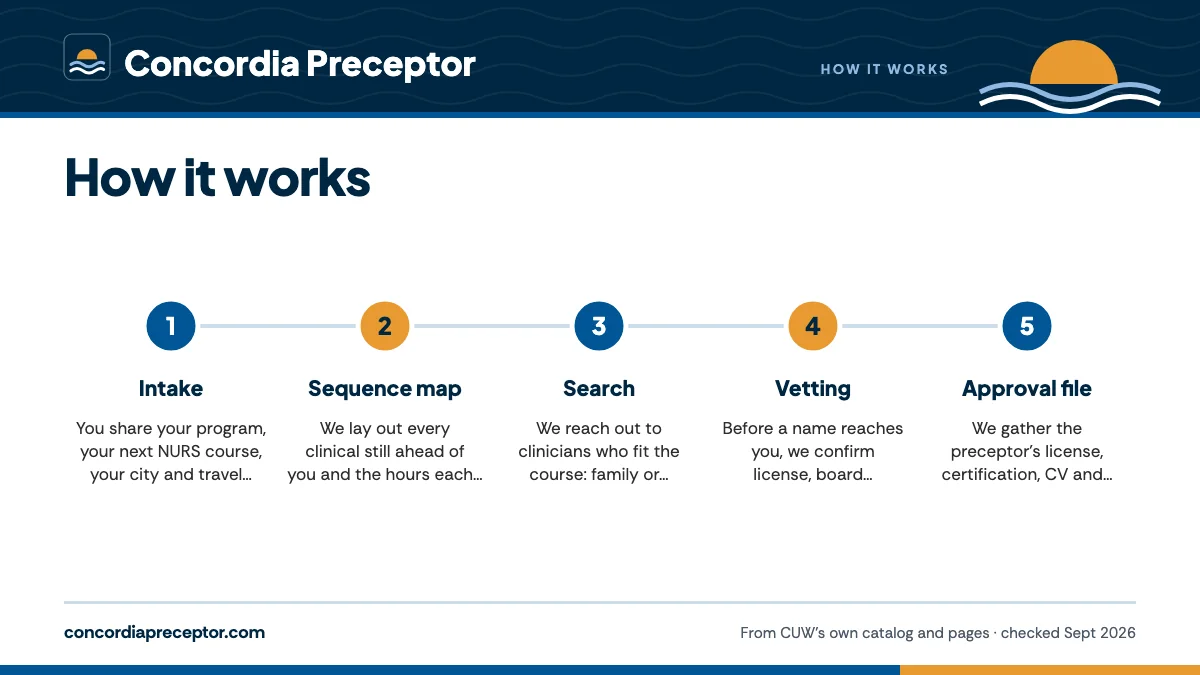
The short version
CUW puts the search on the student and the approval with the graduate faculty, with the Graduate Clinical Coordinator available to assist. Our desk works on the search side. Your placement advisor makes the calls, does the vetting and gathers the paperwork, then hands you a preceptor matched to your course and to CUW's rules.
We plan course by course and program-wide at once. FNP and AGPCNP students need three primary care clinicals, PMHNP students three mental health practicums, and DNP students add an agency mentor. Mapping the full sequence at intake means the next course's search is already moving while you finish the current one. It also lets us ask one clinician to host you for two or three courses, which cuts down on new paperwork each term.
Step by step
- IntakeYou share your program, your next NURS course, your city and travel radius, your work schedule and the semester start. Your placement advisor checks that your state is on CUW's disclosure list for your program.
- Sequence mapWe lay out every clinical still ahead of you and the hours each needs, so clinicians who could take you for more than one course are asked first.
- SearchWe reach out to clinicians who fit the course: family or adult-gerontology primary care, psychiatric and behavioral health settings, or an agency with a project need for DNP work.
- VettingBefore a name reaches you, we confirm license, board certification, years in practice and setting against CUW's criteria, and screen out conflicts such as your own unit or your own provider.
- Approval fileWe gather the preceptor's license, certification, CV and site details so the proposal you submit to CUW is complete on the first pass.
- Contract and clearanceWe ask whether a CUW clinical contract is already on file at the site, flag a new one at once, and track CastleBranch, CPR, vaccination and site onboarding items with you.
- On callWhen a preceptor leaves partway through, your advisor is back on the search that week, while outreach for your next course carries on in parallel.
Who does what
| Task | You | Our desk | CUW |
|---|---|---|---|
| Find and secure a preceptor and site | Secure it, as CUW's rule asks | Finds and vets the options | Graduate Clinical Coordinator can assist |
| Preceptor documents | Review and submit | Gathers them | Graduate faculty review them |
| Approval | Submit the proposal | Readies the file | Graduate faculty approve for appropriateness |
| Clinical contract | Follow CUW's instructions | Checks early whether one exists | Sets up the agreement with the site |
| Background check and site rules | Complete them | Tracks the list with you | Requires CastleBranch; sites set vaccinations |
| Logs, evaluations, site visit | Keep them current | Briefs the preceptor | Faculty evaluate and visit |
Current CUW pages leave out the proposal form, deadlines and tracking system, so your course faculty confirm the details for your semester. The CUW placement process page follows the whole path in order.
What we check before you hear a name
Every preceptor option is screened for
- A current, unencumbered license for the state you will train in; in Wisconsin, at or above the licensure level your program leads to (Wis. Admin. Code N 1.08(6))
- National board certification and a CV showing the experience CUW has asked for, two years in its 2022 FAQ
- A setting that matches the course: primary care for FNP and AGPCNP, with no acute care unit as the main site; mental health settings for PMHNP
- No conflict of interest: not your own health care provider or a family member's, and not your own unit at work
- A patient mix that suits the course, such as children and women's health visits for
NURS 7153 - Room in the schedule for the course's hours, spread across the semester
Where CUW's sources are silent, as they are on PMHNP preceptor credentials, we tell you and put the question to your course faculty before the proposal goes in. The preceptor requirements page dates each rule.
When to reach us
Earlier than feels necessary. CUW's archived proposal form wanted paperwork at least 4 weeks before clinicals, its 2014-15 handbook put a new clinical contract at 8 to 12 weeks, and the first clinical day was the latest of three dates: contract signed, documents approved, semester begun. Several Wisconsin health systems run their own student calendars months ahead; our clinical deadlines page collects them.
A sound habit is to reach us a full semester before the clinical, or as soon as your plan of study is set. That window lets us wait for the right practice instead of the first one that answers, and leaves time for a contract if the site is new to CUW. Closer than that, read need a preceptor fast for how we run a compressed search.
If something changes mid-semester
Preceptors change jobs, take leave or cut clinic days. When that happens, let your placement advisor and your course faculty know at once. Our desk restarts outreach with the site types CUW already approved in mind, collect the new preceptor's documents and help you keep your hours moving; the preceptor dropped out page covers the CUW side of a switch.
CUW's 2014-15 handbook asked a student who changed plans after a preceptor agreed to tell that provider and copy the Clinical Education Coordinator on the email. It also capped students at two preceptors a semester without prior approval. Current practice may differ, so follow your faculty's instructions as we search, and keep your hour log up to date so the handover is clean.
Questions CUW students ask
Do I still submit the clinical proposal to CUW myself?
Yes. In CUW's process the student submits the proposal and graduate faculty approve the preceptor and site for appropriateness. We prepare what goes into it, the preceptor's license, certification, CV and site details, so nothing is missing when you file it through the channel your course faculty name.
Can you place me at my employer's clinic?
It can work when the site fits CUW's rules. The archived handbook allowed the same employer but not your own department or unit, and CUW's 2022 blog noted that working for a health system does not by itself open a clinical spot there. We check both before proposing a site where you work; see clinicals at your workplace.
Do you place CUW PMHNP students?
Yes. We search psychiatric and behavioral health settings for NURS 7510, NURS 7515 and NURS 7520, the practicums shared by CUW's PMHNP MSN, PMHNP DNP and PMHNP certificate. CUW publishes no PMHNP-specific preceptor credentials, so we ask your faculty what they expect before proposing anyone.
What information does the placement desk need from me?
Your CUW program, the next clinical course and its semester, your home city and how far you will drive, the days you can be in clinic, and any site you have already approached. Send them through the form below, and a placement advisor writes back with a plan and a written quote.
Can you help after my clinical has already started?
Yes. If you are short on hours or lost a preceptor partway through, we look for a second site to finish the course and gather what CUW needs to approve the addition. Talk to your faculty while we search; our guide for students behind on clinical hours explains what to raise with them.
Related pages
Last checked 2026-09-26
We check these pages against CUW's own academic catalog, program pages and published nursing documents. Your course faculty and the Graduate Clinical Coordinator have the final word.
CUW asks you to secure your preceptors. We make the search the easy part.
Tell us your CUW track, your city and your next clinical course. We line up preceptors who fit the NURS course, gather the license, board certification and site details CUW's graduate faculty review, and flag early whether the site needs a new clinical contract.
- Preceptors matched to the course: primary care for FNP and AGPCNP, mental health settings for PMHNP, an agency mentor for DNP projects
- Preceptor license, certification, CV and site details ready for CUW's approval
- All three clinical courses planned together, close to home in a state CUW's disclosure lists for your program
Start your placement plan
Track, city and next clinical course is all we need to begin.