Three routes to a CUW preceptor, and how to pick yours
Concordia University Wisconsin leaves the preceptor search to its graduate NP students, then its graduate faculty decide whether each preceptor and site are appropriate. Inside that model you have three practical routes: run the search yourself, work your professional network and employer, or bring in a placement service like ours. What separates them is who spends the hours on the phone and how early problems surface.
Get your placement plan
Tell us your CUW program and where you live. A placement advisor replies with the preceptor and site options that fit your course.
The rule all three routes share
Whichever route you take, the approval step belongs to CUW. The 2026-27 academic catalog says students "identify and secure clinical preceptors" and that graduate faculty then approve them for appropriateness, with the Graduate Clinical Coordinator available to help. The AGPCNP program page puts the same idea in the second person, and the PMHNP certificate page calls finding a placement ultimately your responsibility.
So the choice in front of you is narrower than it looks. It is about who does the legwork before the proposal reaches faculty, how complete that proposal is, and what happens when a preceptor who said yes later backs out. CUW places students itself only in the Direct Entry MSN and the Traditional BSN, so for the MSN, DNP and CAGE tracks one of these three routes is how every clinical starts.
Route one: the search you run yourself
This is the route CUW describes, and plenty of students finish it well. You build a list of primary care or mental health practices near home, call and email them, collect each willing preceptor's license, board certification and CV, and send the proposal through CUW. The Graduate Clinical Coordinator can point you in the right direction along the way.
CUW's own archive is candid about the hard parts. The 2022 program FAQ told students to network in their communities, and the 2014-15 NP clinical handbook warned that large health systems offer very few placements and that students should keep a plan B. The cost of this route is time: every unanswered voicemail comes out of evenings you would otherwise spend on coursework or shifts. It suits a student with a long runway, a dense local market and a preceptor or two already in mind. The self-search guide covers how to do it well.
Route two: your network and your employer
Colleagues, former instructors and the NPs you already hand off patients to are often the warmest leads you have. CUW's archived rules allow a clinical at your employer, as long as it is not your own department or unit, and the 2014-15 handbook said hours logged in your own unit would not count. Your own health care provider and a family member's provider were off the list as well; the conflict rules have the detail.
A job is also no automatic ticket in. CUW's 2022 blog noted that many sites want their students to be employees, while adding that working inside a health system is no promise of a placement there. Several Wisconsin systems accept requests only from a school, so an employer route can still depend on a contract and a school-level request. Read the workplace guide before you ask your manager.
Route three: a placement service built around CUW
Our service takes the search off your evenings and runs it to CUW's rules. We look for preceptors who fit your exact course, primary care practices for NURS 7151 through NURS 7153 or NURS 7265 through NURS 7267, mental health settings for NURS 7510, NURS 7515 and NURS 7520, and an agency mentor for DNP project work, in a state where CUW's disclosure lists your program.
Before anything reaches CUW we gather the preceptor's license, certification, CV and site details, and we tell you early whether the site is likely to need a new clinical contract. Graduate faculty still make the call on every preceptor; our job is to make sure what they review is complete and fits the first time. See how it works for the step-by-step version.
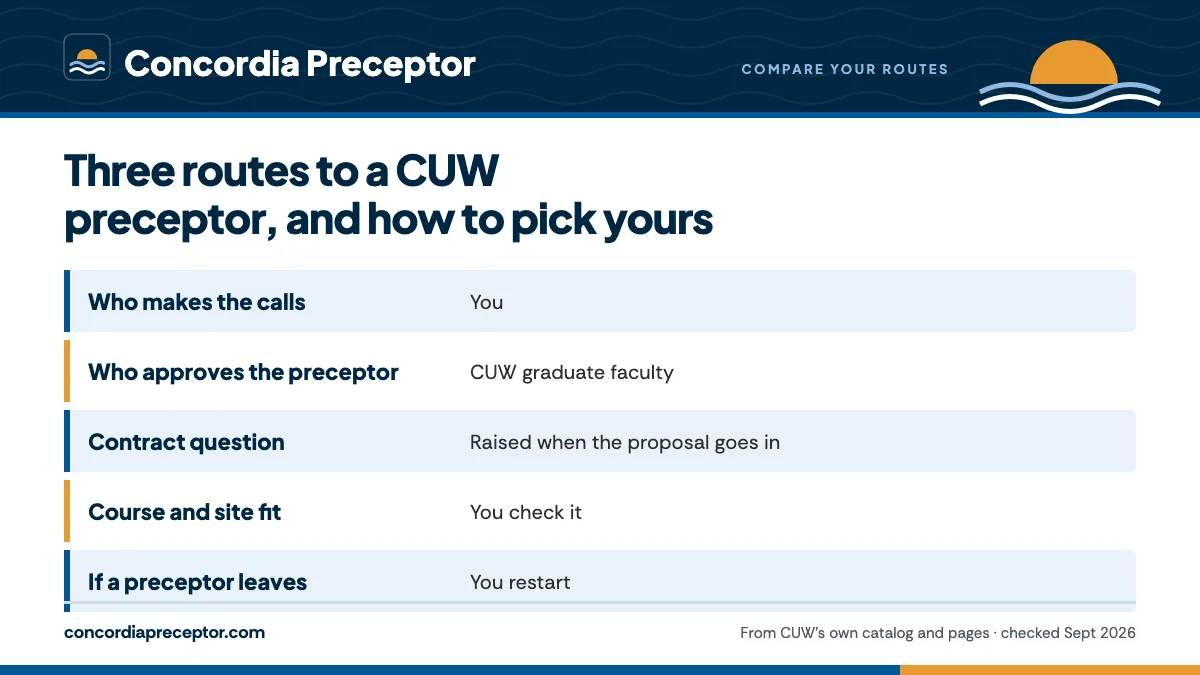
Side by side
| Question | Your own search | Network and employer | Our service |
|---|---|---|---|
| Who makes the calls | You | You, through people you know | Your placement advisor |
| Who approves the preceptor | CUW graduate faculty | CUW graduate faculty | CUW graduate faculty |
| Contract question | Raised when the proposal goes in | Depends on the employer and CUW | Flagged before you commit |
| Course and site fit | You check it | Easy to miss the own-unit rule | Matched to your NURS course |
| If a preceptor leaves | You restart | You restart | Replacement search begins at once |
| Your time each week | Many hours of calls and follow-up | Fewer, warmer conversations | Answering questions and signing forms |
| Best when | Long lead time, busy local market | Strong contacts outside your unit | Short on time or out of leads |
Mixing routes across three clinicals
The routes are not a one-time choice. FNP and AGPCNP students carry 750 hours across three clinical courses, PMHNP students 500 across three practicums, and the 2014-15 handbook capped any one preceptor at 400 program hours, so most students work with more than one preceptor anyway. A common pattern is a contact from work for the first clinical and outside help for the second and third, or a self-run search with us lined up as backup.
Plan the whole sequence at once rather than course by course. The clinical hours guide shows how each track splits its hours, which tells you how many preceptors to line up and when.
Whatever route you choose, start before the term that needs the preceptor: CUW's archived process allowed up to 12 weeks for a new clinical contract.
A quick way to decide
- Count the weeks to your next clinical start. Under about three months, favor sites that may already hold a CUW contract, or bring in help now.
- List the people you know who precept, then strike anyone in your own unit, your own provider and your family's providers.
- Check CUW's disclosure row for your program and state before you contact anyone out of state.
- Estimate the hours a week you can honestly spend on calls. If the answer is close to zero, route three fits.
- Ask yourself who covers you if a preceptor leaves in week six. A backup plan belongs in the decision from the start.
When you are ready to hand the search over, send us your track, city and start term and your placement advisor will reply with a plan.
Questions CUW students ask
Does CUW assign preceptors to its online NP students?
No. For the MSN, DNP and CAGE tracks, CUW's catalog has students identify and secure their own preceptors, which graduate faculty then approve, with the Graduate Clinical Coordinator available to assist. CUW arranges clinical sites only for the Direct Entry MSN and the Traditional BSN, and RN to BSN students complete their hours where they work.
Can a CUW student use a placement service?
CUW's public pages say nothing about placement services either way. What they require is that graduate faculty approve each preceptor and site. A service like ours does the finding and the paperwork gathering; the approval decision stays with CUW's faculty, exactly as the catalog describes.
Is my employer the fastest route to a preceptor?
Sometimes. It is quickest when CUW already has a contract with the site and the preceptor works outside your own unit. It is slower when the system accepts only school-submitted requests or needs a new agreement. CUW's 2022 blog also cautioned that working for a system is no assurance of a clinical spot there.
Can I use a different route for each clinical course?
Yes. Each clinical is its own placement, and CUW's archived proposal form was filed once per preceptor and site each semester. Many students use a work contact for one course and a search partner for the others. The only constant is that CUW's graduate faculty approve each preceptor before patient care starts.
What if I already tried my own search and came up empty?
Then it is time to change where and how you search rather than repeat the same calls. Our guide for when you cannot find a preceptor walks through widening preceptor types and settings, and you can hand the search to us at any point in the semester.
Related pages
Last checked 2026-09-26
We check these pages against CUW's own academic catalog, program pages and published nursing documents. Your course faculty and the Graduate Clinical Coordinator have the final word.
- Concordia University Wisconsin Academic Catalog 2026-2027: MSN Primary Care Nurse Practitioner
- Concordia University Wisconsin: MSN Adult-Gerontology Primary Care NP
- Concordia University Wisconsin: Psychiatric Mental Health NP Certificate
- Concordia University Wisconsin blog: MSN Clinicals, What are they like? (2022)
CUW asks you to secure your preceptors. We make the search the easy part.
Tell us your CUW track, your city and your next clinical course. We line up preceptors who fit the NURS course, gather the license, board certification and site details CUW's graduate faculty review, and flag early whether the site needs a new clinical contract.
- Preceptors matched to the course: primary care for FNP and AGPCNP, mental health settings for PMHNP, an agency mentor for DNP projects
- Preceptor license, certification, CV and site details ready for CUW's approval
- All three clinical courses planned together, close to home in a state CUW's disclosure lists for your program
Start your placement plan
Track, city and next clinical course is all we need to begin.