The Clinical Practicum Site Proposal and Preceptor Information form
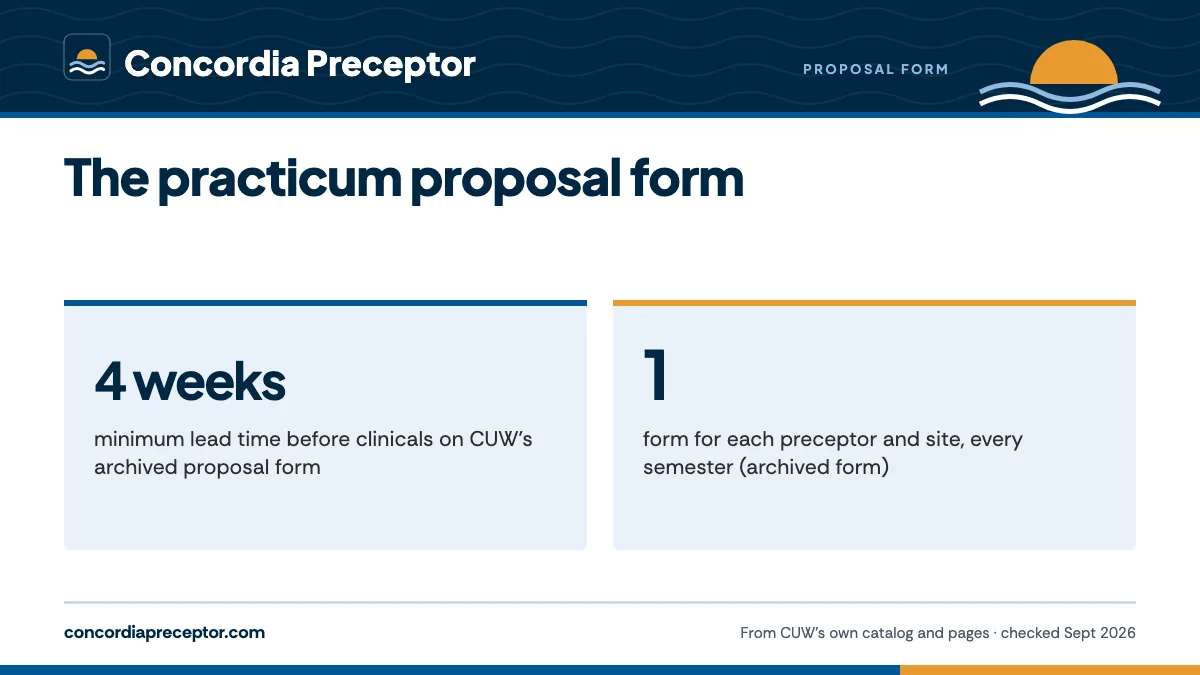
At Concordia University Wisconsin, the proposal form is the document that turns a preceptor's yes into a request CUW can review. The archived version asked for one form per preceptor and site each semester, due no later than 4 weeks before clinicals. CUW does not post the current form publicly, so get this term's version from the Graduate Clinical Coordinator or your course faculty.
Get your placement plan
Tell us your CUW program and where you live. A placement advisor replies with the preceptor and site options that fit your course.
What the form does, and what it does not
The proposal is how your preceptor and site enter CUW's review. CUW's 2014-15 NP clinical handbook called the Clinical Practicum Site Proposal and Preceptor Information form the start of the placement process, and it was clear on two limits: the form is not a contract, and a site may add paperwork of its own.
The 2022 program FAQ describes the same step in plain terms. Once a student completes "a practicum proposal and preceptor form," CUW faculty check that the preceptor is properly credentialed and that the site lets the student meet the course objectives. CUW's 2022 blog adds that the form goes in once a primary care site and preceptor are secured, for approval of the site's appropriateness.
The name has shifted over time. In 2010 CUW used two documents, a Practicum Proposal Form and a Preceptor Information Form. The undated form in CUW's archived repository, titled Clinic Practicum Site Proposal and Preceptor Information Form, puts both in one document. Today's title is not published.
The rules printed on the archived form
The undated form, captured from CUW's form repository in 2023, carried its own instructions. Read them as the rules CUW published at the time, not as confirmed current practice.
- One form per semester for each preceptor and site; a term split between two clinicians needs a form for each.
- Submission no later than 4 weeks before the clinical start date.
- Review by the Clinical Education Coordinator.
- A warning that contracts may take up to 12 weeks, and no going to the site until the Clinical Contract Coordinator approves.
- A late form means no clinical that semester and no matching didactic course either.
- After approval, the student asks the site about any extra paperwork, orientation or computer training.
The 2014-15 handbook added three handling rules: paperwork is due by posted deadlines, incomplete forms are not processed, and faxed copies are not accepted.
What goes into a complete proposal
The archived handbook and form name the preceptor documents CUW wanted. Collect them before you fill in a single field, because an incomplete packet was simply set aside.
| Item | Who supplies it | Where CUW names it |
|---|---|---|
| Current state license | Your preceptor | 2014-15 handbook |
| CV | Your preceptor | 2014-15 handbook |
| National board certification | NPs and CNMs on the form; NPs, PAs and CNMs in the handbook | Form ("for our accreditation purposes") and handbook |
| Practice and site details | You, with the site | Form |
| The own-unit rule | Printed on the form for you to follow | Form and 2014-15 handbook |
| FNP secondary-site hours, capped at 100 each | You, when planning the term | Form and 2014-15 handbook |
The 2022 FAQ says faculty review all documents to confirm credentials and a suitable site, so a clean copy of each item matters as much as the form itself. The preceptor requirements guide explains the credential rules behind these items.
The DNP version of the form
Doctoral students used a different document. CUW's undated DNP Residency Preceptor Proposal Form, from the era of the older DNP residency courses, recorded the proposed preceptor and their academic credentials, the clinical site and its clinical administrator, and what the preceptor would do.
Those duties were specific: help the student set goals, guide the development of leadership skills, meet regularly, and talk with CUW faculty. The same archive holds a DNP Clinical Residency Log and a preceptor and student self-evaluation.
Today's Post-BSN to DNP runs its project hours through NURS 9030 to NURS 9032, the DNP Project Practicum Immersion courses, with a mentor from a selected health care agency. Ask your course faculty which form applies now. The DNP project practicum guide covers the mentor role.
Timing the form against CUW's calendar
The 4-week rule is a minimum, and it assumes the site already has a contract with CUW. Take a Spring 2027 clinical that opens with the semester on January 11, 2027: 4 weeks back is December 14, 2026. If the site is new to CUW and the contract takes the full 12 weeks the form warned about, the paperwork needed to be moving by October 19, 2026.
Those dates only apply if the archived rules still hold, which is why the current deadline from your coordinator comes first. Clinicals that start in an 8-week Session II shift everything later, and summer terms have their own start dates. The clinical deadlines guide lines up every 2026-27 date.
Plan backward from your start date, not forward from the day a preceptor agrees.
Filing on time with a site that has no CUW contract can still delay your start: the form's 4 weeks and the contract's up to 12 weeks run on separate clocks.
Rules a proposal can run into
CUW's archived documents list several conditions that could stop a proposal. Check your placement against each one before you submit.
- A primary site that is a specialty clinic, emergency department or inpatient unit, for FNP and AGPCNP students.
- A preceptor without national board certification where CUW required it.
- A placement in your own department or unit at work.
- A preceptor who is your own or a family member's health care provider.
- More than two preceptors in a semester without prior approval, or more than 400 program hours with one preceptor.
- A clinic in a state where CUW's disclosure marks your program "does not meet", or a Wisconsin site whose nurse preceptor lacks the Wisconsin license that rule N 1.08(6) calls for.
The guide to who cannot precept you explains the conflict rules in full.
Why CUW students choose us for the proposal
The proposal is where a good placement either sails through or stalls, so our placement desk treats it as the finish line of the search. We collect the preceptor's license, board certification and CV, write up the site details, and check the placement against every rule CUW has printed on its forms before the packet reaches you.
We also look past the form to the contract question, asking each site whether it has hosted CUW students, and we build the timeline backward from your start date so the packet is ready well ahead of the 4-week line. When the next clinical course comes around, the paperwork for it is already underway. You submit a proposal that is complete on arrival, and CUW's faculty make the call. Our step-by-step overview shows the full service, and the contact form is the place to share your course and term.
Questions CUW students ask
Where do I get the current CUW proposal form?
Ask the Graduate Clinical Coordinator or your course faculty. CUW's public pages do not carry the form, and the copies in CUW's old form repository are archived versions that may be out of date. Using the current version, with this term's deadline, avoids having to redo the paperwork.
Do I need a separate form for each preceptor?
Under the archived form, yes: every clinician-and-site pairing needed its own copy each term. Two preceptors in one term meant two forms, and returning to the same preceptor next semester meant a new one. Ask your course faculty whether the current process still works this way.
Is the proposal form the same as the clinical contract?
No. CUW's 2014-15 handbook said the proposal form is not a contract. The form asks CUW to approve a preceptor and site; the contract is a separate agreement between CUW and the site that covers responsibilities and liability. The clinical contracts guide explains the difference.
Can I send the form before my preceptor's documents arrive?
Hold it until the packet is complete. CUW's 2014-15 handbook said incomplete forms are not processed, so a form without the license, CV or certification could sit unread while the deadline passes. Ask your preceptor for the documents on the day they agree.
What does my preceptor sign after the form is approved?
In the 2014-15 handbook, preceptors signed the student's learning objectives, completed mid-term and final evaluations and signed a Documentation of Hours form at the end of the term. CUW has not named its current forms publicly, so your course faculty will confirm what your preceptor receives.
Related pages
Last checked 2026-09-26
We check these pages against CUW's own academic catalog, program pages and published nursing documents. Your course faculty and the Graduate Clinical Coordinator have the final word.
- Concordia University Wisconsin Academic Catalog 2026-2027: MSN Primary Care Nurse Practitioner
- Concordia University Wisconsin Clinic Practicum Site Proposal and Preceptor Information Form (archived)
- Concordia University Wisconsin NP Student Clinical Practicum Handbook 2014-2015 (archived)
- Concordia University Wisconsin MSN program page with FAQs, 2022 (archived)
- Concordia University Wisconsin DNP Residency Preceptor Proposal Form (archived)
CUW asks you to secure your preceptors. We make the search the easy part.
Tell us your CUW track, your city and your next clinical course. We line up preceptors who fit the NURS course, gather the license, board certification and site details CUW's graduate faculty review, and flag early whether the site needs a new clinical contract.
- Preceptors matched to the course: primary care for FNP and AGPCNP, mental health settings for PMHNP, an agency mentor for DNP projects
- Preceptor license, certification, CV and site details ready for CUW's approval
- All three clinical courses planned together, close to home in a state CUW's disclosure lists for your program
Start your placement plan
Track, city and next clinical course is all we need to begin.