Clinical hours in Concordia University Wisconsin's nursing programs
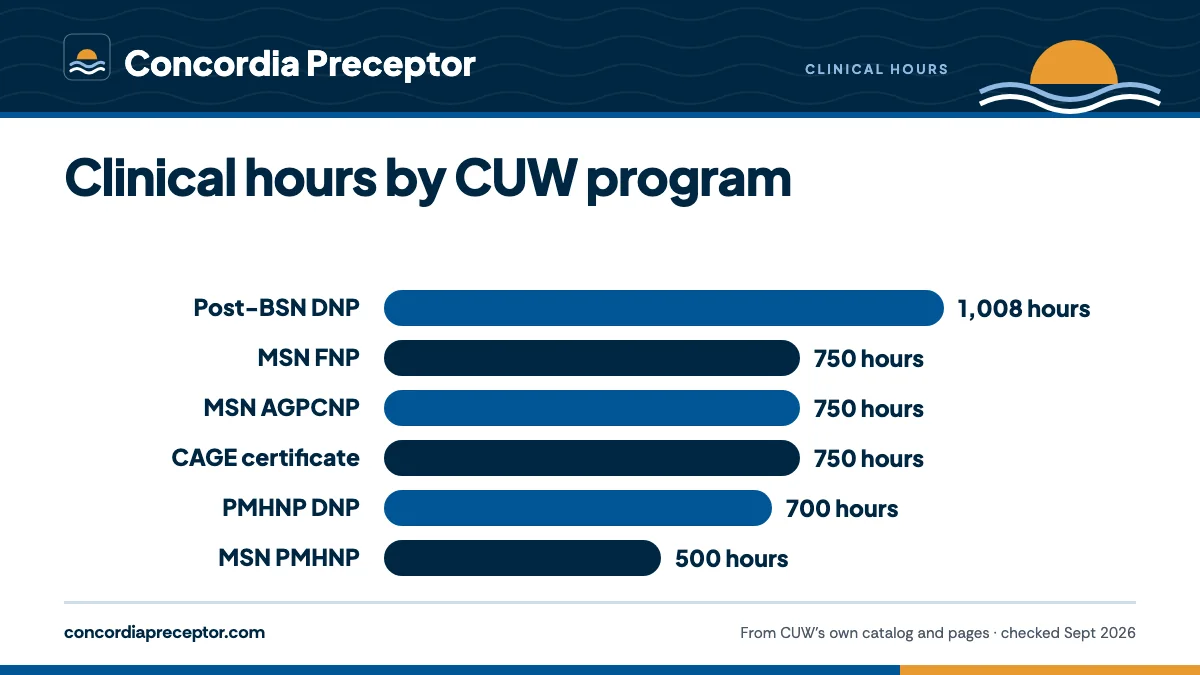
Concordia University Wisconsin's 2026-27 catalog sets a floor of 750 clinical hours for the MSN FNP and AGPCNP, 500 for the PMHNP tracks and 1,008 for the Post-BSN to DNP. The per-course numbers live in CUW's progression plans rather than the catalog, and a handful of figures differ from one CUW page to the next. Pick your track in the planner, then read on for what counts and where the numbers conflict.
Get your placement plan
Tell us your CUW program and where you live. A placement advisor replies with the preceptor and site options that fit your course.
Pick your CUW program
Your clinical courses and hours, who can precept you, where, and when to start looking. From CUW's own catalog and program pages.
- Who precepts
- A preceptor you secure, approved for appropriateness by CUW's graduate faculty
- Where
- Primary care practices near home, in a state CUW's disclosure lists for the MSN
- Start looking
- After the on-campus Advanced Health Assessment intensive; the three clinicals run in sequence
- Who precepts
- Primary care preceptors for adolescents through older adults, approved by graduate faculty
- Where
- Outpatient primary care near home; sites reviewed and approved by CUW's nursing faculty
- Start looking
- Secure the site early: a new clinical contract can take weeks, and no patient care starts without one
- Who precepts
- Psychiatric preceptors CUW approves; CUW publishes no PMHNP-specific credential list
- Where
- Mental health settings in approved locations
- Start looking
- Per-course hours follow CUW's 2023 PMHNP certificate plan, which uses the same three courses
- Who precepts
- Primary care preceptors for the residencies, then an agency mentor for the DNP project
- Where
- Primary care sites near home and the organization where your project runs
- Start looking
- 750 clinical hours across the residencies plus 258 leadership hours in the project courses
- Who precepts
- Psychiatric preceptors for the practicums and a mentor for the leadership hours
- Where
- Mental health settings and a leadership setting near home
- Start looking
- The program page counts 1,000 residency hours in total, with prior-degree hours making up the rest
- Who precepts
- The same preceptor approval as the matching MSN track
- Where
- Near home, in a state CUW's disclosure lists for the certificates
- Start looking
- Hours from an earlier APRN degree may be considered case by case
Every figure is a minimum, printed in different places
Each hour count in the 2026-27 catalog is a floor. The MSN page asks for at least 750 clinical hours in the FNP and AGPCNP clinical courses and at least 500 in the PMHNP track. The catalog's course descriptions give no per-course count at all; those splits come from CUW's progression plan PDFs, dated February 2024 for the MSN and the Post-BSN to DNP and May 2023 for the PMHNP certificate.
The word minimum carries weight. The catalog's Post-BSN to DNP and PMHNP certificate sections both note that, depending on how a student performs, success can take more clinical time than the stated minimum. If course faculty ask for more time in clinic, the preceptor you bring has to have room to give it.
| Figure | What it covers | CUW source |
|---|---|---|
| 750 | MSN FNP, MSN AGPCNP, both FNP dual degrees, CAGE FNP or AGPCNP | 2026-27 academic catalog |
| 250 a course | NURS 7151 to NURS 7153, NURS 7265 to NURS 7267 | MSN progression plans, Feb 2024 |
| 500 | MSN PMHNP, PMHNP CAGE, psychiatric hours in the PMHNP DNP | 2026-27 academic catalog |
| 125 / 200 / 175 | NURS 7510, NURS 7515, NURS 7520 | PMHNP certificate plan, May 2023 |
| 1,008 | Post-BSN to DNP: 750 clinical, 258 leadership | Catalog and program page agree |
| 120 | Primary Care Clinical Residency I (NURS 8123 or NURS 8226) | Post-BSN to DNP plan, Feb 2024 |
| 200 | Leadership hours in the PMHNP DNP | 2026-27 academic catalog |
Where CUW's pages give two answers
Four hour questions get different answers depending on which CUW page you open. When one of them affects your plan, follow the current catalog and put the question in writing to your instructors or the Graduate Clinical Coordinator.
- PMHNP DNP: 700 or 1,000. The catalog's floor is 500 hours of mental health practicum and a further 200 in leadership. The program page headlines 1,000 residency hours, with the balance filled by verified clinical experience from an earlier advanced practice degree. What you complete inside the program is the 700.
- The PMHNP split outside the certificate. The 125 / 200 / 175 pattern comes from the certificate's plan, which uses the same three practicum courses. No MSN or DNP plan with its own split was found, so treat it as likely rather than confirmed.
- Post-BSN DNP Residencies II and III. Residency I is 120 hours. How the remaining 630 clinical hours divide between the next two residencies is not published.
- Post-MSN DNP residency hours. Between 2019 and at least March 2025 the program page set a 500-hour in-program residency, which with MSN hours had to reach a 1,000-hour DNP total. The live page and the catalog now give no figure, just residency work in areas the student chooses.
One scheduling wrinkle sits beside these: every primary care clinical appears as an 8-week course in the MSN progression plans, yet nothing in the catalog's sample plan assigns those courses to a session. The weekly load differs sharply between the two readings, and the pacing guide works through both.
Hours you may carry in from an earlier degree
Post-graduate students can sometimes count clinical time from a previous program. For the CAGE FNP or AGPCNP, the 2026-27 catalog lets CUW weigh clinical hours from a prior advanced practice degree one applicant at a time, and the certificate page asks applicants for a letter stating the clinical hours earned in their master's program. The 2025-26 catalog lacked that sentence and carried the additional-hours warning in its place. The CAGE guide covers the rest of that program.
The PMHNP DNP counts verified APRN clinical experience toward its 1,000-hour total, and the Post-MSN DNP asks applicants to document the faculty-supervised clinical hours from their MSN. In every case CUW decides what transfers, so the number you still owe is settled at admission review. Budget preceptor time for the full requirement until CUW confirms a lower figure.
What counted toward the total in CUW's archived rules
Current CUW pages say little about which hours count. CUW's 2014-15 NP clinical practicum handbook spelled it out, and the limits below are dated to that handbook. Your syllabus and course faculty set the rules in force now.
- Orientation, shadowing and pre-approved conference time: no more than 8 hours a semester.
- Time with a nurse practitioner: at least 50 program hours, whoever else precepts you.
- Time with any one preceptor: no more than 400 program hours.
- FNP secondary sites (pediatrics, urgent care, women's health, geriatrics): capped at 100 hours each across the program, with 50 to 100 specialty hours allowed in the third clinical.
- Hours found to be worked in your own department or unit at your job: removed from the count.
The 2022 Post-MSN DNP page added one more limit: of those 500 in-program residency hours, at most 120 could be indirect care done away from the student's own practice. The setting rules behind these caps are on the primary care sites page.
How the hour rules shape a preceptor search
The rules matter more to your search than the totals do. By CUW's 2022 program FAQ, one 250-hour course meant something like 30 shifts of 8 to 10 hours, so each preceptor is agreeing to most of a semester of steady clinic days. Under the archived 400-hour cap, no single clinician could carry all three FNP or AGPCNP courses, which means a 750-hour plan names at least two preceptors.
PMHNP students face a different curve: 125 hours in the first practicum, 200 in the second and 175 in the third, so the heaviest term falls in the middle. On the Post-BSN to DNP, the 258 leadership hours bring in one more person, a mentor at the agency hosting the project, beside the clinical preceptors. The course pages, starting with NURS 7151, show how each clinical fits that arc.
Why CUW students plan their hours with us
Our placement desk maps every clinical hour of your program in one plan. We match each preceptor to the block of hours a course needs, confirm the practice can host you for the whole stretch, and start the next course's search while the current one is still running, so each hand-off lands on time.
For every preceptor we collect the credentials and practice profile the graduate faculty look at, and we learn early whether CUW still has to sign an agreement with that site. If a preceptor steps away mid-course, your placement advisor opens the replacement search right away and keeps your hour count moving. Send your track and next course through the form below, or see how it works.
Questions CUW students ask
How many clinical hours is the CUW FNP program?
The 2026-27 catalog sets at least 750 clinical hours for the MSN FNP. CUW's February 2024 progression plans divide them evenly, so NURS 7151, NURS 7152 and NURS 7153 hold 250 apiece. The FNP dual degrees with the MBA or the MPH run the same three courses, so they carry the same 750 hours.
Did CUW used to require 720 clinical hours?
Yes. The 2020-21 and 2021-22 catalogs required 720 hours, with the 2020-21 edition listing 240 in each clinical course, and the 2013-2015 handbooks asked for 600. The 2022-23 catalog raised the total to 750. Check the year on any CUW handbook or blog post before you plan around it; the hours history has the full timeline.
Do PMHNP certificate and PMHNP MSN students log the same hours?
Both tracks run the same three practicums, NURS 7510, NURS 7515 and NURS 7520, with a 500-hour floor. The 125, 200 and 175 split appears only in the certificate's 2023 curriculum plan, so MSN students should confirm their own split with course faculty before they book preceptor time for each term.
Where do CUW students record clinical hours?
Current CUW pages name no clinical tracking system. From 2013 to 2015 CUW used Typhon for time logs, which students had a week to enter, and each preceptor signed off the hours on paper at the end of the term. Ask your course faculty which system your course uses today.
Can hours at my own workplace count?
Under CUW's 2014-15 handbook, clinicals with your own employer were acceptable, but never in your own department or unit, and hours found to be logged there were dropped. The 2022 FAQ also let students use an employer's site, provided it satisfied CUW's credential rules. Current pages are silent, so confirm with your course faculty first.
Related pages
Last checked 2026-09-26
We check these pages against CUW's own academic catalog, program pages and published nursing documents. Your course faculty and the Graduate Clinical Coordinator have the final word.
- Concordia University Wisconsin academic catalog 2026-27: MSN Primary Care NP
- Concordia University Wisconsin academic catalog 2026-27: Post BSN to DNP
- Concordia University Wisconsin academic catalog 2026-27: DNP and PMHNP DNP
- CUW MSN Nurse Practitioner progression plan (Feb 2024)
- CUW PMHNP DNP program page
CUW asks you to secure your preceptors. We make the search the easy part.
Tell us your CUW track, your city and your next clinical course. We line up preceptors who fit the NURS course, gather the license, board certification and site details CUW's graduate faculty review, and flag early whether the site needs a new clinical contract.
- Preceptors matched to the course: primary care for FNP and AGPCNP, mental health settings for PMHNP, an agency mentor for DNP projects
- Preceptor license, certification, CV and site details ready for CUW's approval
- All three clinical courses planned together, close to home in a state CUW's disclosure lists for your program
Start your placement plan
Track, city and next clinical course is all we need to begin.