NURS 7153: Advanced Primary Care Clinical III - FNP
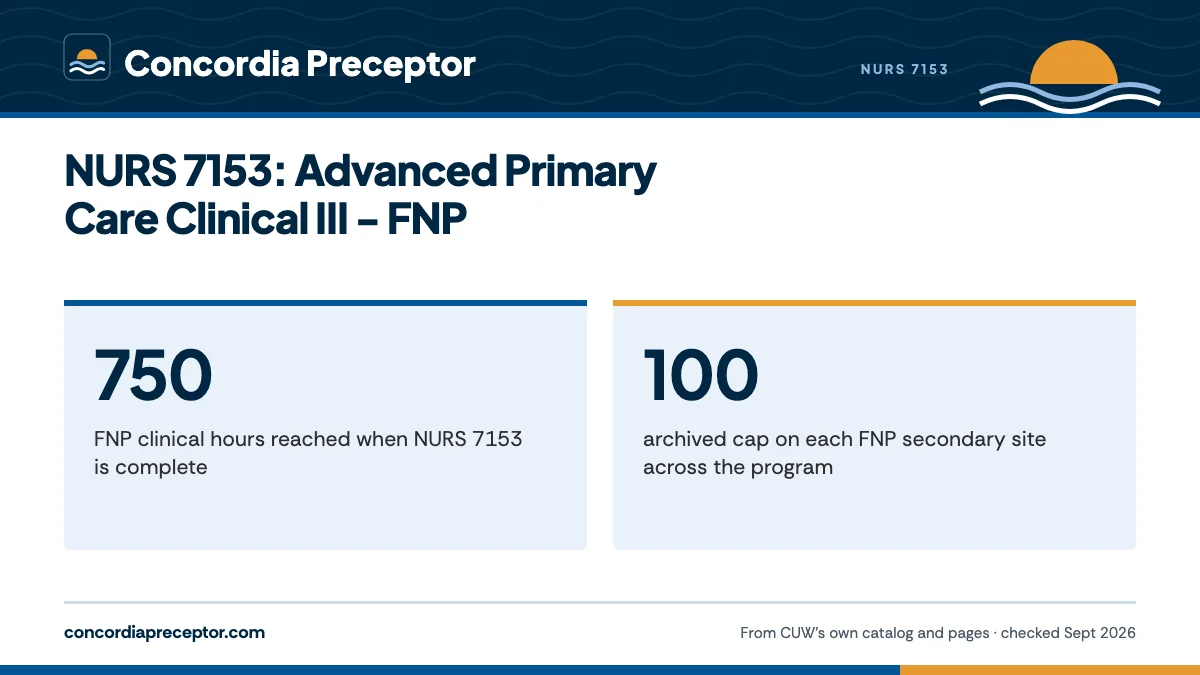
NURS 7153 Advanced Primary Care Clinical III - FNP closes Concordia University Wisconsin's FNP clinical sequence with 4 credits and 250 hours (February 2024 plans), taking you to the 750-hour minimum. The catalog aims this course at pediatric and older adult patients and at women's health, across the lifespan. That focus usually means a main family practice plus a limited block of specialty time, planned well before your last semester opens.
Get your placement plan
Tell us your CUW program and where you live. A placement advisor replies with the preceptor and site options that fit your course.
The final clinical's focus
The 2026-27 catalog describes Clinical III as primary care across the lifespan that highlights "the pediatric and older adult population along with women's health issues". Its prerequisite is Clinical II, listed as MSN 852, NURS 752 or NURS 7152. Before 2024-25 the course was NURS 753, and in 2020-21 it was MSN 853.
Timing depends on your program. The catalog's sample MSN FNP plan places Clinical III in semester 8, the last semester. The MSN FNP with an MBA stretches to 11 semesters, with NURS 7153 taken in semester 11. FNP students on the MPH dual degree and in the CAGE FNP certificate take the same course, and CAGE students may carry prior clinical hours in, case by case.
Covering children, older adults and women's health
A family practice with a mixed panel can cover most of Clinical III by itself. Where it cannot, CUW's archived rules show how specialty time fit in. The third clinical was the one place a specialty block could be proposed, sized between 50 and 100 hours, and the 2014-15 handbook and the undated proposal form let each FNP secondary setting take no more than 100 hours of the entire program.
| Setting | Archived limit | Planning note |
|---|---|---|
| Primary care practice | Required as the main site | Carries most of the 250 hours |
| Pediatrics | Secondary site, 100 hours for the program | Subtract any pediatric hours from Clinical II |
| Women's health | Secondary site, 100 hours for the program | Fits the course's women's health focus |
| Geriatrics | Secondary site, 100 hours for the program | Fits the older adult focus |
| Urgent care | Secondary site, 100 hours for the program | Least tied to this course's focus |
| Specialty time in the third clinical | 50 to 100 hours by proposal | Needs faculty approval first |
Hospital, emergency and surgical settings stay off the list; CUW's 2022 blog kept FNP clinicals in community primary care. Current limits come from your course faculty. The primary care sites page explains the setting rules in full.
Health systems with their own last-semester rules
Pediatric and women's health hours often point students toward large systems, and several Wisconsin systems publish their own student processes. None of these is described by CUW as a partner; each rule below is the system's own published wording.
Children's Wisconsin, for example, accepts graduate placement requests from faculty rather than from the student, books one semester per request, and aims its graduate form at MSN and DNP students in their final term. Its request deadlines are May 31 for fall, July 1 for winter, November 1 for spring and April 1 for summer, and the school needs both an affiliation agreement and a program agreement. Other systems require school-level requests or are not signing new agreements. Compare them on the sites with their own processes page before you ask a clinician inside one.
Finishing the hours on schedule
Clinical III is where a late start costs the most, because graduation depends on it. CUW's 2014-15 handbook wanted the hours paced across the whole term, with the last of them logged inside the final two weeks, not earlier. Grades waited on paperwork too: a signed Documentation of Hours form from every preceptor, and the End-term Documentation Checklist.
If the hours run out before the term does, an Incomplete is possible, and CUW's grading policy gives three weeks past the term to clear it, stretching to six when the delay is justified. For spring 2027, graduate commencement is Friday, May 7 and the semester's last day of classes is May 9, so ask your advisor early how an open Incomplete affects the term you graduate in. The delayed graduation page covers what happens next.
Paperwork when you use two sites
A primary practice plus a specialty office doubles the approval work. In the archived process, the pediatric or women's health office needed its own proposal filed four weeks before its first day, just like the main practice, and if CUW had no agreement with it, the office also needed a contract, which the 2014-15 handbook said could run eight to twelve weeks.
Two clinicians in one term sat within the old handbook's rules, while a third required faculty sign-off beforehand. Once CUW approved a site, the archived form sent students back to it to settle any onboarding of its own, from forms to orientation to computer training, and a specialty office may ask for more of that than a small family practice. Begin the specialty search during Clinical II, and read clinical contracts for how the agreement step works.
Why FNP students finish with our desk
We plan NURS 7153 a full semester ahead. Your placement advisor maps the hours you already logged in each setting, finds a primary care practice with pediatric and older adult volume near you, and adds a women's health or pediatric office only where the course needs it and the archived caps allow.
Each clinician's license, certification and CV reach you together with a profile of the site, and we tell you at the outset whether either office lacks a CUW agreement. Your advisor also lines up the start dates so both sites are cleared before the semester opens, with hours spread across the term rather than squeezed into its last weeks. If a preceptor pulls out in your final term, we start the replacement search at once so your graduation date stays within reach.
Questions CUW students ask
Is NURS 7153 the last clinical in the CUW FNP program?
Yes. NURS 7153 is the third and final FNP clinical for the MSN FNP, both FNP dual degrees and the CAGE FNP certificate. When it is complete you reach the 750-hour minimum, unless course faculty require extra time; the 2025-26 MSN catalog noted that performance could call for additional hours.
Can I do all of NURS 7153 in a pediatric office?
Not under CUW's archived rules. The 2014-15 handbook kept primary care as the home base, let the third clinical include one specialty block of 50 to 100 hours, and held pediatric time as a secondary FNP setting to 100 hours over the whole program. A family practice with many young patients is the simplest answer. Confirm with course faculty.
When do MSN FNP and MBA students take NURS 7153?
The 2026-27 catalog's plan for the MSN FNP with an MBA runs 11 semesters and places NURS 7153 in semester 11. The MSN FNP with an MPH runs 8 semesters, like the standalone MSN. Both dual degrees use the same three FNP clinicals and the same 750 hours.
What if I have not finished my NURS 7153 hours by the end of the semester?
Talk to your course faculty before the term ends. Under CUW's grading policy, an unresolved Incomplete can turn into a failing grade once three weeks have passed after the term, or six in a justified case. See behind on clinical hours for ways to recover time.
What was NURS 7153 called in older catalogs?
It was MSN 853 in the 2020-21 catalog, when each FNP clinical carried at least 240 hours, and NURS 753 in the three catalogs before four-digit numbers arrived in 2024-25. Its place as the final FNP clinical, and its prerequisite chain back through Clinical II and Clinical I, has stayed the same throughout.
Related pages
Last checked 2026-09-26
We check these pages against CUW's own academic catalog, program pages and published nursing documents. Your course faculty and the Graduate Clinical Coordinator have the final word.
- Concordia University Wisconsin academic catalog 2026-27: graduate NURS course descriptions
- Concordia University Wisconsin academic catalog 2026-27: MSN Primary Care NP and dual degrees
- Concordia University Wisconsin grading policy (incompletes)
- CUW NP Student Clinical Practicum Handbook 2014-2015 (archived)
- Children's Wisconsin: nursing student placement coordinators
CUW asks you to secure your preceptors. We make the search the easy part.
Tell us your CUW track, your city and your next clinical course. We line up preceptors who fit the NURS course, gather the license, board certification and site details CUW's graduate faculty review, and flag early whether the site needs a new clinical contract.
- Preceptors matched to the course: primary care for FNP and AGPCNP, mental health settings for PMHNP, an agency mentor for DNP projects
- Preceptor license, certification, CV and site details ready for CUW's approval
- All three clinical courses planned together, close to home in a state CUW's disclosure lists for your program
Start your placement plan
Track, city and next clinical course is all we need to begin.