When a missing preceptor pushes back your CUW graduation
Concordia University Wisconsin's NP clinical courses run as a chain, each one a prerequisite for the next, so a clinical that cannot start on time tends to move every later course and your graduation with it. Knowing the time limits and lining up all your clinicals together is how you keep a one-term slip from stretching into a lost year.
Get your placement plan
Tell us your CUW program and where you live. A placement advisor replies with the preceptor and site options that fit your course.
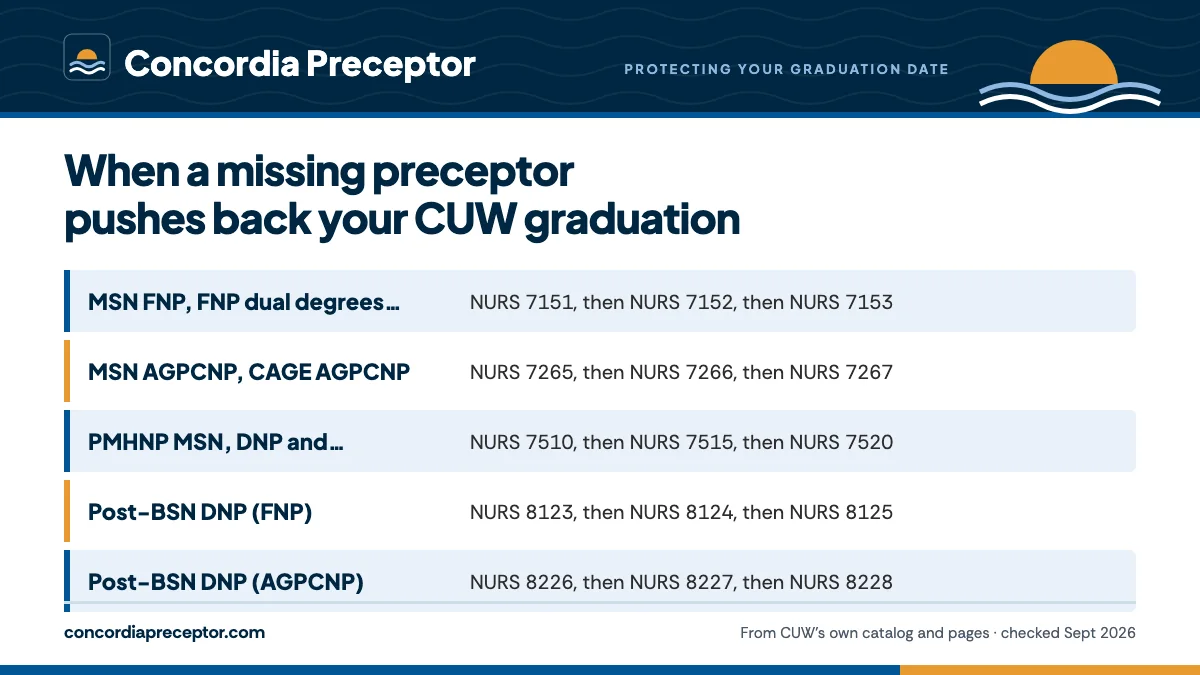
How one late start ripples forward
The catalog lists each clinical course as the prerequisite for the one after it, and it drops a student from a registered class when a prerequisite is not completed. In the catalog's sample plan for the FNP and AGPCNP MSN, the three clinicals sit in semesters 5, 7 and 8, so there is little slack near the end. A late first clinical can push the second and third into later terms, and the last one decides your graduation date.
The archived proposal form made the stakes sharper: a proposal received late meant no clinical that semester and no paired didactic course either. CUW's current pages do not publish that rule, but if it still applies, one missing preceptor can idle a full term of coursework.
| Track | Clinical sequence | If the first course slips |
|---|---|---|
| MSN FNP, FNP dual degrees, CAGE FNP | NURS 7151, then NURS 7152, then NURS 7153 | Both later clinicals move |
| MSN AGPCNP, CAGE AGPCNP | NURS 7265, then NURS 7266, then NURS 7267 | Both later clinicals move |
| PMHNP MSN, DNP and certificate | NURS 7510, then NURS 7515, then NURS 7520 | Both later practicums move |
| Post-BSN DNP (FNP) | NURS 8123, then NURS 8124, then NURS 8125 | Residencies II and III move |
| Post-BSN DNP (AGPCNP) | NURS 8226, then NURS 8227, then NURS 8228 | Residencies II and III move |
The clocks that keep running
A delay costs more than time on paper, because several CUW limits keep counting while you wait for a preceptor. The 2026-27 catalog sets these:
- Five years to finish the MSN, the Post-BSN DNP or a CAGE certificate, counted from your first course in the program.
- Courses expire after seven years under the general graduate rule, unless the department sets something different.
- A leave of absence runs from one semester to 12 months; after that you are withdrawn and must reapply.
- Continuous enrollment means back-to-back fall and spring terms, or the next 8-week terms in your structure, with summer optional.
The post-master's DNP, the PMHNP DNP and the PMHNP certificate print no program time limit in 2026-27, so ask the Graduate Clinical Coordinator or your advisor what governs your track. CUW's 2013-14 graduate handbook also allowed only one voluntary class withdrawal during the program; the current rule is not published, which is one more reason to ask before you withdraw from anything.
What a later graduation also moves
Graduation is the start of the next set of dates, not the end. The 2026-27 calendar puts graduate commencement on Friday, May 7, 2027, two days before spring classes end on May 9. In Wisconsin, the new APRN license under 2025 Act 17 asks for completion of an accredited graduate or post-graduate APRN program plus current national certification. A later graduation date therefore moves your license, and your first NP job, back with it. If an offer depends on your license date, tell that employer as soon as a clinical term slips.
If you plan to practice in Wisconsin, the Wisconsin practice guide explains the license steps that follow graduation, including the prescribing hours and the jurisprudence exam.
If a term already looks lost
Start with your course faculty and your academic advisor, whom you can reach through Concordia Central, and ask three things: whether an incomplete is possible if you are close, whether a later session start could keep the sequence moving, and which courses you can still take this term. The catalog gives incompletes three weeks after the term ends, sometimes six, before they turn into failing grades.
Summer can help. CUW runs a 14-week summer session plus 8-week and 6-week sessions, and some CUW plans already place clinical work in summer: the Fall 2024 Post-BSN DNP cohort plan ran Residency I in summer, and the PMHNP certificate plan runs fall, spring and summer. Whether your course is offered then is a question for your advisor. A leave of absence is the last resort, given the 12-month cap.
The best protection: plan every clinical at once
A search run one course at a time leaves no room for surprises. FNP and AGPCNP students need 750 hours across three courses, and the 2014-15 handbook's 400-hour cap per preceptor means at least two preceptors anyway. PMHNP students need 500 hours across three practicums, and Post-BSN DNP students 1,008 including leadership hours with an agency mentor.
Line up the preceptor for your next clinical while you are in the current one, keep a backup name for each course, and ask early whether each site already has a CUW contract. If a search has already stalled, the can't find a preceptor guide has a reset plan, and the hours guide maps your track.
How we keep your timeline intact
Our service is built around the whole program, not a single course. Your placement advisor maps every clinical you still need, the hours in each and the terms they fall in, then searches for preceptors for all of them, with the documents CUW's graduate faculty review gathered ahead of each proposal. You get one plan covering every remaining course, updated each time a preceptor confirms.
When a site will need a new contract, you hear it early enough to plan around it, and if a preceptor steps away mid-course we are on call to find the replacement. Share your track and expected graduation term and we will build the plan backward from that date.
Questions CUW students ask
How long do I have to finish CUW's MSN program?
The 2026-27 catalog gives MSN students five years from their first course in the program to complete all degree requirements. The same five-year limit appears for the Post-BSN DNP and the CAGE certificate. A missed clinical term uses up part of that window, so plan the remaining clinicals early.
Can I take a leave of absence while I look for a preceptor?
CUW's graduate catalog allows a leave of absence from one semester up to 12 months. After 12 months a student is withdrawn and must reapply. Talk with your advisor first, since a leave also pauses your clinical sequence and may interact with the five-year completion limit.
Does a late clinical affect my other courses?
It can. Under CUW's archived proposal form, a late proposal meant no clinical that semester and no paired didactic course. The catalog also drops students from courses whose prerequisites are unfinished. Ask your course faculty which of your courses depend on the clinical before you change your schedule.
Can I walk at commencement if I am still finishing hours?
CUW's public pages reviewed for this guide do not say. The 2026-27 graduate commencement is Friday, May 7, 2027. If your final clinical may run past that date or into an incomplete, ask your advisor and the registrar's office how participation works for your program.
Related pages
Last checked 2026-09-26
We check these pages against CUW's own academic catalog, program pages and published nursing documents. Your course faculty and the Graduate Clinical Coordinator have the final word.
- Concordia University Wisconsin Academic Catalog 2026-2027: MSN Primary Care Nurse Practitioner
- Concordia University Wisconsin Academic Catalog 2026-2027: Registration policies
- Concordia University Wisconsin Academic Calendars
- Concordia University Wisconsin Academic Catalog 2026-2027: Graduate nursing courses
- Wisconsin DSPS: Advanced Practice Registered Nurse profession
CUW asks you to secure your preceptors. We make the search the easy part.
Tell us your CUW track, your city and your next clinical course. We line up preceptors who fit the NURS course, gather the license, board certification and site details CUW's graduate faculty review, and flag early whether the site needs a new clinical contract.
- Preceptors matched to the course: primary care for FNP and AGPCNP, mental health settings for PMHNP, an agency mentor for DNP projects
- Preceptor license, certification, CV and site details ready for CUW's approval
- All three clinical courses planned together, close to home in a state CUW's disclosure lists for your program
Start your placement plan
Track, city and next clinical course is all we need to begin.