Wisconsin's new APRN license and what it means for your preceptor
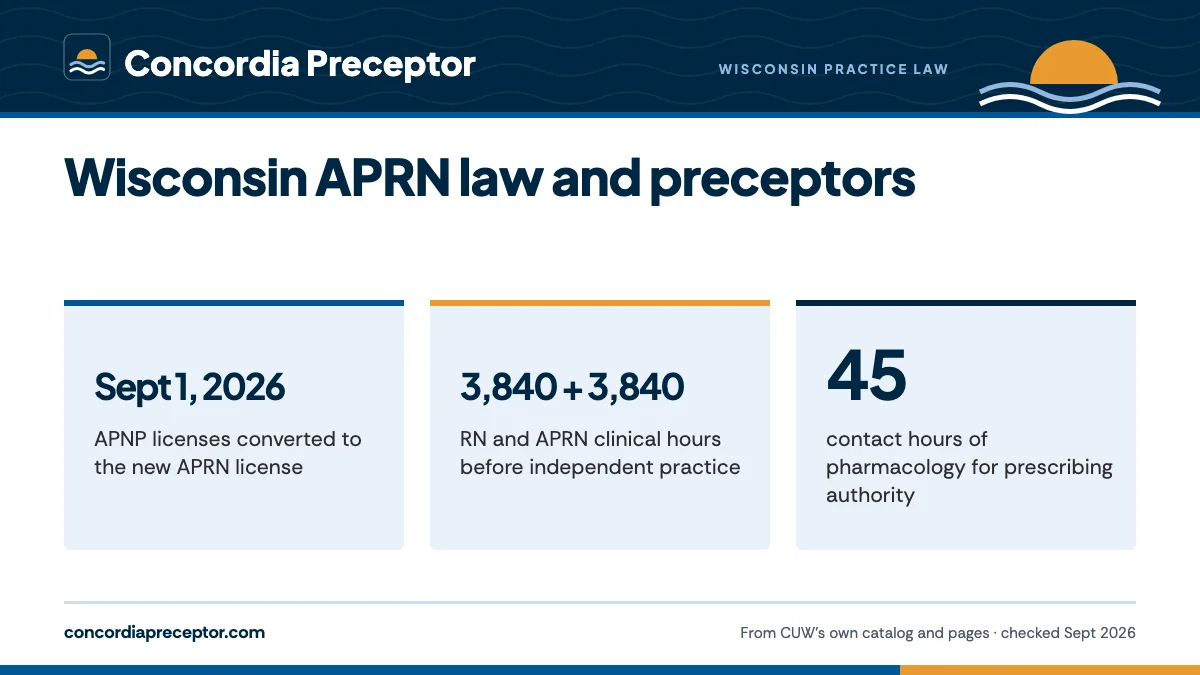
Since September 1, 2026, Wisconsin licenses nurse practitioners as APRNs under 2025 Wisconsin Act 17, and the old APNP credential is gone. New APRNs practice in collaboration with a physician or dentist until the Board approves them for independent practice. For a Concordia University Wisconsin student in a Wisconsin clinical, the rule that touches your preceptor most directly is an older one in the administrative code.
Get your placement plan
Tell us your CUW program and where you live. A placement advisor replies with the preceptor and site options that fit your course.
What Act 17 changed
The Department of Safety and Professional Services, which runs the Board of Nursing, describes Act 17 as creating a dedicated APRN license that replaces the APNP credential. It covers four roles: nurse practitioner, certified nurse-midwife, clinical nurse specialist and certified registered nurse anesthetist. DSPS opened APRN applications on August 3, 2026, stopped taking APNP applications that day, and issued the first licenses on September 1.
Existing APNPs converted automatically and kept their credential numbers; only the profession name changed. Nurse-midwives moved to an APRN-CNM credential with a new number, and neither group had to apply. The law also protects the title: nobody may practice advanced practice registered nursing or call themselves an A.P.R.N. without the license. The Board's emergency rules, approved by the Governor on July 2, 2026, stay in force for up to two years or until permanent rules replace them.
Collaboration first, independence later
By default a Wisconsin APRN practices in collaboration with a physician or dentist; nurse-midwives are exempt. Statute describes that relationship as working together, in each other's presence when necessary, and the APRN documents it. DSPS says an existing collaborative arrangement is not filed with the agency, though the Board may ask for evidence of it during a complaint.
Independent practice takes a Board application and two blocks of experience, each spread over at least 24 months: 3,840 hours of professional nursing in a clinical setting and 3,840 hours as an APRN in that role with a physician or dentist immediately available. DSPS totals that at 7,680 hours. Hours from other states, and hours before September 2026, can count. Two limits survive independence: invasive pain treatment still needs a pain-management physician relationship outside hospital exceptions, and any employer may set its own additional requirements.
| Stage | What Wisconsin asks for |
|---|---|
| APRN license | Wisconsin or multistate RN license, required malpractice insurance, an accredited APRN program, current national certification, and the new jurisprudence exam |
| Prescribing | At least 45 contact hours of clinical pharmacology or therapeutics within 5 years before applying |
| First years of practice | Collaboration with a physician or dentist, documented by the APRN |
| Independent practice | Board approval after 3,840 RN hours and 3,840 APRN hours, each over 24 months |
The preceptor license rule: N 1.08(6)
The rule that governs clinical teaching sits in a different place, chapter N 1 of the administrative code. Under Wisconsin Administrative Code N 1.08(6), a clinical preceptor needs an unencumbered license or privilege to practice in Wisconsin as a nurse at or above the level the student is preparing for, and the school's faculty must approve the preceptor. The chapter defines a school of professional nursing to include the graduate level, so the rule reaches CUW's NP clinicals in Wisconsin.
For a nurse practitioner preceptor, that points to a current Wisconsin APRN license. Wisconsin belongs to the Nurse Licensure Compact, which covers RN practice, but it has not joined the APRN Compact, so no multistate APRN privilege exists to lean on. CUW's archived handbooks also accepted physicians and physician assistants, whom this nursing rule does not describe; ask your graduate faculty how they apply it to a non-nurse preceptor.
Nothing in the Wisconsin rules summarized here makes independent practice status a condition for precepting; N 1.08(6) names the license level and faculty approval.
What changes on your paperwork
CUW's archived documents asked each preceptor for a state license, a CV and national board certification, and its 2022 FAQ repeated the license and certification requirement. After September 1, 2026, a Wisconsin NP preceptor's license reads APRN rather than APNP, with the same number, so an older copy of the credential should be replaced with the current one. A nurse-midwife preceptor now holds a new APRN-CNM number, which is the one to put on the proposal.
Your own planning changes too. Graduate APRN program hours do not count toward the 3,840 RN hours for independent practice, but clinical hours from your RN program do. That makes your CUW clinical hours about licensure and certification, not about the independence clock, which starts once you practice as an APRN.
If you live near a border
If home is near Illinois, Iowa, Michigan or Minnesota, note that CUW's disclosure marks all four as meeting requirements for the MSN primary care NP. When a clinical sits across the line, CUW makes it your responsibility to confirm the program is eligible in that state, and the destination state's practice rules shape who can precept you. The Wisconsin Board summarized its neighbors this way in its emergency-rule analysis:
- Illinois: a written collaborative agreement until full practice authority, after 4,000 post-certification hours and 250 continuing education hours.
- Iowa: ARNPs practice to the full extent of their education and training.
- Michigan: APRNs prescribe non-scheduled drugs on their own; Schedule 2-5 prescribing is delegated by a physician.
- Minnesota: new NPs and CNSs complete 2,080 hours under a written collaborative agreement.
Iowa and Wisconsin both belong to the Nurse Licensure Compact; Illinois, Michigan and Minnesota do not. The license guide and the state disclosure guide cover the CUW side.
How we put these rules to work for you
Every Wisconsin preceptor we propose is checked against N 1.08(6) before you see the name: the license type, the level and whether it is unencumbered. We collect the current APRN credential rather than an outdated APNP copy, note a nurse-midwife's new number, and pair each preceptor with the national certification CUW has asked for.
For students near a state line, we compare your program's row on CUW's disclosure with the neighboring state's rules before we approach a practice there. The result is a proposal your graduate faculty can review without chasing missing details. If a license shows any encumbrance, you hear it from us before the name goes anywhere near CUW. Start with the Wisconsin state guide or send us your track and county.
Questions CUW students ask
Can an APRN who still practices in collaboration precept a CUW student?
The Wisconsin rule for preceptors asks for an unencumbered Wisconsin license or privilege at or above your target level plus faculty approval; it does not mention independent status. CUW's archived criteria focused on the license, board certification and years of practice. Graduate faculty make the final call on every preceptor.
Do my CUW clinical hours count toward Wisconsin's independent practice hours?
Not the graduate ones. Wisconsin counts clinical hours from an RN program toward the 3,840 professional nursing hours, but hours earned in a graduate APRN program are excluded. The 3,840 APRN hours build up only after you are licensed and practicing as an APRN with a physician or dentist available.
My preceptor's license still says APNP. Is that a problem?
DSPS converted active APNP licenses to APRN licenses on September 1, 2026, keeping the same credential number and changing only the profession name. Ask your preceptor for the current record so your proposal shows the credential as it now reads, and replace any older copy you gathered before September.
Is Wisconsin part of the APRN Compact?
No. Wisconsin joined the Nurse Licensure Compact on January 19, 2018, which covers RN practice, but it has not enacted the APRN Compact. NCSBN says that compact takes effect only once seven states enact it. For now, NP practice in Wisconsin requires a Wisconsin APRN license.
Will I have to pass a jurisprudence exam after graduating?
The Board's emergency rules add a new APRN jurisprudence examination for people applying for the APRN license. If you plan to practice in Wisconsin after CUW, expect it alongside national certification, malpractice insurance and your RN license. Check DSPS for the current version when you apply.
Related pages
Last checked 2026-09-26
We check these pages against CUW's own academic catalog, program pages and published nursing documents. Your course faculty and the Graduate Clinical Coordinator have the final word.
CUW asks you to secure your preceptors. We make the search the easy part.
Tell us your CUW track, your city and your next clinical course. We line up preceptors who fit the NURS course, gather the license, board certification and site details CUW's graduate faculty review, and flag early whether the site needs a new clinical contract.
- Preceptors matched to the course: primary care for FNP and AGPCNP, mental health settings for PMHNP, an agency mentor for DNP projects
- Preceptor license, certification, CV and site details ready for CUW's approval
- All three clinical courses planned together, close to home in a state CUW's disclosure lists for your program
Start your placement plan
Track, city and next clinical course is all we need to begin.