Your RN license and CUW clinicals, in Wisconsin and beyond
Concordia University Wisconsin expects an unencumbered RN license from its MSN, Post-BSN to DNP and CAGE students for as long as they are enrolled, and an unencumbered NP prescribing license from PMHNP certificate and PMHNP DNP students. No CUW page says in plain words that you need a license in the state where you do clinicals, but its out-of-state rule puts that check on you. In Wisconsin, your preceptor's license has a rule of its own.
Get your placement plan
Tell us your CUW program and where you live. A placement advisor replies with the preceptor and site options that fit your course.
The license CUW requires, program by program
CUW's catalog makes an unencumbered license a condition of the whole program, not just of admission. Unencumbered means the license carries no restrictions or conditions. Which license you keep depends on your program.
| Program | License you keep |
|---|---|
| MSN FNP, AGPCNP and PMHNP; FNP dual degrees | Unencumbered RN license throughout |
| Post-BSN to DNP | Unencumbered RN license throughout |
| CAGE certificate (FNP or AGPCNP) | Unencumbered RN license throughout |
| PMHNP certificate | Unencumbered NP prescribing license |
| PMHNP DNP | Unencumbered NP prescribing license |
| Post-MSN DNP | Unencumbered RN license in your state of residence, at admission |
| RN to BSN | RN license, with RN employment throughout |
If anything changes with your license, including a move to a new state, tell the Graduate Clinical Coordinator promptly. CUW publishes no process for that situation, so an early conversation keeps the most options open.
Clinicals outside Wisconsin: the check sits with you
CUW's catalog leaves no doubt about whose job this is. When clinicals happen in another state, "it is the student's responsibility" to confirm that the program qualifies there and satisfies that state's licensing agency. Several graduate catalog pages repeat the rule, from the MSN to the PMHNP certificate.
Two checks follow from it. First, the program: CUW's Distance Education Disclosures mark each state as meeting or not meeting requirements, program by program, and the tables differ. The licensure disclosure guide walks through them, and clinicals outside Wisconsin covers the separate Washington approvals.
Second, your license. CUW never quite says that your RN license has to reach the state where you see patients, but the out-of-state wording leans that way, and the board in that state has the final say. The safe plan is to hold RN authority in that state, either its own license or a multistate license through the compact, and to confirm with that board before your proposal goes in.
The Nurse Licensure Compact, and the APRN Compact that is not running
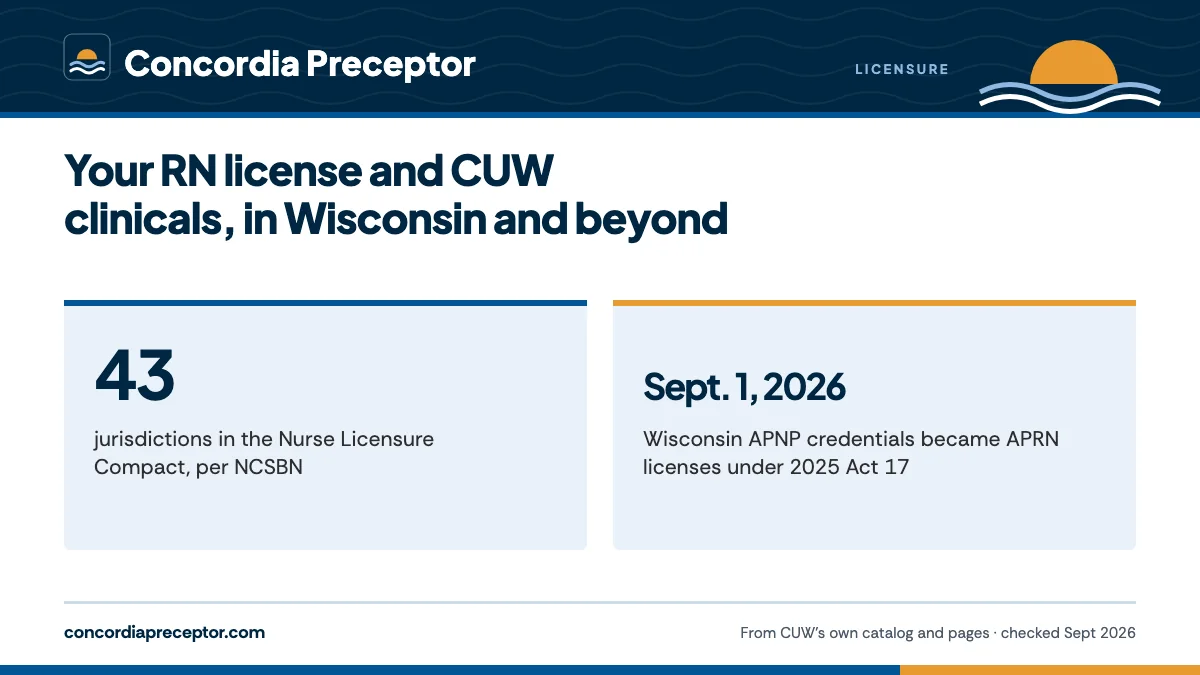
Wisconsin has belonged to the Nurse Licensure Compact since January 19, 2018, and NCSBN counts 43 jurisdictions in it. A multistate RN license issued by your home compact state covers RN practice in the other compact states. A Wisconsin resident with a multistate license is therefore covered for RN practice in Iowa, another compact member, though Iowa's own rules for student clinicals still apply.
Illinois, Michigan and Minnesota sit outside the compact; NCSBN named them in January 2025 among the states that have yet to join. RN practice in those states takes that state's own license.
The compact covers RN licenses only. The separate APRN Compact has been enacted by just a handful of states, takes effect only after seven enact it, and does not include Wisconsin. An NP license, which the PMHNP certificate and PMHNP DNP require you to keep, is still issued state by state.
Wisconsin's rule for your preceptor's license
Wisconsin regulates the clinical preceptors of every school of nursing, graduate programs included. Under Wis. Admin. Code N 1.08(6), a preceptor needs an unencumbered Wisconsin license or practice privilege as a nurse, pitched at the level the student is training for or higher, and the school's faculty must sign off on the choice. For an NP student, that means a preceptor who is licensed in Wisconsin at the advanced practice level.
The rule is written about nurses. Older CUW handbooks let physicians and PAs precept NP students as well, so when your preceptor is not a nurse, ask the Graduate Clinical Coordinator how CUW reads the rule now. Wisconsin's April 2024 Board guidance for out-of-state schools sets a parallel expectation: faculty and preceptors for clinicals in Wisconsin must hold a Wisconsin license or privilege.
Credential names changed this fall, too. 2025 Wisconsin Act 17 turned APNP credentials into the new APRN license on September 1, 2026, with each holder's number carried over, so a preceptor's license may now read APRN where last year's read APNP. Wisconsin NP practice and preceptors covers the new license.
Border states at a glance
Many CUW students live within reach of a state line. Here is how Wisconsin and its four neighbors compare on the questions this page covers.
| State | Nurse Licensure Compact | CUW MSN primary care NP disclosure | RN authority for clinicals there |
|---|---|---|---|
| Wisconsin | Member since Jan. 19, 2018 | Meets requirements | Wisconsin license, or a multistate license from another compact state |
| Iowa | Member since Jan. 19, 2018 | Meets requirements | Iowa license, or a multistate license from another compact state |
| Illinois | Not a member | Meets requirements | Illinois RN license |
| Michigan | Not a member | Meets requirements | Michigan RN license |
| Minnesota | Not a member | Meets requirements | Minnesota RN license |
The disclosure column reflects the MSN primary care NP table; other CUW programs have their own tables. The last column is our reading of compact membership, so confirm it with the state board. One Wisconsin system spells its rule out: Aurora's student page asks every student for a current Wisconsin RN license. Each state guide, such as Wisconsin or Illinois, adds board and practice details.
Why CUW students choose us for multi-state searches
We start every search from the state where you will see patients, not only where you live. We check that CUW's disclosure lists your program there, that your RN license or multistate privilege reaches that state, and that the preceptor's license meets the rule where the site sits, including Wisconsin's N 1.08(6) standard. Then we gather the preceptor's license, board certification and CV so graduate faculty can confirm the match without chasing documents. For PMHNP certificate and DNP students, we also set the state that issued your NP license beside the practicum state and raise any gap with you before a proposal goes in.
If you live near a state line, we compare the options on each side and show you which one clears every check first. Send us your home state and track, or read how it works.
Questions CUW students ask
Must my RN license be from Wisconsin to enroll at CUW?
CUW's catalog asks for an unencumbered RN license without naming a state, and the Post-MSN DNP asks for one in your state of residence. Clinicals in Wisconsin take authority to practice there, meaning a Wisconsin license or a multistate compact license, and some systems, Aurora among them, ask every student for a Wisconsin RN license.
Does the Nurse Licensure Compact cover NP clinicals in another state?
It covers RN practice only. A multistate RN license from your home compact state reaches other compact states such as Iowa, but not Illinois, Michigan or Minnesota. The APRN Compact is not in effect and Wisconsin has not joined it, so NP licenses stay state by state. The destination board has the final word on student clinicals.
Can my Wisconsin preceptor be licensed only in another state?
Not under Wisconsin's rule for nurse preceptors. N 1.08(6) calls for an unencumbered Wisconsin license or practice privilege, set at your target level or higher, and the school's faculty must approve the preceptor. If a preceptor would supervise you from another state, for example by telehealth, clear the arrangement with the Graduate Clinical Coordinator first.
I am relocating partway through CUW's program. What changes?
Start with CUW's disclosure table, since some states are marked as not meeting requirements for your program. Next, sort out the RN license the new state requires, and let the Graduate Clinical Coordinator know before you approach anyone there, because a move usually means new sites and new preceptors as well.
Which CUW students need an NP license, not just an RN license?
Students in the PMHNP certificate and the PMHNP DNP. Both admit nurse practitioners who already hold certification with prescriptive authority, and CUW's catalog requires an unencumbered NP prescribing license throughout. In Wisconsin, APNP credentials became APRN licenses on September 1, 2026, with prescriptive authority noted for those who held it.
Related pages
Last checked 2026-09-26
We check these pages against CUW's own academic catalog, program pages and published nursing documents. Your course faculty and the Graduate Clinical Coordinator have the final word.
- Concordia University Wisconsin Academic Catalog 2026-2027: MSN Primary Care Nurse Practitioner
- Concordia University Wisconsin Academic Catalog 2026-2027: PMHNP CAGE Certificate
- Concordia University Wisconsin: Distance Education Disclosures
- Wisconsin Administrative Code ch. N 1 (preceptor rule N 1.08(6))
- NCSBN: Nurse Licensure Compact map
CUW asks you to secure your preceptors. We make the search the easy part.
Tell us your CUW track, your city and your next clinical course. We line up preceptors who fit the NURS course, gather the license, board certification and site details CUW's graduate faculty review, and flag early whether the site needs a new clinical contract.
- Preceptors matched to the course: primary care for FNP and AGPCNP, mental health settings for PMHNP, an agency mentor for DNP projects
- Preceptor license, certification, CV and site details ready for CUW's approval
- All three clinical courses planned together, close to home in a state CUW's disclosure lists for your program
Start your placement plan
Track, city and next clinical course is all we need to begin.