CUW's CAGE certificate: a new NP role, 750 hours, shaped by what you bring
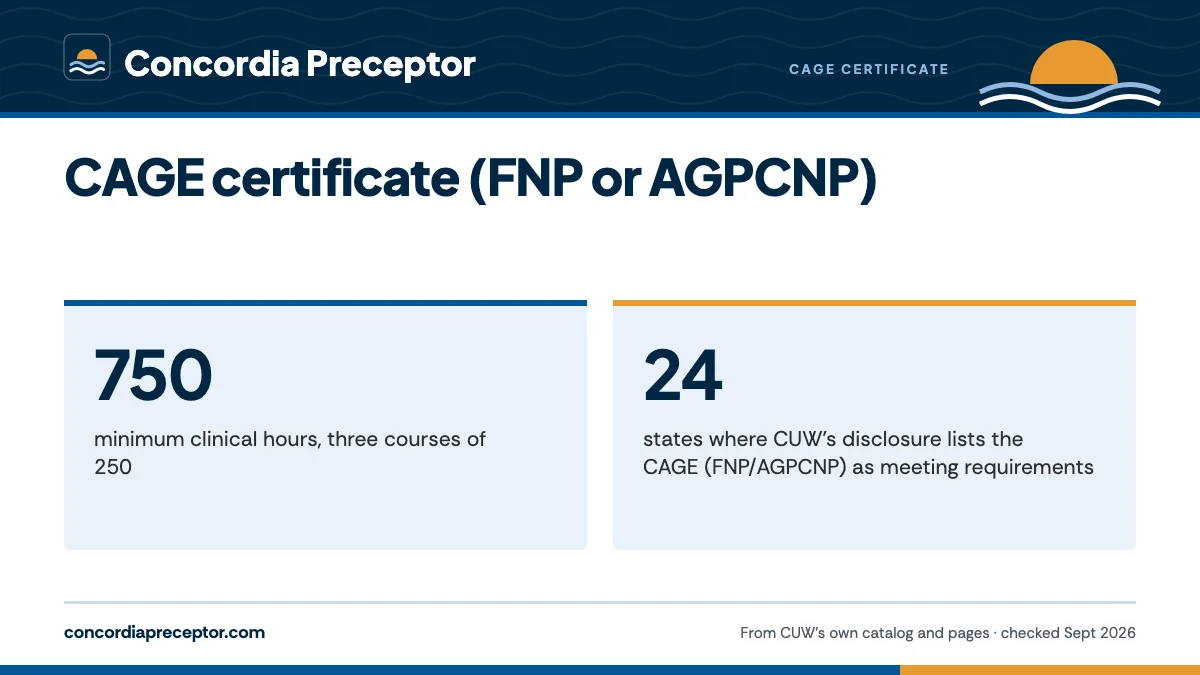
Concordia University Wisconsin's Certificate After Graduate Education in Nursing (CAGE) lets a nurse who already holds an MSN or DNP add the FNP or AGPCNP role. It runs the same three primary care clinicals as CUW's MSN, with a 750-hour minimum, and clinical hours from an earlier advanced practice degree may count case by case. You secure each preceptor, graduate faculty approve them, and our desk does the finding.
Plan your CAGE clinicals
Tell us your new role, your prior degree and your state. Your placement advisor plans all three clinicals with you.
Who the CAGE is for, and why each plan differs
CAGE admits registered nurses who hold an MSN, a DNP or both. The catalog lists 35 credits, then adds that credit requirements will vary based on prior academic work, so two CAGE students can end up with very different plans. Two roles are offered now, FNP and AGPCNP; a Nurse Educator option was dropped after 2023-24. The psychiatric route is its own certificate, covered on our PMHNP certificate page.
Transfer credit is where CUW's sources part company. The catalog allows up to 50 percent of the certificate's credit requirements, with more possible on the Dean's approval, while the program page speaks of a 20-credit transfer maximum. Half of 35 is 17.5, so the two figures do not agree. Your own credit evaluation is what settles it.
The program page estimates three to three and a half years, or two years with the maximum transfer. Whatever your plan, all requirements must be complete within five years of your first course.
Clinical hours: the 750 minimum and your earlier hours
Credits can shrink; the clinical minimum is fixed at 750 hours. The catalog says clinical hours from a previous advanced practice degree may be considered on a case-by-case basis, and at application you send a letter stating the clinical hours you earned in your master's program. That letter is where the review starts.
The case-by-case wording is new to the 2026-27 catalog. The 2025-26 edition carried a different line, warning that performance might call for extra hours. Until faculty rule on your file, plan preceptors for the full 750 and treat any credit for earlier hours as a welcome cut to the search.
Ask for that decision in writing before your first clinical semester. It decides whether you need three preceptors or fewer, and how many hours each one must host.
The clinical sequence
CAGE students take the MSN clinical courses for their chosen role, each one the prerequisite for the next. Clinical I requires pathophysiology (NURS 6036), Advanced Health Assessment (NURS 6038) and pharmacology (NURS 6042), or the older numbers the catalog still accepts.
| Course | Focus in the catalog | Hours |
|---|---|---|
NURS 7151 Advanced Primary Care Clinical I - FNP | Episodic and chronic conditions, health promotion and prevention | 250 |
NURS 7152 Advanced Primary Care Clinical II - FNP | Primary health care settings, community partnerships | 250 |
NURS 7153 Advanced Primary Care Clinical III - FNP | Across the lifespan, with pediatric, older adult and women's health emphasis | 250 |
NURS 7265 Advanced Primary Care Clinical I - AGPCNP | Episodic and chronic conditions through the adult lifespan | 250 |
NURS 7266 Advanced Primary Care Clinical II - AGPCNP | Primary health care settings, community partnerships | 250 |
NURS 7267 Advanced Primary Care Clinical III - AGPCNP | The older adult in the outpatient setting | 250 |
For NURS 7153, look for a family practice whose panel includes children and women's health visits as well as adults. Course detail sits on the NURS 7151 and NURS 7267 pages.
Preceptors and sites for a nurse with a graduate degree
CAGE students come in with a graduate degree and often a working role in health care, and that shapes the search. CUW's 2014-15 NP handbook barred your own department or unit at work as a site, while accepting the same employer, and would not let the clinician who treats you or a relative serve as your preceptor. The primary care rule holds for both tracks; CUW's 2022 blog excluded acute care settings such as the hospital, ER and surgery.
Current CUW pages publish no credential list. The 2022 FAQ asked for at least two years of clinical experience, a state license and board certification; the 2014-15 handbook allowed NPs, PAs, CNMs and physicians, with at least 50 program hours spent with an NP. The preceptor requirements page dates each rule; confirm the current one with the Graduate Clinical Coordinator.
Compliance follows the MSN list: CUW's Castle Branch background check at acceptance, CPR kept current, the vaccinations each site sets, an RN license with no encumbrance and the Student Responsibilities Agreement.
States: why Texas and Washington drop out
CUW's disclosure lists the CAGE (FNP/AGPCNP) as meeting requirements in 24 states. That is the MSN primary care list minus Texas and Washington, even though the certificate runs the MSN's own clinical courses. CUW prints no reason, and its 2022 CAGE page already excluded both states. The CAGE (PMH NP) table drops the same two. Texas shows how narrow the split is: the MSN and both DNP tables mark it as meeting requirements, while the certificate that uses the same courses does not.
If you live in Texas or Washington, talk to CUW before you enroll. Everywhere else, the licensure disclosures table and your state's guide show where your clinicals can happen. For clinicals outside Wisconsin, the catalog leaves the check that the program meets that state's requirements to you.
Start terms, the intensive and outdated plans
CAGE admits for fall (applications by July 1) and spring (by November 1). Advanced Health Assessment, NURS 6038, is taught in a hybrid format that includes 2-3 days of hands-on work on campus if you take it at CUW; the health assessment intensive page covers the days.
Take care with the progression plans still linked from the CAGE page. They are dated February 2021, use pre-2024 course numbers such as 751 and 765, and show Advanced Health Assessment as a two-week residency in January. The 2026-27 catalog's four-digit numbers and 2-3 day format are current, so use them with preceptors and on paperwork.
Your term of entry also sets the earliest clinical, because Clinical I waits for Advanced Health Assessment, pathophysiology and pharmacology. Mapping those courses at admission tells you which term your first preceptor must be lined up for.
Why CAGE students choose our desk
You are adding a role on top of a working life, so the search has to be efficient and right the first time. Our placement desk fits it to the plan your faculty set.
- Primary care preceptors matched to your new role, including family practices with pediatric and women's health visits for
NURS 7153 - Sites outside your own unit, checked against CUW's archived conflict rules
- Preceptor license, board certification and CV collected for faculty review
- A search sized to your real hour target once faculty rule on your earlier hours
- A quick read on contract status, so a first-time site starts its CUW paperwork early
Use the form below for your new role, your earlier degree and your state; your placement advisor answers with a plan covering all three clinicals.
Questions CUW students ask
Can clinical hours from my first NP program count toward CUW's CAGE?
They may. The 2026-27 catalog says clinical hours from an earlier advanced practice degree may be weighed case by case against the 750-hour minimum, and you list your master's clinical hours in a letter when you apply. Faculty make the call, so get their answer before you size your preceptor search.
Is CUW's CAGE certificate fully online?
Mostly. The program page says most classes are online, but Advanced Health Assessment (NURS 6038) includes a 2-3 day hands-on experience on campus if you take it at CUW. Your clinical hours happen with approved preceptors near where you live, in a state on CUW's list for the certificate.
How is the PMHNP certificate different from the FNP or AGPCNP CAGE?
CUW lists it separately. The PMHNP CAGE is an 18-credit certificate of about a year, with 500 practicum hours in mental health, and it admits nurses who already hold NP certification with prescriptive authority. The FNP and AGPCNP CAGE is individualized, runs the 750-hour primary care sequence and has its own admission rules.
How long do I have to finish the CAGE?
The catalog sets a five-year limit from your first course. The program page estimates three to three and a half years, or two if you receive the maximum transfer credit. The clinical courses are chained by prerequisites, so a missed clinical semester moves your finish date.
Does CUW still offer a Nurse Educator CAGE?
No. CAGE offered three options through 2023-24: FNP, AGPCNP and Nurse Educator. The current catalog lists only the two NP roles. The MSN Nurse Educator track went at the same time; its page said in 2024 that it was not accepting applications for the 2024-2025 academic year.
Related pages
Last checked 2026-09-26
We check these pages against CUW's own academic catalog, program pages and published nursing documents. Your course faculty and the Graduate Clinical Coordinator have the final word.
- Concordia University Wisconsin Academic Catalog 2026-2027: CAGE (FNP/AGPCNP)
- Concordia University Wisconsin: Certificate After Graduate Education in Nursing program page
- Concordia University Wisconsin: MSN Nurse Practitioner Progression Plan, 3-year fall start (PDF)
- Concordia University Wisconsin Academic Catalog 2026-2027: Graduate NURS courses
- Concordia University Wisconsin: Distance Education Disclosures
CUW asks you to secure your preceptors. We make the search the easy part.
Tell us your CUW track, your city and your next clinical course. We line up preceptors who fit the NURS course, gather the license, board certification and site details CUW's graduate faculty review, and flag early whether the site needs a new clinical contract.
- Preceptors matched to the course: primary care for FNP and AGPCNP, mental health settings for PMHNP, an agency mentor for DNP projects
- Preceptor license, certification, CV and site details ready for CUW's approval
- All three clinical courses planned together, close to home in a state CUW's disclosure lists for your program
Start your placement plan
Track, city and next clinical course is all we need to begin.