CUW's PMHNP certificate: 500 practicum hours packed into one year
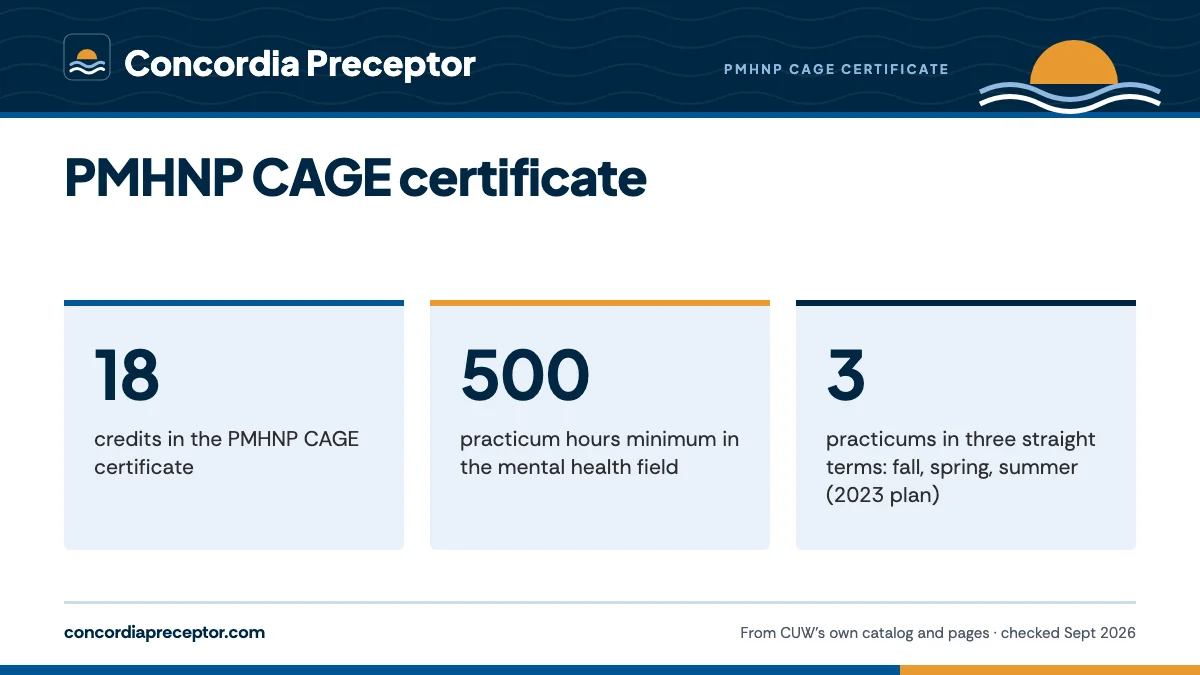
Concordia University Wisconsin's Psychiatric Mental Health Nurse Practitioner CAGE certificate lets a practicing NP add the psychiatric role in 18 credits and about a year. Coursework is fully online; the 500 practicum hours happen locally in three courses taken back to back, NURS 7510, then NURS 7515, then NURS 7520. CUW's page says finding the placement is ultimately your responsibility, with a coordinator to help.
Get your placement plan
Tell us your CUW program and where you live. A placement advisor replies with the preceptor and site options that fit your course.
What the certificate is
CAGE stands for Certificate After Graduate Education in Nursing. The PMHNP version first appeared in CUW's 2023-24 catalog, and CUW's blog announced its launch in October 2023. It is open to nurses holding an MSN or DNP plus NP certification with prescriptive authority, and your NP prescribing license must stay unencumbered from the first course to the last.
CUW describes a one-year, 18-credit certificate that can be finished in as little as three semesters, with online coursework matched to practicum hours you complete locally. Unlike the MSN PMHNP and the PMHNP DNP, it names no on-campus session. Applications for the fall start close July 1.
The 2026-27 catalog prints no program time limit for the certificate. It does carry one warning worth planning around: some students may be asked for extra hours, depending on how they perform. A one-year plan with no slack leaves little room for that, so build some into your summer.
Three practicums, three terms
The per-course hours come from CUW's PMHNP curriculum plan, created in May 2023 and archived in 2024, which laid the courses out fall, spring, summer. Each practicum requires the one before it, so a missed term pushes the rest back rather than letting you catch up in parallel.
Some quick arithmetic helps with preceptor talks. Over a full 16-week fall term, Practicum I averages about 8 hours a week, and Practicum II's 200 hours come to about 12 or 13 a week over spring. CUW's summer runs a 14-week session beside shorter 8- and 6-week ones, so Practicum III needs roughly 12 or 13 hours a week, or far more if your section is shorter. Ask which session your course uses.
| Term | Course | Hours | Catalog focus |
|---|---|---|---|
| Fall | NURS 7510 Psychiatric Mental Health Practicum I | 125 | Advanced assessment and clinical management of psychiatric disorders |
| Spring | NURS 7515 Psychiatric Mental Health Practicum II | 200 | Diagnosis and treatment of complex psychiatric disorders |
| Summer | NURS 7520 Psychiatric Mental Health Practicum III | 175 | Patients and families with complex needs |
Planning preceptors before you start
A one-year plan leaves almost no slack between terms, and a new clinical contract can outlast the gap. CUW's 2014-15 NP handbook budgeted eight to twelve weeks for a first contract with a site, and the old proposal form set a four-week filing cutoff before clinicals. The sensible target is Practicum I secured before fall opens, and the spring and summer preceptors identified while fall is underway. The clinical deadline calendar shows how those lead times stack up.
Keeping one preceptor for two practicums can help continuity. CUW's older MSN rules allowed up to 400 hours with any one preceptor, which would cover Practicum I and II together, but those rules were written for the primary care tracks. Ask the Graduate Clinical Coordinator whether the same ceiling applies to PMHNP hours before you plan around it.
If a practicum site belongs to a health system with its own student process, that system's calendar may run ahead of CUW's. Several Wisconsin systems publish their own request windows and school-only submission rules, collected on health systems with their own processes.
Who can supervise your hours
CUW's certificate page asks for practicum hours under qualifying supervision and leaves the definition to faculty. No CUW source spells out PMHNP preceptor credentials, so expect approval to weigh license, board certification, experience and the fit between the site and each course. Practicums in Wisconsin also fall under N 1.08(6), which asks for a preceptor holding an unencumbered Wisconsin credential, license or privilege, pitched at your target role or higher and approved by faculty.
CUW's PMHNP program pages place its graduates in psychiatric inpatient units, behavioral health clinics, community mental health, integrated primary care and telehealth. Whether any practicum hours may be virtual is not stated, so ask before you count on a telehealth preceptor.
As a working NP you likely know psychiatric clinicians already. CUW's past NP rules excluded your own unit at work and any clinician who treats you or a relative, while accepting a different setting within the same employer. The dated general rules are on CUW's preceptor standards.
Two coordinator titles, one role
The certificate page still names the Clinical Contract Coordinator, the title CUW's 2023-24 catalog used when the certificate launched. The 2025-26 and 2026-27 catalogs call the same role the Graduate Clinical Coordinator. Both names point to the same kind of help: assistance with the placement process, while the search stays with you and approval stays with graduate faculty.
In CUW's 2014-15 handbook the work was split between a Clinical Education Coordinator, who reviewed proposals, and a Clinical Contract Coordinator, who looked up existing contracts and cleared the start. Today's catalog names one coordinator, and either title reaches the right desk when you write to CUW. Send your proposal, contract and state questions to that one role. Who reviews what now is laid out on the Graduate Clinical Coordinator.
State rules and the Washington conflict
CUW's Distance Education Disclosures carry a table for the CAGE (PMH NP). It lists 24 states plus Washington, D.C. as meeting requirements and 26 states as not, including Texas and Washington, both of which the MSN primary care table counts as meeting. The catalog leaves out-of-state eligibility to the student, so check your state before you apply.
Washington is where the sources collide. The certificate page says the Washington State Board of Nursing approved CUW to run clinical experiences in Washington for Washington residents in this program, while the disclosure table marks Washington as not meeting requirements. If you live in Washington, ask CUW for a written answer before enrolling. Texas residents meet a similar split: the MSN table marks Texas as meeting requirements, both CAGE tables do not, and CUW gives no reason. The full table is on licensure disclosures.
Why certificate students choose us
In a one-year certificate the preceptor search cannot wait for the term to start. Our placement desk plans all three practicums before fall begins: a psychiatric preceptor near you for NURS 7510, with the spring and summer placements lined up while the first is underway. Each file holds what graduate faculty look at: license, national certification, CV and practice details.
We check each organization's clinical contract status the day it says yes, confirm the preceptor can give the weekly hours each course demands, and stay on call if anyone has to step away mid-term. If your employer runs a behavioral health service, we also check whether a unit other than your own could host you, which CUW's past rules allowed. Use the form below and choose the PMHNP CAGE certificate.
Questions CUW students ask
Can I finish CUW's PMHNP certificate in one year?
CUW's plan is built for it: three semesters, fall through summer, with the practicums in order. Staying on that pace depends on having each preceptor approved and each site's contract in place before its term begins. A late placement moves the next practicum back, because each course requires the one before it.
Is the PMHNP certificate fully online?
The coursework is. CUW describes online classes matched with local practicum hours and names no campus visit, unlike the MSN PMHNP and PMHNP DNP, which list a 3-day workshop. Your 500 practicum hours take place with approved preceptors at sites near home.
Who helps certificate students with placements?
The certificate page puts the placement on you in the end, with the Clinical Contract Coordinator assisting. The current catalog uses the newer title, Graduate Clinical Coordinator. Graduate faculty approve each preceptor. Our placement desk takes on the searching and gathers the preceptor details faculty review.
What if I need more than 500 practicum hours?
The catalog warns that, based on level of performance, a certificate student may need to complete additional hours. Leave some room in your summer plan and ask your Practicum III preceptor early whether they could extend if your faculty ask for more time, so a request does not arrive as a surprise.
Can Washington residents take the PMHNP certificate?
CUW's certificate page says Washington's Board of Nursing approved its clinical experiences for Washington residents, but the Distance Education Disclosures table marks Washington as not meeting requirements for the CAGE (PMH NP). Before you apply, get CUW's current answer in writing and file it with your records.
Related pages
Last checked 2026-09-26
We check these pages against CUW's own academic catalog, program pages and published nursing documents. Your course faculty and the Graduate Clinical Coordinator have the final word.
- Concordia University Wisconsin Academic Catalog 2026-27: PMHNP CAGE certificate
- Concordia University Wisconsin: Psychiatric Mental Health Nurse Practitioner Certificate
- Concordia University Wisconsin: PMHNP certificate curriculum plan (2023, archived)
- Concordia University Wisconsin: Distance Education Disclosures
- Concordia University Wisconsin blog: PMHNP certificate launch (2023)
CUW asks you to secure your preceptors. We make the search the easy part.
Tell us your CUW track, your city and your next clinical course. We line up preceptors who fit the NURS course, gather the license, board certification and site details CUW's graduate faculty review, and flag early whether the site needs a new clinical contract.
- Preceptors matched to the course: primary care for FNP and AGPCNP, mental health settings for PMHNP, an agency mentor for DNP projects
- Preceptor license, certification, CV and site details ready for CUW's approval
- All three clinical courses planned together, close to home in a state CUW's disclosure lists for your program
Start your placement plan
Track, city and next clinical course is all we need to begin.