Preceptor requirements for Concordia University Wisconsin NP students
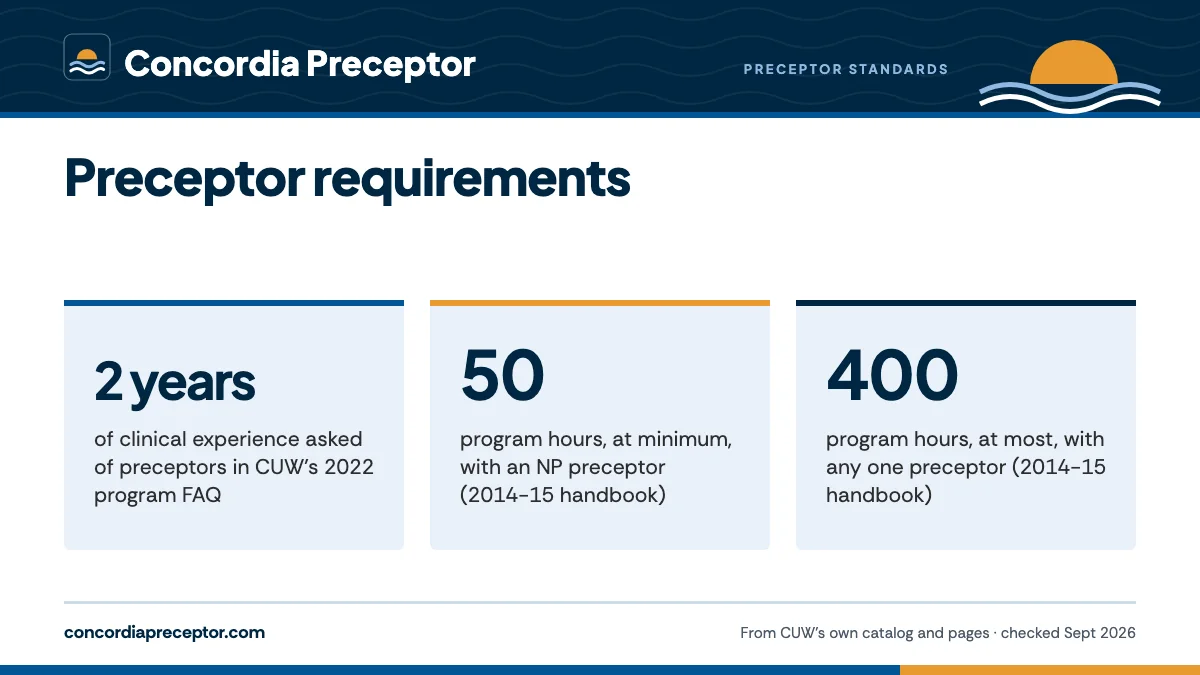
Concordia University Wisconsin's current pages ask for preceptors that graduate faculty approve as appropriate, and the detailed credential rules come from dated CUW documents. In 2022 CUW wanted a licensed, board-certified clinician with two or more years of clinical work behind them. Back in 2014-15, NPs, PAs, nurse-midwives and physicians could all qualify, subject to caps on hours.
Get your placement plan
Tell us your CUW program and where you live. A placement advisor replies with the preceptor and site options that fit your course.
The current rule: faculty judge what is appropriate
Today's CUW pages publish no preceptor checklist. The FNP page speaks of approved preceptors, the PMHNP certificate page of clinical hours under qualifying supervision, and the 2026-27 catalog of faculty sign-off on whether a preceptor is appropriate. The working standard is therefore the one your course faculty apply this term.
State law sets a floor for sites in Wisconsin. Wisconsin Administrative Code N 1.08(6) asks each nurse who precepts for a Wisconsin nursing school to hold a clear Wisconsin license, or the privilege to practice there, at the level the student is preparing for or higher, and it leaves the approval to that school's faculty. Read plainly, a nurse preceptor for an NP student at a Wisconsin site needs Wisconsin authority to practice at the advanced practice level; your course faculty can confirm how CUW applies it.
That level has a new name. Under 2025 Wisconsin Act 17, the APNP credential became an APRN license, with current APNPs converted on September 1, 2026. The Wisconsin practice guide explains what the change means for preceptors.
CUW's preceptor standards, side by side
The two most detailed CUW sources are eight years apart and do not match on every point. The table sets them next to the current catalog.
| Standard | 2014-15 NP handbook | 2022 program FAQ and blog | 2026-27 catalog |
|---|---|---|---|
| Who may precept | NP, PA, CNM, or physician (MD or DO) | Not listed | Approved by graduate faculty |
| License | Current state license | State license | Not listed |
| Board certification | National certification for NPs, PAs and CNMs; optional for MD and DO | Board certification | Not listed |
| Experience | At least one year of practice | At least two years of clinical experience | Not listed |
| Time with an NP | At least 50 program hours | Not listed | Not listed |
| Practice type | Primary care; urgent care or walk-in as an exception | Community primary care, no acute care (blog) | Not listed |
The experience rule is the clearest conflict: one year in the handbook, two in the 2022 FAQ. Plan around the newer and stricter two years, and ask the Graduate Clinical Coordinator which figure applies to your course.
Limits on how many preceptors, and for how long
The 2014-15 handbook also capped how students used preceptors. A third clinician in one term needed sign-off in advance, and no single clinician could supervise more than 400 of your program hours.
The 400-hour cap has a practical effect. The FNP and AGPCNP tracks now require 750 clinical hours, 250 in each of three courses, so under that rule one clinician could host a full course and part of the next, but not the whole sequence. Planning for at least two preceptors across your program avoids a scramble in the last term.
The 50-hour NP minimum matters if most of your offers come from physicians or PAs. A plan built entirely on physician preceptors would miss it, so line up at least one NP. Orientation, shadowing and approved conference time together could fill no more than 8 hours of a term under that handbook, and the pacing guide covers how hours spread across a term.
What your preceptor provides
CUW's archived documents are consistent about the paperwork. The 2014-15 handbook asked preceptors for a current state license, a CV and, for NPs, PAs and CNMs, proof of national certification. The undated proposal form lists board certification for "NP's and CNM's only" and says CUW needed it for accreditation purposes.
Beyond documents, the preceptor's role in the handbook era included signing the learning objectives your clinical adjunct had approved, completing mid-term and final evaluations, and signing a Documentation of Hours form for their share of your hours. A CUW clinical instructor visited at least once a semester, according to the 2022 blog and FAQ.
Preceptors who want the full picture before they agree can read our page for preceptors.
PMHNP and DNP preceptors: what CUW has not published
No CUW source states credential rules for PMHNP preceptors. Whether CUW expects a board-certified PMHNP, accepts a psychiatrist, sets a minimum number of years, or allows telehealth supervision is not public. The PMHNP program page describes its practicum settings only as approved ones, with no list attached.
For the DNP, the supervising clinician is often an agency mentor rather than a preceptor in the NP sense. In the Post-BSN to DNP immersion courses, the catalog describes the mentor as coming from a selected health care agency, and an older CUW proposal form for DNP residencies recorded the mentor's degrees and credentials. No minimum degree for that mentor appears in any CUW source. In 2022, the Post-MSN DNP page reserved faculty's right to check a mentor's hour counts whenever they chose.
For both groups, get the current standard in writing from your course faculty before you ask anyone to commit.
Why CUW students trust us to vet preceptors
Our placement desk screens every clinician against the strictest dated CUW standard: an active license, national board certification, at least two years in practice and a setting, primary care or psychiatric, that suits your track. For Wisconsin sites we also confirm the license level the state's preceptor rule expects, and we plan the 50 NP hours and the 400-hour cap into your three-course sequence from the start.
When a clinician says yes, your advisor gathers the license, certification and CV the same week, so nothing is missing on the day graduate faculty open your proposal. For PMHNP and DNP students, where CUW has published less, we build the search around the standard your course faculty give you and document it for the proposal. Our service overview walks through each step, and the contact form takes your track and term.
Questions CUW students ask
Can a physician assistant precept a CUW FNP student?
Under CUW's 2014-15 NP handbook, yes: PAs were an allowed preceptor type, with current national certification. That handbook also reserved a minimum of 50 hours for time with an NP, so a PA can carry part of your hours but not all of them. CUW has not restated the rule, so check it with your course faculty.
Does my preceptor need a Wisconsin license?
At a Wisconsin site, yes for nurse preceptors: the state's school rule wants a clear Wisconsin license or practice privilege at your target level or above. Outside Wisconsin, look to the host state's board. The RN license guide covers your own license in the clinical state.
Does a CUW preceptor have to be board certified?
CUW's 2022 program FAQ listed board certification among preceptor requirements. The 2014-15 handbook required national certification for NP, PA and CNM preceptors and made it optional for physicians. The undated proposal form said CUW needed NP and CNM certification for accreditation purposes, so treat it as expected.
How many years of experience does a CUW preceptor need?
CUW's sources disagree. One year of practice satisfied the 2014-15 handbook; the 2022 FAQ doubled that to two. Current pages give no figure. Aim for two years to be safe and ask the Graduate Clinical Coordinator which rule applies to your course.
Who can precept PMHNP students at CUW?
No public CUW document sets out who may supervise the psychiatric practicums; the catalog leaves it to graduate faculty's judgment of appropriateness. Before you approach a psychiatric NP, psychiatrist or other clinician, ask your course faculty what they expect for NURS 7510 through NURS 7520.
Related pages
Last checked 2026-09-26
We check these pages against CUW's own academic catalog, program pages and published nursing documents. Your course faculty and the Graduate Clinical Coordinator have the final word.
- Concordia University Wisconsin Academic Catalog 2026-2027: MSN Primary Care Nurse Practitioner
- Concordia University Wisconsin: MSN Family Nurse Practitioner
- Concordia University Wisconsin MSN program page with FAQs, 2022 (archived)
- Concordia University Wisconsin NP Student Clinical Practicum Handbook 2014-2015 (archived)
- Wisconsin Administrative Code ch. N 1 (schools of nursing), incl. N 1.08(6)
CUW asks you to secure your preceptors. We make the search the easy part.
Tell us your CUW track, your city and your next clinical course. We line up preceptors who fit the NURS course, gather the license, board certification and site details CUW's graduate faculty review, and flag early whether the site needs a new clinical contract.
- Preceptors matched to the course: primary care for FNP and AGPCNP, mental health settings for PMHNP, an agency mentor for DNP projects
- Preceptor license, certification, CV and site details ready for CUW's approval
- All three clinical courses planned together, close to home in a state CUW's disclosure lists for your program
Start your placement plan
Track, city and next clinical course is all we need to begin.