Which clinical sites fit your CUW nurse practitioner courses
For Concordia University Wisconsin's FNP and AGPCNP tracks, your main clinical site should be a primary care practice. CUW's 2022 blog ruled out acute care settings, and its archived 2014-15 handbook put hour caps on specialty and secondary sites. PMHNP students work from a different set of settings, and CUW has published no matching rule list for them.
Get your placement plan
Tell us your CUW program and where you live. A placement advisor replies with the preceptor and site options that fit your course.
The short answer: primary care is your home base
Every clinical course in Concordia University Wisconsin's FNP and AGPCNP tracks carries "Advanced Primary Care Clinical" in its title, and the site you propose has to support that. The AGPCNP program page places its clinicals "in approved adult or gerontology primary-care settings", and the catalog's course descriptions speak of primary health care settings, episodic and chronic conditions, and health promotion.
CUW's graduate faculty approve each site for appropriateness. CUW's 2022 program FAQ explained what that review looks at: whether the preceptor is properly credentialed and whether the site lets you meet the course objectives. A busy family or internal medicine practice passes that test comfortably. A hospital unit, however skilled its nurse practitioners, is built for a different kind of course.
The current catalog publishes no list of approved site types, so the specifics on this page come from dated CUW sources. Confirm them with your course faculty before you commit to a site.
Settings CUW's archived rules kept off the main site
CUW's 2022 blog on MSN clinicals was blunt: community primary care sites only, and no clinical sites in the acute care setting, which it spelled out as the hospital, the ER and surgery. The 2014-15 NP clinical handbook said the same thing at greater length. It limited the main site to traditional-medicine primary care and did not approve specialty clinics, emergency departments or inpatient units as primary sites.
Urgent care sat in between. That handbook let urgent care and walk-in practices serve as an exception to its primary care practice rule, yet it also listed urgent care among the FNP secondary sites with a program-wide cap. The practical reading is a limited block of urgent care hours on top of a primary care home, not a replacement for one.
CUW's 2022 blog ruled out hospital, ER and surgical settings for FNP and AGPCNP clinicals. Check with your course faculty before you plan a single acute care hour.
Specialty and secondary hours: the archived caps
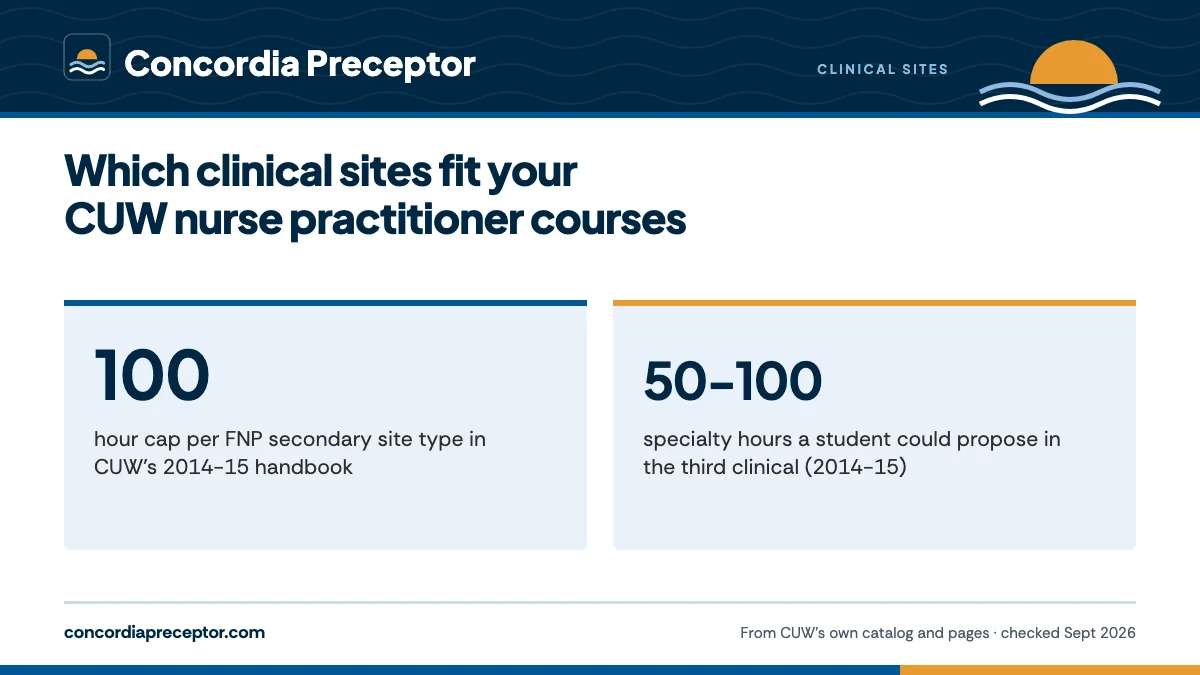
The 2014-15 handbook and CUW's undated proposal form, archived in 2023, put numbers on the exceptions. They are the most specific site limits CUW has ever published, so plan around them unless your course faculty give you newer figures.
| Setting | How the archived rules treated it |
|---|---|
| Traditional-medicine primary care practice | The expected main site for every clinical course |
| Specialty clinic | Not approved as a primary site; in the third clinical (APN III), a student could propose 50 to 100 specialty hours |
| FNP secondary sites: pediatrics, urgent care, women's health, geriatrics | Allowed, capped at 100 hours each across the whole program |
| Emergency department or inpatient unit | Not approved as a primary site |
| Your own department or unit at work | Not allowed; hours worked there did not count |
Two related caps belong to the preceptor rules: no more than two preceptors a semester without prior approval, and no more than 400 program hours with any single preceptor. The preceptor requirements guide covers both, and who cannot precept you explains the own-unit rule.
How each clinical course shifts the site you need
Each FNP and AGPCNP clinical carries 250 hours in CUW's February 2024 progression plans, and the 2026-27 catalog gives each course its own patient focus. Choosing a site for the course in front of you, rather than assuming one site covers all three, keeps the third clinical from turning into a last-minute scramble.
| Course | Catalog focus | Site profile that tends to fit |
|---|---|---|
NURS 7151 Clinical I - FNP | Episodic and chronic conditions through the adult lifespan; health promotion and prevention | Family or internal medicine practice with steady adult volume |
NURS 7152 Clinical II - FNP | Common problems across the life span in primary health care settings; community partnerships | Family practice or community clinic seeing all ages |
NURS 7153 Clinical III - FNP | Lifespan care with emphasis on pediatric and older adult patients and women's health | Family practice with children and older adults, plus limited pediatric or women's health hours |
NURS 7265 Clinical I - AGPCNP | Episodic and chronic conditions through the adult lifespan | Adult internal medicine or adult primary care |
NURS 7266 Clinical II - AGPCNP | Primary health care settings; community partnerships | Adult primary care practice with community ties |
NURS 7267 Clinical III - AGPCNP | The older adult in the outpatient setting | Geriatric or adult primary care clinic with many older patients |
The third column is our planning guide, not CUW policy. Post-BSN to DNP students follow the same logic: their residencies are titled Primary Care Clinical Residency, and the AGPCNP versions describe patients from adolescence through older adulthood. Hours by course are on the clinical hours page, and the residencies have their own DNP residency guide.
PMHNP students: mental health settings, fewer published rules
The primary-care-only rule comes from CUW's FNP and AGPCNP sources. CUW's PMHNP programs, the MSN, the PMHNP DNP and the PMHNP certificate, share three practicums: NURS 7510, NURS 7515 and NURS 7520. The catalog describes them as supervised clinical work with patients who have psychiatric disorders, moving on to complex disorders and then to patients and families with complex needs, across all ages.
CUW's PMHNP program pages describe where graduates practice: inpatient psychiatric units, outpatient behavioral health, integrated primary care, community mental health centers and telehealth. Those are natural places to look for practicum hours. Still, CUW's published rule is simply practicum hours in approved settings under qualifying supervision, and no CUW source states PMHNP preceptor credentials, setting caps or whether telehealth hours count.
Take those questions to the Graduate Clinical Coordinator before you commit. The PMHNP certificate page still uses the older title, Clinical Contract Coordinator, and says that role helps with the process while the responsibility for finding a placement stays with you.
Questions to settle with a site before you propose it
Before a proposal goes in, confirm that:
- Most visits are primary care (or, for PMHNP, psychiatric care) rather than specialty, urgent or inpatient work.
- The patient ages match your course, especially the pediatric, women's health and older adult emphasis in
NURS 7153and the older adults ofNURS 7267. - The volume is there. CUW's 2014-15 handbook expected about 5 to 8 patients a day by the midpoint of the first clinical.
- The site is outside your own unit at work, and the preceptor is neither your own nor a family member's health care provider.
- The site already has a clinical contract with CUW, or can start one early. The contracts guide explains the lead time.
- The site sits in a state where CUW's licensure disclosure lists your program.
Why CUW students choose us to match sites
We screen every site against the specific CUW course before it reaches you: the share of primary care visits, the ages the preceptor sees, and whether any specialty or secondary hours fit inside CUW's archived caps. For PMHNP students we look for psychiatric settings with a preceptor whose role fits the practicum, and we put the open questions to you before a proposal goes in.
We plan all three clinicals together, so a family practice with strong pediatric volume lands where NURS 7153 needs it, and we tell you at the outset whether a site will need a new CUW contract. If a preceptor steps away partway through, we line up a replacement that fits the same course. Your proposal reaches graduate faculty complete. See how it works, or send us your track and city.
Questions CUW students ask
Can FNP students at CUW do clinical hours in urgent care?
Some, under CUW's archived rules. The 2014-15 NP handbook listed urgent care as an FNP secondary site capped at 100 hours across the program, and it treated walk-in and urgent care practices as an exception to its primary care practice rule. The current catalog publishes no cap, so ask your course faculty how many urgent care hours they will approve before you book shifts.
Can a specialty clinic be my main CUW clinical site?
Under the 2014-15 handbook, no. Specialty clinics were not approved as primary sites, though a student in the third clinical (APN III in that handbook) could propose 50 to 100 specialty hours. CUW's 2022 blog kept the focus on community primary care. If a specialty preceptor is your only lead, line up a primary care site alongside it.
Does a hospital-based NP count as a primary care preceptor at CUW?
Not for your main site, going by CUW's published history. The 2022 blog said FNP and AGPCNP students have no clinical sites in the acute care setting, naming the hospital, ER and surgery, and the 2014-15 handbook excluded inpatient units and emergency departments as primary sites. An NP who also sees patients in an outpatient primary care clinic is a different question for your faculty.
Where do CUW PMHNP students complete practicum hours?
In approved mental health settings under qualifying supervision. CUW's PMHNP pages describe graduates working in inpatient psychiatric units, outpatient behavioral health, integrated primary care, community mental health centers and telehealth. CUW publishes no PMHNP-specific site caps or preceptor credentials, so the Graduate Clinical Coordinator and your course faculty confirm what fits each practicum.
Can AGPCNP students count hours with adolescent patients?
CUW's MSN AGPCNP course descriptions center on adults and, in NURS 7267, older adults in outpatient care. The Post-BSN to DNP's AGPCNP residencies describe patients from adolescence through older adulthood. If a site sees many teenagers, ask your course faculty how those encounters count for your track before you rely on them.
Related pages
Last checked 2026-09-26
We check these pages against CUW's own academic catalog, program pages and published nursing documents. Your course faculty and the Graduate Clinical Coordinator have the final word.
- Concordia University Wisconsin Academic Catalog 2026-2027: MSN Primary Care Nurse Practitioner
- Concordia University Wisconsin Academic Catalog 2026-2027: graduate NURS course descriptions
- Concordia University Wisconsin: MSN Adult-Gerontology Primary Care Nurse Practitioner
- Concordia University Wisconsin: MSN Psychiatric Mental Health Nurse Practitioner
- Concordia University Wisconsin blog: MSN Clinicals, What are they like? (2022)
CUW asks you to secure your preceptors. We make the search the easy part.
Tell us your CUW track, your city and your next clinical course. We line up preceptors who fit the NURS course, gather the license, board certification and site details CUW's graduate faculty review, and flag early whether the site needs a new clinical contract.
- Preceptors matched to the course: primary care for FNP and AGPCNP, mental health settings for PMHNP, an agency mentor for DNP projects
- Preceptor license, certification, CV and site details ready for CUW's approval
- All three clinical courses planned together, close to home in a state CUW's disclosure lists for your program
Start your placement plan
Track, city and next clinical course is all we need to begin.