Post-BSN DNP Primary Care Clinical Residencies I-III and the 1,008 hours
Concordia University Wisconsin's Post-BSN to DNP builds its clinical training into three Primary Care Clinical Residencies: NURS 8123 to NURS 8125 on the FNP track and NURS 8226 to NURS 8228 on the AGPCNP track. The program totals 1,008 hours: 750 of clinical practicum and 258 of leadership. Residency I carries 120 hours in CUW's February 2024 plan; how Residency II and III divide the rest is not published.
Get your placement plan
Tell us your CUW program and where you live. A placement advisor replies with the preceptor and site options that fit your course.
Six course numbers, one sequence
Each track has its own three residencies with the same credit pattern: a 1-credit Residency I, then two 5-credit courses. The FNP descriptions cover patients across the lifespan; the AGPCNP descriptions cover patients from adolescence through older adulthood. Each residency requires the one before it, and the catalog still accepts older numbers (NURS 923, NURS 924, NURS 926, NURS 927) as prerequisites.
| Residency | FNP track | AGPCNP track | Credits | Hours | Catalog focus |
|---|---|---|---|---|---|
| I | NURS 8123 | NURS 8226 | 1 | 120 | Comprehensive history and physical exams |
| II | NURS 8124 | NURS 8227 | 5 | Not published | Health promotion; acute and chronic conditions |
| III | NURS 8125 | NURS 8228 | 5 | Not published | Complex acute and chronic conditions; leadership and systems-based practice |
Residency III's description adds something the first two lack: leadership and systems-based practice with increasingly independent decision making. In practice, that calls for a preceptor willing to let you run visits from history to plan with growing independence.
How the 1,008 hours add up
On the total, catalog and program page agree: 1,008 hours, with the clinical practicum share at 750 and the leadership share at 258. The leadership share runs through the DNP Project Practicum Immersions and DNP Project courses, covered on the DNP project practicum page.
On the clinical side, only Residency I has a published figure. Taking its 120 hours from 750 leaves 630 for Residency II and III together, but that is subtraction, not a CUW statement, and CUW gives no split of the 630. Ask the Graduate Clinical Coordinator for the per-course targets before you and a preceptor commit to a fall or spring schedule.
The catalog adds a performance clause: a resident who needs more practice can be asked for hours beyond the minimum. Build a cushion into each residency instead of aiming for the bare number.
Only Residency I's 120 hours are published; get the Residency II and III targets from the Graduate Clinical Coordinator before scheduling.
The residency calendar in CUW's 2024 cohort plan
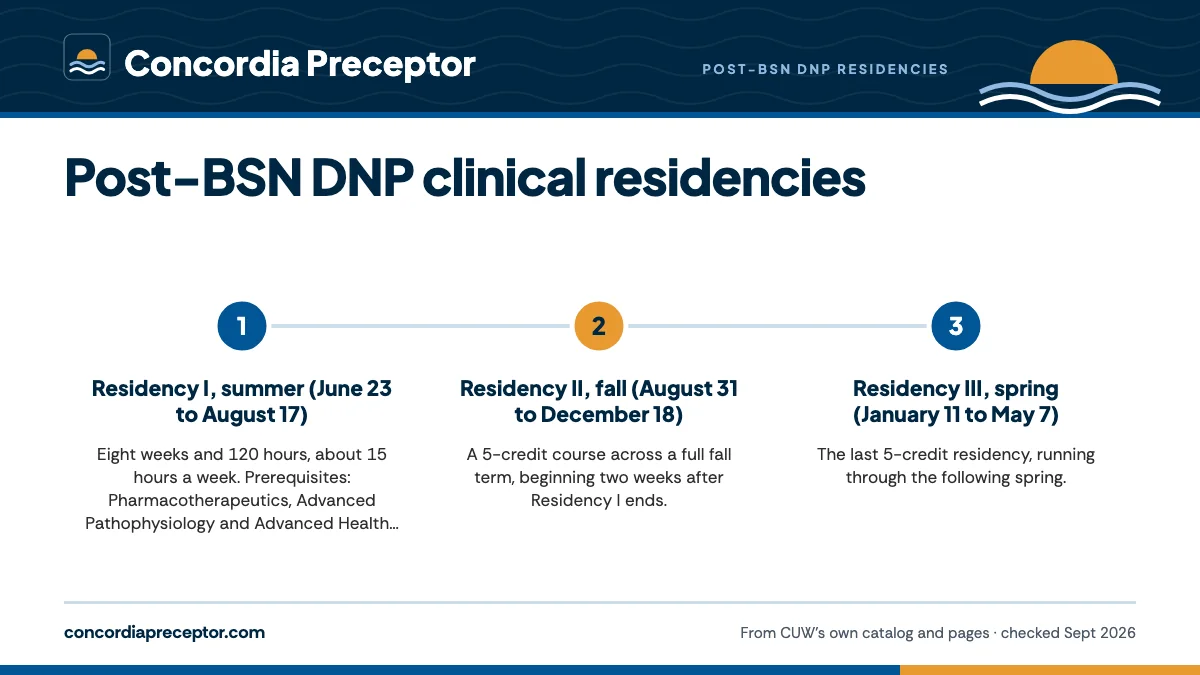
CUW's progression plan for the fall 2024 cohort shows how the three residencies line up after the primary care didactic courses (NURS 7110 to NURS 7112 for FNP, NURS 7220 to NURS 7222 for AGPCNP) and NURS 7013 Diagnostic Skills for APRN:
- Residency I, summer (June 23 to August 17)Eight weeks and 120 hours, about 15 hours a week. Prerequisites: Pharmacotherapeutics, Advanced Pathophysiology and Advanced Health Assessment (
NURS 6042,NURS 6036,NURS 6038). - Residency II, fall (August 31 to December 18)A 5-credit course across a full fall term, beginning two weeks after Residency I ends.
- Residency III, spring (January 11 to May 7)The last 5-credit residency, running through the following spring.
The two-week break between Residency I and II leaves little time for a new site to clear a contract, so keeping one site across summer and fall is often the simplest path. Dates shift by cohort, and CUW also posts a 4-year plan, so work from your own plan and the semester calendar.
Two meanings of "residency" at CUW
The word covers two different things. The Post-BSN DNP program page mentions a mandatory four-day on-campus residency, while the catalog lists a 2-3 day on-campus experience inside NURS 6038 Advanced Health Assessment, an orientation over Zoom before classes begin, and a closing cohort meeting on campus, timed with graduation, at which students present their DNP projects. Nothing CUW has published reconciles the four days with the catalog's figure.
None of that is the clinical residency. NURS 8123 to NURS 8125 and NURS 8226 to NURS 8228 are precepted courses in a primary care setting you secure near home. For the on-campus side, see the Health Assessment intensive page; for the courses on this page, the preceptor is the center of everything.
Preceptors, sites and states for the residencies
The Post-BSN DNP catalog uses CUW's standard graduate wording: you line up your own clinical preceptors, graduate faculty judge each one's appropriateness, and the Graduate Clinical Coordinator offers help along the way. The course titles settle the setting, since these are primary care residencies, and CUW's archived NP sources kept primary care students out of acute care as a main placement. The dated credential rules sit on the preceptor requirements page.
State eligibility is one place the DNP differs from the MSN. CUW's disclosure clears the Post-BSN DNP in every state it clears for the primary care MSN, Washington excepted, yet the Post-BSN DNP program page says Washington's nursing commission approved practice experiences there for both tracks. If a residency would fall in Washington, or anywhere outside Wisconsin, confirm with the Graduate Clinical Coordinator first; the licensure disclosures page has the table.
How the residencies took shape
The current structure is recent. In November 2020, CUW's program page split the program into a 720-hour NP Clinical Residency and 288 project hours of DNP Project Practicum. The 2021-22 catalog, the program's first listing, spoke of 1,000 leadership and practicum hours and gave each track two 5-credit residencies: NURS 935 then NURS 936 on the FNP side, NURS 937 then NURS 938 for AGPCNP.
The 2022-23 catalog returned to 1,008 hours and split the clinical work into three residencies of 1, 5 and 5 credits, and since 2023-24 the catalog has described the total as 750 clinical plus 258 leadership hours. The clinical hours history page traces the MSN changes that ran alongside.
Why Post-BSN DNP students plan their residencies with us
Three residencies across summer, fall and spring leave almost no slack between courses, so we plan them together from the start. We look for primary care preceptors near home who fit your track, FNP or AGPCNP, in states where CUW's disclosure lists the Post-BSN DNP as meeting requirements, and we favor sites able to host you across more than one residency when that fits CUW's rules.
Each proposal we build pairs the preceptor's credentials and certification with a clear picture of the practice, and we say early when a site will probably need a new contract. If a residency preceptor drops, your placement advisor goes straight to work on a successor, and we keep your DNP project mentor search in step with the clinical plan. Start with the form below or contact us.
Questions CUW students ask
Can I keep one preceptor for all three DNP residencies?
CUW's current pages set no limit, but its 2014-15 NP handbook capped hours with a single preceptor at 400 across a program and allowed two preceptors a semester without prior approval. With Residency II and III at 5 credits each, one preceptor could pass that old cap. Ask the Graduate Clinical Coordinator whether a limit applies to DNP residencies.
Is DNP Residency I only 8 weeks long?
In the fall 2024 cohort plan, yes: Residency I ran from June 23 to August 17, 120 hours across eight weeks. Later cohorts and the 4-year plan may differ, so check your own progression plan. A preceptor who can offer two full clinic days a week covers that pace with room to spare.
Do AGPCNP DNP students take NURS 7265 to 7267?
No. The Post-BSN DNP gives each track its own residencies: NURS 8226 to NURS 8228 for AGPCNP and NURS 8123 to NURS 8125 for FNP. MSN and CAGE students on the AGPCNP option take NURS 7265 to NURS 7267 instead, at 250 hours each in CUW's February 2024 plans.
What happens if I fall short of hours in a residency?
CUW's catalog says a Post-BSN DNP student may need to complete additional hours based on performance, and CUW's graduate grading rules give an incomplete a three-week window after the term closes, stretching to six in some cases. Each residency is the prerequisite for the next, so an open incomplete can hold up the whole sequence.
Do residency hours count toward the 258 leadership hours?
CUW counts them separately, and the leadership 258 sits outside the 750 clinical hours. The residencies are the clinical courses, while the leadership hours run through the DNP project courses with an agency mentor. The Post-BSN DNP page shows how both fit the 70-credit program.
Related pages
Last checked 2026-09-26
We check these pages against CUW's own academic catalog, program pages and published nursing documents. Your course faculty and the Graduate Clinical Coordinator have the final word.
- Concordia University Wisconsin 2026-27 catalog: Post BSN to DNP
- Concordia University Wisconsin 2026-27 catalog: graduate NURS course descriptions
- Concordia University Wisconsin: Post-BSN to DNP program page
- CUW Post BSN to DNP progression plan (Feb 2024)
- Concordia University Wisconsin: Distance Education Disclosures
CUW asks you to secure your preceptors. We make the search the easy part.
Tell us your CUW track, your city and your next clinical course. We line up preceptors who fit the NURS course, gather the license, board certification and site details CUW's graduate faculty review, and flag early whether the site needs a new clinical contract.
- Preceptors matched to the course: primary care for FNP and AGPCNP, mental health settings for PMHNP, an agency mentor for DNP projects
- Preceptor license, certification, CV and site details ready for CUW's approval
- All three clinical courses planned together, close to home in a state CUW's disclosure lists for your program
Start your placement plan
Track, city and next clinical course is all we need to begin.