NURS 9030-9032 DNP Project Practicum Immersion, NURS 9040 and 9041: your agency mentor
The leadership side of Concordia University Wisconsin's DNP runs through a health care agency you choose and a mentor inside it. Post-BSN DNP students take three 1-credit Project Practicum Immersions, NURS 9030 to NURS 9032, alongside NURS 9040 and NURS 9041, DNP Project I and II, the courses where the program's 258 leadership hours are earned. The PMHNP DNP and Post-MSN DNP use the two DNP Project courses without the immersions.
Get your placement plan
Tell us your CUW program and where you live. A placement advisor replies with the preceptor and site options that fit your course.
Five courses, in the order the prerequisites set
The prerequisites tell you the order. NURS 9040 DNP Project I has no printed prerequisite and is itself required for the first immersion, so the project starts in coursework before the agency work begins. Each immersion then requires the one before it, and NURS 9041 builds the capstone out of the immersion experience.
| Course | Credits | What the catalog describes | Prerequisites |
|---|---|---|---|
| NURS 9040 DNP Project I | 4 | Organizational needs assessment and quality improvement; practicum hours tied to the DNP Project | None printed |
| NURS 9030 DNP Project Practicum Immersion I | 1 | Work with a mentor from a selected health care agency as part of an interdisciplinary team | NURS 5040, NURS 8015 and NURS 9040 (or older equivalents) |
| NURS 9031 DNP Project Practicum Immersion II | 1 | Continued work with the agency mentor; project design | NURS 9030 |
| NURS 9032 DNP Project Practicum Immersion III | 1 | Implementation within the selected health care agency, with the mentor | NURS 9031 |
| NURS 9041 DNP Project II | 4 | Capstone derived from the practice immersion experience | NURS 9040 and NURS 8015 |
CUW publishes no hour split across these five courses. The catalog says only that DNP Project I includes practicum hours related to the project, so ask the Graduate Clinical Coordinator how your 258 hours should be spread before you agree on a schedule with a mentor.
Leadership hours differ by DNP program
CUW runs three DNP paths, and each counts its non-clinical hours differently. The table sets them side by side.
| Program | Leadership or residency hours | Project courses |
|---|---|---|
| Post-BSN DNP (FNP or AGPCNP) | 258 leadership, beside 750 clinical | NURS 9030-9032, NURS 9040, NURS 9041 |
| PMHNP DNP | At least 200 leadership, beside at least 500 psychiatric clinical | NURS 9040, NURS 9041 |
| Post-MSN DNP | Residency hours in areas of the student's choice; no number in the current catalog | NURS 9040, NURS 9041 |
The Post-MSN DNP is the open case. Its catalog entry describes residency work alongside preceptors or mentors, aimed at growing leadership ability and feeding the DNP Project. From 2019 until at least March 2025, its program page added a firmer rule: at least 500 residency hours in the program toward 1,000 total DNP hours, with at most 120 of them spent on indirect care away from the student's own practice.
The live page has dropped that note, so confirm the current rule before planning a residency. The Post-MSN DNP page has more.
Choosing the agency and the mentor
The immersion descriptions speak of a mentor from a selected health care agency, and the choice of agency is yours, subject to faculty approval. Because DNP Project I opens with an organizational needs assessment and quality improvement, the strongest agency is one with a real problem it wants studied and the access to let you study it: data, staff time and a leader willing to sponsor the work.
CUW publishes no minimum degree or title for the mentor. The undated DNP Residency Preceptor Proposal Form in CUW's archived form repository gives the clearest picture of what the school has asked for: the mentor's name and academic credentials, the site and its clinical administrator, and a list of duties. Your project faculty can tell you what the current version requires.
Mentor duties on CUW's archived DNP proposal form
- Help you set goals for the residency
- Guide the development of your leadership skills
- Meet with you regularly
- Stay in contact with CUW faculty
Logging project and leadership time
CUW's current pages name no system for DNP hours. The archived DNP forms show one approach: a combined Clinical Residency and Translational Research Project log where every line carried a letter, C for clinical time or T for project time, plus a Doctor of Nursing Practice Clinical Residency I and II Preceptor and Student Self-Evaluation rating DNP competencies. Those forms belong to an older course structure (DNP 930 and 931), so treat them as a model rather than today's rule.
One archived line deserves attention today. The 2022 version of the Post-MSN DNP page warned that faculty could reach out to your mentor whenever they chose to confirm the hours you logged. Keep your log current, dated and specific, and make sure your mentor recognizes every entry. The logs and evaluations page covers the clinical side.
From Zoom orientation to the final cohort meeting
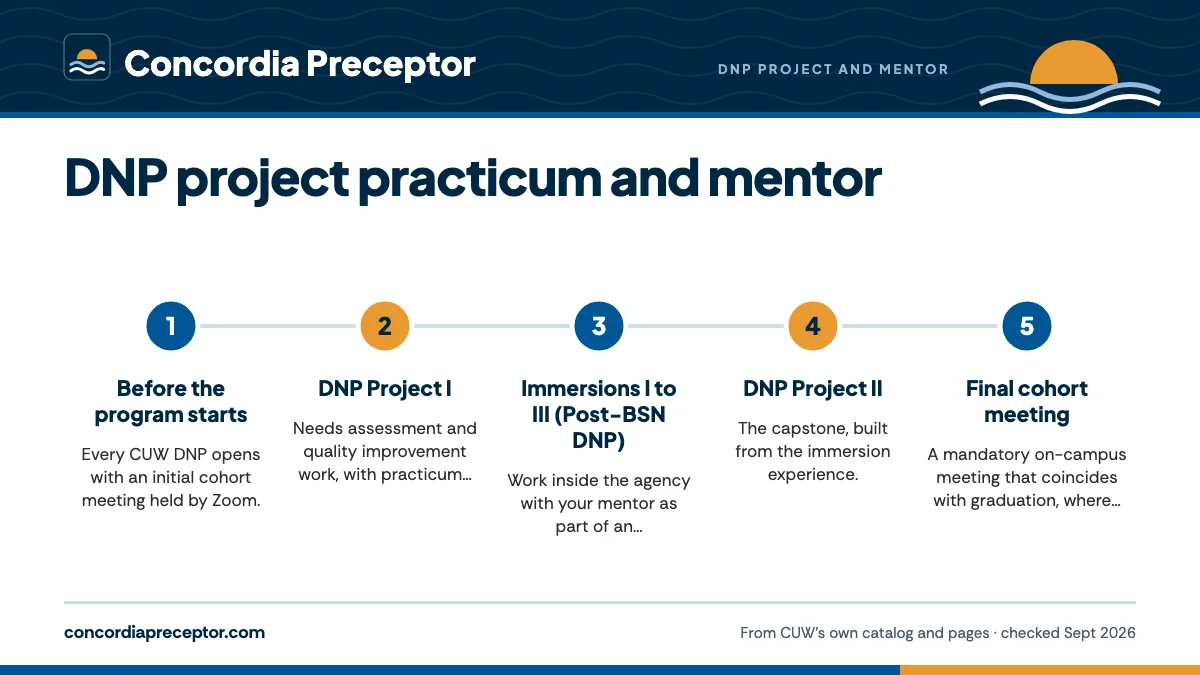
- Before the program startsEvery CUW DNP opens with an initial cohort meeting held by Zoom.
- DNP Project INeeds assessment and quality improvement work, with practicum hours tied to the project. Settle the agency and mentor during this course.
- Immersions I to III (Post-BSN DNP)Work inside the agency with your mentor as part of an interdisciplinary team, moving from project design to implementation.
- DNP Project IIThe capstone, built from the immersion experience.
- Final cohort meetingA mandatory on-campus meeting that coincides with graduation, where final DNP projects are presented.
Because the presentation happens at graduation, a mentor who leaves the agency mid-project can affect more than one course; it can move your finish. Name a second contact at the agency early, someone who knows the project and could step in.
How the project hours evolved
In November 2020, CUW's Post-BSN DNP page listed a DNP Project Practicum of 288 project hours. The 2021-22 catalog used four DNP Project Practicum courses, NURS 930 to NURS 933, and the 2022-23 catalog replaced them with three Project Practicum Immersions. Since 2023-24 the catalog has put leadership at 258 hours.
Traces of the older numbering remain: the catalog still accepts NURS 930 and NURS 931 as prerequisites for the second and third immersions. If you began under an earlier structure, ask the Graduate Clinical Coordinator how your completed project hours map onto the current courses. For the clinical half of the same program, see the DNP clinical residency page.
How we help with DNP project placements
Finding a health care agency with a real improvement need and a mentor willing to see a project through is its own search, separate from finding a clinical preceptor. We look for agencies near you whose leaders can sponsor a needs assessment and quality improvement project, and we collect the mentor's credentials, role and site details so your proposal reaches CUW's faculty complete.
We brief each mentor on the duties set out in CUW's archived DNP form (goal setting, regular meetings, contact with faculty) so expectations are clear from the first conversation. For Post-BSN DNP students, we plan the agency search alongside your three clinical residencies, and if a mentor steps away mid-project, your placement advisor moves quickly to find someone new. Use the form below or send a message.
Questions CUW students ask
Does my DNP agency mentor have to be a nurse?
CUW publishes no rule on the mentor's profession or degree. Its archived DNP proposal form asked for the mentor's academic credentials so faculty could judge the fit, and the catalog speaks of preceptors or mentors who help build leadership skills. Ask your DNP project faculty before approaching a mentor from another discipline.
Can I do my DNP project at my own employer?
No CUW source addresses this for DNP projects. The archived NP clinical rules allowed the same employer but not your own unit, and the 2022 Post-MSN DNP page capped indirect care outside your current practice at 120 hours, which suggests some residency work could sit inside your own practice. Confirm with the Graduate Clinical Coordinator; see the workplace page.
How many hours is each DNP Project Practicum Immersion?
CUW has not published the split. The Post-BSN DNP catalog sets 258 leadership hours in total; the three immersions carry 1 credit each, DNP Project I and II carry 4 credits each, and DNP Project I includes practicum hours tied to the project. Ask the Graduate Clinical Coordinator for your per-course targets.
Do Post-MSN DNP students take NURS 9030 to 9032?
No. The Post-MSN DNP's 30 credits include NURS 9040 and NURS 9041 but none of the immersion courses. Its residency hours are completed in areas of the student's choice, working with preceptors or mentors. The PMHNP DNP likewise uses the two DNP Project courses without the immersions.
Where are final DNP projects presented?
At the final cohort meeting, a mandatory on-campus event that coincides with graduation. CUW's catalog lists it for the Post-BSN DNP, the Post-MSN DNP and the PMHNP DNP, along with the initial Zoom orientation. Plan your travel to campus for that meeting well ahead, and keep your mentor informed of the date.
Related pages
Last checked 2026-09-26
We check these pages against CUW's own academic catalog, program pages and published nursing documents. Your course faculty and the Graduate Clinical Coordinator have the final word.
- Concordia University Wisconsin 2026-27 catalog: graduate NURS course descriptions
- Concordia University Wisconsin 2026-27 catalog: Post BSN to DNP
- Concordia University Wisconsin 2026-27 catalog: Doctor of Nursing Practice (Post-MSN and PMHNP DNP)
- Concordia University Wisconsin: Post-MSN DNP, 2025 archived copy with the residency-hour note
- CUW DNP Residency Preceptor Proposal Form (archived copy)
CUW asks you to secure your preceptors. We make the search the easy part.
Tell us your CUW track, your city and your next clinical course. We line up preceptors who fit the NURS course, gather the license, board certification and site details CUW's graduate faculty review, and flag early whether the site needs a new clinical contract.
- Preceptors matched to the course: primary care for FNP and AGPCNP, mental health settings for PMHNP, an agency mentor for DNP projects
- Preceptor license, certification, CV and site details ready for CUW's approval
- All three clinical courses planned together, close to home in a state CUW's disclosure lists for your program
Start your placement plan
Track, city and next clinical course is all we need to begin.