CUW's Post-MSN DNP: residency hours you choose, a mentor you secure
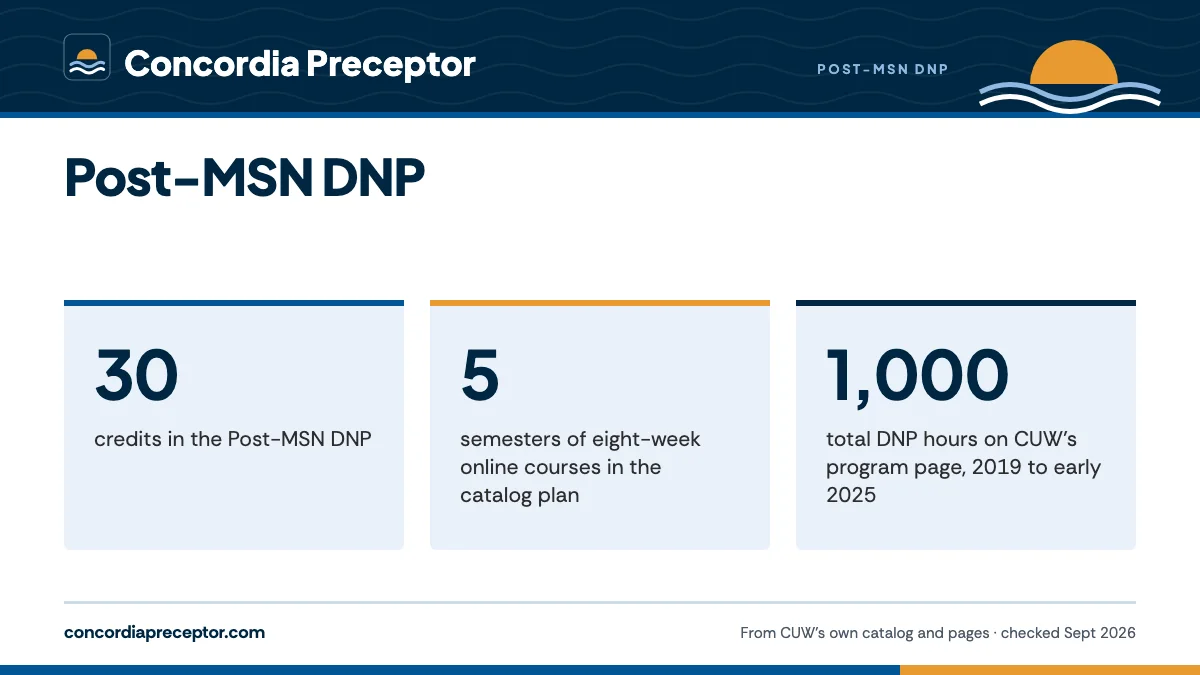
Concordia University Wisconsin's Post-MSN DNP is a 30-credit online doctorate for APRNs and advanced nurse administrators. Its field work is the residency: the 2026-27 catalog has you working with preceptors or mentors on leadership skills and your DNP Project, in areas of your choice. CUW's page long set that at 500 in-program hours toward 1,000 in total; today's page prints no number, so faculty give you yours.
Find your residency mentor
Tell us your project idea, your MSN hours and your state. Your placement advisor replies with agencies and mentors that fit.
What the residency is for
The Post-MSN DNP has no clinical courses of the MSN kind and none of the Project Practicum Immersions that the Post-BSN DNP uses. Its field work is the residency, which the catalog describes as experiential learning with preceptors or mentors, aimed at leadership skills and at the DNP Project you build in NURS 9040 DNP Project I and finish in NURS 9041 DNP Project II.
That turns the mentor into a project decision as much as a scheduling one. The residency hours feed the project, and the project is what you present at the final cohort meeting on campus. A mentor inside an organization with a live quality, safety or access problem gives you something real to assess, change and measure.
The rest of the 30 credits is coursework: NURS 8003, NURS 8010, NURS 8015 and NURS 8021, plus three business courses, BUS 5100, BUS 5610 and BUS 5840.
The 1,000-hour rule, then and now
The figure most Post-MSN DNP students hear is 1,000, and it came from CUW itself. The current sources are quieter, as the table shows.
| Source | What it says |
|---|---|
| 2026-27 catalog | Residency hours in areas of your choice; no number given |
| Current program page | No hour count |
| Program page, 2019 to March 2025 | At least 500 residency hours in the program to reach the 1,000 required DNP hours |
| Same page, same years | Of those 500, no more than 120 in indirect patient care outside your current practice |
| Current admission rule | Documentation of the faculty-supervised clinical hours you completed in your MSN |
Admission still asks for your MSN's supervised hours, but the in-program minimum is no longer printed. Ask your faculty advisor or the Graduate Clinical Coordinator for your number before you promise a mentor a schedule.
Working out your own hour target
Start from the document that records your MSN clinical hours. Under the 2019 to 2025 rule those hours counted toward the 1,000, and the program added at least 500 of its own. Anyone whose MSN documented fewer than 500 supervised hours would have needed more than 500 in the program to close the gap.
Backgrounds vary widely in this cohort. CUW admits NPs, CNSs, CNMs and CRNAs as well as advanced nurse administrators, and a master's from another school, or from CUW in an earlier era, may carry a different documented count. CUW's own MSN asked for 600 hours in its 2013-15 handbooks and 720 across the 2020-21 and 2021-22 catalogs before settling at 750.
Faculty check residency hours, too. CUW's 2022 page said faculty may contact the mentor at any time to verify them, and the undated DNP residency log coded each entry as clinical (C) or translational project (T). Keep the log current from the first week, and see clinical logs and evaluations for the archived forms.
Choosing an agency mentor
No CUW source sets a minimum degree or job title for a Post-MSN DNP mentor. The best guide is its undated DNP Residency Preceptor Proposal Form, written for an older version of the doctorate. It recorded the proposed preceptor's academic background, identified the host site and its clinical administrator, and spelled out the mentor's role: helping you set goals, guiding your growth as a leader, meeting with you on a regular basis and staying in contact with CUW faculty.
Settle these before you propose a mentor
- Does the organization have a problem your DNP Project can address, and will its leaders let you gather data on it?
- Can the mentor stay with you across several eight-week courses, from needs assessment to implementation?
- Does the site already hold a clinical contract with CUW, or does one need to start now? Our clinical contracts page explains the wait.
- Will the mentor sign off on hours and take a faculty call to confirm them?
- Is the residency in a state where CUW's disclosure lists the Post-MSN DNP?
The cohort calendar
The program runs as an online cohort in eight-week courses across five semesters, and CUW says it can be finished in two years. A cohort is admitted each spring for an August start, with a July 1 priority deadline; that date was March 1 in 2020-21 and moved later each year until 2023-24.
The program page calls the classes fully online, and the catalog adds two fixed meetings: an orientation by Zoom before the program starts, and a mandatory closing cohort meeting, held on campus as you graduate, at which you present your DNP Project. The first meeting was held on the Mequon campus through 2023-24 and moved to Zoom in 2024-25, although the program page captured in March 2025 still said on campus. Follow the catalog and your admission materials.
Today's catalog prints no completion limit for this doctorate; the 2020-21 edition set a two-year time frame. If work or family stretches your plan, confirm the current policy with your advisor.
States, licenses and the North Dakota gap
CUW's disclosure marks the Post-MSN DNP as meeting requirements in 25 states: the MSN primary care list without North Dakota, a state both the MSN and Post-BSN DNP tables include. Washington stays in, and the program page names Washington's Nursing Care Quality Assurance Commission as having approved practice experiences in that state for this doctorate. The licensure disclosures page has the full table.
Admission calls for an unencumbered RN license in your state of residence. If your residency sits outside Wisconsin, the catalog makes you responsible for confirming the program meets that state's requirements; the clinicals outside Wisconsin guide covers what that involves.
The list has moved before. In 2022 the program page named the states it was not taking Post-MSN DNP students from and sent Washington, D.C. residents to Virginia for clinical work. Current pages point only to the disclosure, so check it again the term you apply.
How our desk sets up a Post-MSN residency
Residency hours in areas of your choice give you wide room, and the securing is still yours. Our placement desk starts from your project idea and your hour target, then finds an agency and a mentor who fit both.
- Organizations near you whose needs match your project topic, from primary care practices to health system departments
- A mentor with the academic credentials and the time CUW's faculty look for, briefed on the logging and verification ahead
- An early flag if the agency will need its first clinical contract with CUW
- A second option ready if your first mentor changes roles partway through the project
Send your project topic, your documented MSN hours and your state using the form below; a residency plan comes back from your placement advisor. The full sequence is on how it works.
Questions CUW students ask
Is CUW's Post-MSN DNP open to CRNAs, CNMs and nurse administrators?
Yes. The catalog admits master's-prepared nurses with APRN certification as an NP, CNS, CNM or CRNA, and it is the one current CUW doctorate open to advanced nurse administrators. Certified NPs after a psychiatric specialty have a separate route, the PMHNP DNP, which carries its own clinical hours.
Can I do Post-MSN DNP residency hours where I already work?
CUW's current pages say only that residency hours are in areas of your choice. The page used from 2019 to early 2025 limited indirect patient care done outside your current practice to 120 hours of the 500 earned in the program. Ask faculty how that limit reads now, and whether your own unit counts, before you build the residency around your employer.
Does the Post-MSN DNP include the Project Practicum Immersion courses?
No. NURS 9030 to NURS 9032 belong to the Post-BSN to DNP. The post-master's curriculum carries project work through NURS 9040 and NURS 9041, with residency hours supporting the project alongside. If you are weighing the two doctorates, the Post-BSN to DNP page shows how its 258 leadership hours are organized.
How long does CUW's Post-MSN DNP take?
The catalog lays out five semesters of eight-week online courses, and CUW's page says the degree can be done in two years. The cohort begins in August after a spring admission, with a July 1 priority deadline. Residency hours run alongside the courses, so line up your mentor before the first semester opens.
Can I complete Post-MSN DNP residency hours in North Dakota?
CUW's disclosure marks North Dakota as not meeting requirements for the Post-MSN DNP, although the MSN and Post-BSN DNP tables list it as meeting them. No reason is printed. If you live there, put the question to the Graduate Clinical Coordinator before you apply or plan a residency, and keep the answer in writing.
Related pages
Last checked 2026-09-26
We check these pages against CUW's own academic catalog, program pages and published nursing documents. Your course faculty and the Graduate Clinical Coordinator have the final word.
- Concordia University Wisconsin Academic Catalog 2026-2027: Doctor of Nursing Practice
- Concordia University Wisconsin: Doctor of Nursing Practice (post-master's) program page
- Concordia University Wisconsin: DNP program page as captured March 2025 (Wayback Machine)
- Concordia University Wisconsin: DNP Residency Preceptor Proposal Form, undated (Wayback Machine)
- Concordia University Wisconsin: Distance Education Disclosures
CUW asks you to secure your preceptors. We make the search the easy part.
Tell us your CUW track, your city and your next clinical course. We line up preceptors who fit the NURS course, gather the license, board certification and site details CUW's graduate faculty review, and flag early whether the site needs a new clinical contract.
- Preceptors matched to the course: primary care for FNP and AGPCNP, mental health settings for PMHNP, an agency mentor for DNP projects
- Preceptor license, certification, CV and site details ready for CUW's approval
- All three clinical courses planned together, close to home in a state CUW's disclosure lists for your program
Start your placement plan
Track, city and next clinical course is all we need to begin.