CUW's Post-BSN to DNP: three residencies, an agency mentor, 1,008 hours
Concordia University Wisconsin's Post-BSN to DNP takes a BSN-prepared RN to the FNP or AGPCNP role and a doctorate in 70 credits. The 2026-27 catalog counts 1,008 field hours: 750 in primary care clinical residencies and 258 in leadership work with an agency mentor. You secure the preceptors and the mentor, graduate faculty approve them, and our desk plans the whole set as one search.
Plan your DNP residencies
Share your track, your city and your cohort year. Your placement advisor maps the residencies and the agency mentor together.
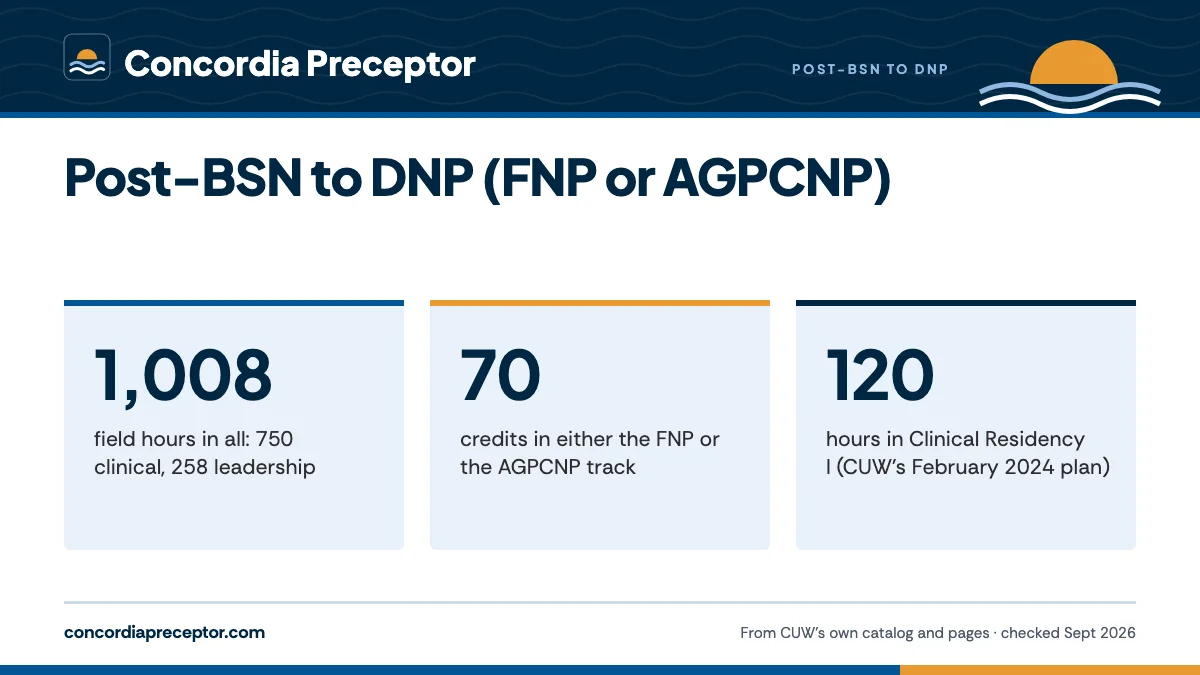
How the 1,008 hours break down
CUW's catalog and its program page give the same total: 1,008 hours, of which 750 are clinical practicum hours and 258 are leadership hours. The clinical share lives in three Primary Care Clinical Residencies. The leadership share runs through three DNP Project Practicum Immersions and the two DNP Project courses.
| Piece | FNP track | AGPCNP track | Credits | Hours |
|---|---|---|---|---|
| Clinical Residency I | NURS 8123 | NURS 8226 | 1 | 120 |
| Clinical Residency II | NURS 8124 | NURS 8227 | 5 | not published |
| Clinical Residency III | NURS 8125 | NURS 8228 | 5 | not published |
| Project Practicum Immersion I to III | NURS 9030, NURS 9031, NURS 9032 | same courses | 1 each | share of the 258 |
| DNP Project I and II | NURS 9040, NURS 9041 | same courses | 4 each | project practicum hours, count not published |
Take Residency I away from the 750 and 630 clinical hours remain for Residencies II and III together. CUW prints no split between those two, so ask your course faculty before you tell a preceptor how many hours a given semester will need.
The three primary care residencies, one at a time
NURS 8123 (FNP) and NURS 8226 (AGPCNP) open the sequence with one credit and 120 hours. The catalog builds the course around comprehensive history and physical exams: across the lifespan for FNP, from adolescence through older adulthood for AGPCNP. Pharmacology (NURS 6042), pathophysiology (NURS 6036) and Advanced Health Assessment (NURS 6038) come first.
Residency II (NURS 8124 or NURS 8227) turns to health promotion and acute and chronic conditions. Residency III (NURS 8125 or NURS 8228) adds complex cases, leadership, systems-based practice and more independent clinical decisions. Each residency lists the one before it as a prerequisite, so a lost semester in one pushes back the rest.
Ahead of the residencies sit the track's didactic series, NURS 7110, NURS 7111 and NURS 7112 for FNP or NURS 7220, NURS 7221 and NURS 7222 for AGPCNP, plus the diagnostics course NURS 7013. The setting rule is the one CUW applies to its MSN primary care tracks; our primary care sites guide covers what qualifies.
Residency I is short, yet it is a full clinical: it needs an approved preceptor and a site with a contract in place before you see a patient.
The 258 leadership hours and your agency mentor
The immersions are where this doctorate parts ways with the MSN. In NURS 9030 you join an interdisciplinary team under a mentor at a health care agency you select; in NURS 9031 the two of you design the project; in NURS 9032 you carry it out inside that agency. NURS 9040 adds practicum hours tied to the project and an organizational needs assessment, and NURS 9041 is the capstone drawn from the immersion.
In practice you recruit two kinds of people: primary care preceptors for 750 clinical hours, and an agency mentor able to host a quality improvement project across several semesters. An undated CUW form from an earlier version of the doctorate, the DNP Residency Preceptor Proposal Form, captured the mentor's degrees and credentials, named the site's clinical administrator, and described a mentor who helps shape goals, coaches leadership, meets on a schedule and keeps CUW faculty informed.
Use that form as a picture of what faculty look for, and get the current paperwork from your course faculty. The split of the 258 hours across the five courses is unpublished; the DNP project practicum page tracks what is known.
When each piece lands
The program admits in fall only, with applications due July 1. The catalog lays out eight semesters on a three-year plan, while the program page says three to four years (a 2022 capture said three to five). Every requirement has to be finished within five years of your first course.
CUW's progression plan for its fall 2024 cohort shows the clinical rhythm: Residency I in an eight-week summer window (June 23 to August 17), Residency II through the fall (August 31 to December 18) and Residency III through the spring (January 11 to May 7). Your own plan sets your dates, but the pattern tells you when each preceptor has to be confirmed.
The on-campus piece is described two ways. The program page names a mandatory four-day on-campus residency; the catalog lists a 2-3 day hands-on experience inside NURS 6038, an orientation held over Zoom before classes begin, and a closing cohort gathering on campus timed with graduation, where DNP projects are presented. Read the health assessment intensive page and confirm the days with the program before you book travel.
Where you can do residencies
CUW's Distance Education Disclosure counts 25 states where the Post-BSN to DNP meets requirements: the 26 on the MSN primary care list, minus Washington. The program page, though, says CUW holds approval from Washington's Nursing Care Quality Assurance Commission for practice experiences in both DNP tracks. Washington residents should ask the Graduate Clinical Coordinator to confirm in writing before planning clinicals; the licensure disclosures page sets out the full table.
An unencumbered RN license is required for the whole program. For residencies outside Wisconsin, the catalog leaves it to you to check that the program qualifies under that state's rules. Inside Wisconsin, the state's nursing code (N 1.08(6)) expects clinical preceptors to be licensed or privileged in Wisconsin without restriction, at or above your target licensure level.
Compliance items run alongside the search: the Castle Branch background check CUW calls for at acceptance, CPR that stays current, whatever vaccinations each site demands, and CUW's Student Responsibilities Agreement.
How our desk runs a 1,008-hour search
A DNP search has two tracks on two different clocks, and our desk builds both at intake. Your placement advisor looks for primary care preceptors who can carry you through Residencies I to III and, at the same time, an agency whose leaders have a project need and someone willing to mentor it.
What your placement advisor lines up
- Primary care preceptors who fit your track, FNP across the lifespan or AGPCNP from adolescence up, near home and in a state on CUW's Post-BSN DNP list
- License, board certification, CV and practice details for each preceptor, ready for graduate faculty review
- An early answer on whether CUW already holds a clinical contract with each site, since patient care waits for one
- An agency mentor whose organization has a real improvement need, with the credentials CUW's faculty will ask about
- A backup search the moment a preceptor steps away mid-residency, to protect the prerequisite chain
Use the form below to send your track, city and cohort year; a placement advisor then maps the residencies and the mentor side by side. How it works walks through each step.
Questions CUW students ask
Is the Post-BSN to DNP clinical load different from CUW's MSN FNP?
The clinical total matches: 750 hours in primary care. The shape differs. The MSN spreads them over three 4-credit clinicals of 250 hours each, while the DNP uses residencies of 1, 5 and 5 credits, with 120 hours in the first. The DNP then adds 258 leadership hours and a project hosted by an agency mentor.
How has the Post-BSN to DNP hour structure changed over the years?
CUW's 2020 program page described 720 hours of NP residency and another 288 of project work. The 2021-22 catalog listed two 5-credit residencies and four project practicums. In 2022-23 it moved to three residencies and three immersions, and from 2023-24 the split has read 750 clinical and 258 leadership, with the total still 1,008.
What if I need more clinical hours than the minimum?
The catalog cautions that your performance can mean extra hours beyond the minimum. Leave slack in your preceptor's schedule instead of booking the bare minimum, and talk to course faculty early if an evaluation points to extra time. Our desk can add a second site when the first cannot stretch.
Can I start CUW's Post-BSN to DNP in the spring?
The current catalog lists a fall start only, with applications due July 1. CUW's 2024 cohort plan put Residency I in a summer session, so the first preceptor search has a fixed target. Starting a semester early covers the weeks a brand-new clinical contract can take.
Does my DNP residency preceptor have to be a nurse practitioner?
CUW's present-day pages list no credentials for residency preceptors. For NP students, the 2014-15 handbook let NPs, PAs, CNMs, MDs and DOs precept, provided 50 or more program hours were with an NP, and the 2022 FAQ asked for two years of experience, a license and board certification. Confirm today's rule with faculty; see preceptor requirements.
Related pages
Last checked 2026-09-26
We check these pages against CUW's own academic catalog, program pages and published nursing documents. Your course faculty and the Graduate Clinical Coordinator have the final word.
- Concordia University Wisconsin Academic Catalog 2026-2027: Post BSN to DNP
- Concordia University Wisconsin: Post-BSN to DNP program page
- Concordia University Wisconsin: Post BSN to DNP Progression Plan (PDF, February 2024)
- Concordia University Wisconsin Academic Catalog 2026-2027: Graduate NURS courses
- Concordia University Wisconsin: Distance Education Disclosures
CUW asks you to secure your preceptors. We make the search the easy part.
Tell us your CUW track, your city and your next clinical course. We line up preceptors who fit the NURS course, gather the license, board certification and site details CUW's graduate faculty review, and flag early whether the site needs a new clinical contract.
- Preceptors matched to the course: primary care for FNP and AGPCNP, mental health settings for PMHNP, an agency mentor for DNP projects
- Preceptor license, certification, CV and site details ready for CUW's approval
- All three clinical courses planned together, close to home in a state CUW's disclosure lists for your program
Start your placement plan
Track, city and next clinical course is all we need to begin.