CUW's MSN AGPCNP: 750 hours of adult and older-adult primary care
Concordia University Wisconsin's online MSN Adult-Gerontology Primary Care Nurse Practitioner runs 41 credits, with a 750-hour clinical minimum spread evenly over NURS 7265, NURS 7266 and NURS 7267. The AGPCNP page says it outright: identifying preceptors and clinical sites is your responsibility, and CUW's nursing faculty review and approve them. The last course centers on older adults in outpatient care, so your final preceptor needs a practice full of them.
Get your placement plan
Tell us your CUW program and where you live. A placement advisor replies with the preceptor and site options that fit your course.
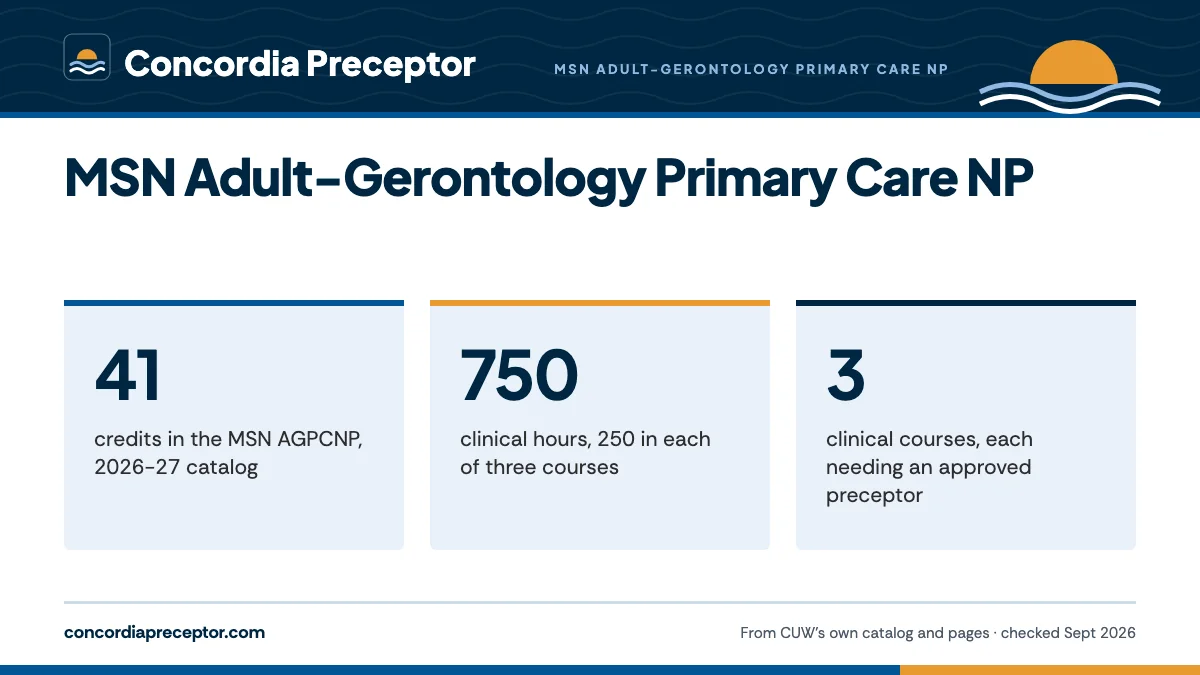
The AGPCNP track at a glance
The AGPCNP and the FNP sit side by side in CUW's 2026-27 catalog and share one frame: 41 credits, online courses with required on-campus pieces, and three 4-credit clinicals. The difference is the patient population. CUW's AGPCNP course descriptions speak of the adult lifespan and of older adults, and its doctoral AGPCNP residencies frame the population as adolescence through older adulthood.
You apply with a BSN and an RN license, and CUW's AGPCNP page asks for a brief video introduction recorded and submitted through the Future Falcon application. The catalog's deadlines are July 1 for fall entry and November 1 for spring entry. The progression plans run three to four years from a fall start, and the catalog sets a five-year ceiling for finishing.
The same page lists clinical placement review and approval among the supports CUW gives AGPCNP students. Read that as the faculty side of the process: you bring the preceptor and site, CUW checks that they fit, and the Graduate Clinical Coordinator is there to help when the process stalls.
Clinical courses, hours and focus
Clinical I waits on the three advanced foundation courses in pathophysiology, health assessment and pharmacotherapeutics; each later course needs the one before it. One catalog quirk is worth knowing: the Clinical II description repeats the FNP wording about problems across the life span. The track's population still applies, so plan adult and older-adult caseloads for all three courses.
The catalog gives only the 750-hour total. The even 250-hour split comes from CUW's progression plans, which label each clinical an 8-week course; the catalog grid leaves them untagged. Ask your faculty which length your section runs, because it decides whether your preceptor needs to offer two clinic days a week or closer to four.
| Course | Credits | Hours | Catalog focus |
|---|---|---|---|
NURS 7265 Advanced Primary Care Clinical I - AGPCNP | 4 | 250 | Episodic and chronic conditions throughout the adult lifespan |
NURS 7266 Advanced Primary Care Clinical II - AGPCNP | 4 | 250 | Primary health care settings and prevention through community partnerships |
NURS 7267 Advanced Primary Care Clinical III - AGPCNP | 4 | 250 | The older adult in the outpatient setting |
What an AGPCNP preceptor practice looks like
CUW's AGPCNP page names the setting plainly: approved adult or gerontology primary care. Internal medicine groups, adult primary care clinics and geriatric primary care practices are the natural fits. A family practice can work too when most of the patients you would see are adults.
Some settings that suit FNP students suit you less. Pediatric clinics fall outside the AGPCNP population, and a women's health practice built around younger patients adds little for Clinical III. Acute care is out for both primary care tracks: a 2022 CUW blog post about MSN clinicals excluded hospitals, emergency departments and surgery. The dated site rules are on primary care sites.
Leave the most lead time for the older-adult course. It has the narrowest setting of the three, and a practice new to CUW may need a clinical contract before your first day there. Beginning that search while you are still in Clinical I gives the paperwork time to catch up.
Preceptor credentials, with dates
Today's catalog hands approval to graduate faculty and publishes no checklist, so the older documents fill in the picture. CUW's MSN FAQ from 2022 set two years in clinical practice as the bar, along with a state license and board certification. Back in 2014-15, the NP handbook opened the role to nurse practitioners, physician assistants, certified nurse midwives and physicians who had practiced for a year or more, required national certification of everyone but the physicians, and wanted 50 or more of the student's hours spent with an NP.
That handbook also held each preceptor to 400 program hours at most and allowed two preceptors a semester without extra approval, so the 750 hours were never meant to rest on one clinician. It kept students away from clinicians who treat them or their relatives, and off their own work unit. Where the one-year and two-year figures conflict, propose someone who clears two and let the Graduate Clinical Coordinator confirm.
Wisconsin sets its own floor for placements inside the state. Under N 1.08(6) of its nursing rules, a preceptor needs an unencumbered license or practice privilege in Wisconsin at the NP level or higher, plus the school faculty's approval. The complete list lives on CUW's preceptor rules page.
Timeline, intensive and state checks
The catalog's sample plan puts Advanced Health Assessment in semester four and the three clinicals in semesters five, seven and eight. The AGPCNP page describes a required three-day on-campus intensive in Mequon for that course and an online orientation lasting one day at entry; the catalog calls the campus piece 2-3 days.
CUW's current pages post no proposal deadline or contract lead time. CUW's archived proposal form wanted fresh paperwork every semester for every preceptor and site, filed at least four weeks before clinicals began, while its 2014-15 handbook allowed eight to twelve weeks for a contract with a new site. How contracts work, and why no patient care starts without one, is on clinical contracts.
Out of state, the catalog makes the eligibility check yours. CUW's disclosure table for the primary care NP master's lists 26 states as meeting requirements, and the AGPCNP page notes approval from Washington's Nursing Care Quality Assurance Commission for practice experiences there.
Why AGPCNP students choose our placement desk
Our search is built around the adult-gerontology population. We look for internal medicine and adult primary care practices near home for Clinicals I and II, and we start early on a practice with a strong older-adult caseload for NURS 7267. Every preceptor file carries the documents CUW's nursing faculty weigh (license, certification, CV and a description of the practice), so approval can move as soon as the proposal lands.
We also find out whether the practice already holds a clinical contract with CUW, so any new agreement can start weeks before your semester does, and we stay on call through all three courses in case a preceptor has to step away. Tell us your start term and city in the form below, and your placement advisor replies with a plan.
Questions CUW students ask
How many clinical hours does CUW's AGPCNP require?
At least 750 under the 2026-27 catalog, which CUW's February 2024 progression plans split evenly: 250 each in NURS 7265, NURS 7266 and NURS 7267. Catalogs through 2021-22 required 720, at 240 a course, under the older MSN 865-867 and NURS 765-767 numbers. The total rose to 750 in the 2022-23 catalog.
Can an AGPCNP student train in a family practice?
It can work when the patients you see are mainly adults and older adults and CUW's faculty approve the site. A family practice with a large adult panel suits Clinicals I and II well. Ask your course faculty before counting pediatric visits, since the AGPCNP population runs from adolescence through older adulthood.
How is the MSN AGPCNP different from the Post-BSN DNP AGPCNP track?
The doctoral route covers the same population through different courses: Primary Care Clinical Residencies NURS 8226 to NURS 8228 plus leadership immersions, for 1,008 hours in total. The MSN's three 250-hour clinicals are the shorter path to the same NP role. The Post-BSN to DNP guide lays out the doctoral hours.
Does CUW help AGPCNP students find preceptors?
The AGPCNP page lists clinical placement review and approval among its student supports, and the catalog names the Graduate Clinical Coordinator as a source of help. The search itself belongs to the student, which is where our placement desk takes over the calls, the credential gathering and the contract check.
Can I do AGPCNP clinicals where I work?
Possibly, in a different unit or clinic. CUW's 2022 FAQ accepted employer sites meeting its credential rules, and the 2014-15 handbook drew the line only at your own department or unit. CUW's 2022 blog added that working for a health system brings no automatic placement there, so the site still needs a willing preceptor and approval.
Related pages
Last checked 2026-09-26
We check these pages against CUW's own academic catalog, program pages and published nursing documents. Your course faculty and the Graduate Clinical Coordinator have the final word.
- Concordia University Wisconsin Academic Catalog 2026-27: MSN Nurse Practitioner
- Concordia University Wisconsin: MSN Adult-Gerontology Primary Care Nurse Practitioner
- Concordia University Wisconsin Academic Catalog: graduate NURS course descriptions
- Concordia University Wisconsin: MSN NP progression plan, 3-year fall start (2024)
- Concordia University Wisconsin blog: MSN clinicals, what are they like? (2022)
CUW asks you to secure your preceptors. We make the search the easy part.
Tell us your CUW track, your city and your next clinical course. We line up preceptors who fit the NURS course, gather the license, board certification and site details CUW's graduate faculty review, and flag early whether the site needs a new clinical contract.
- Preceptors matched to the course: primary care for FNP and AGPCNP, mental health settings for PMHNP, an agency mentor for DNP projects
- Preceptor license, certification, CV and site details ready for CUW's approval
- All three clinical courses planned together, close to home in a state CUW's disclosure lists for your program
Start your placement plan
Track, city and next clinical course is all we need to begin.