NURS 7265 Advanced Primary Care Clinical I - AGPCNP: your first 250 hours
NURS 7265 Advanced Primary Care Clinical I - AGPCNP opens the clinical half of Concordia University Wisconsin's adult-gerontology primary care NP track: 4 credits and, per CUW's February 2024 progression plans, 250 supervised hours with adult patients. You find and secure the preceptor and site, CUW's graduate faculty approve them, and the course opens only once Pharmacotherapeutics, Advanced Pathophysiology and Advanced Health Assessment are behind you.
Get your placement plan
Tell us your CUW program and where you live. A placement advisor replies with the preceptor and site options that fit your course.
What NURS 7265 is, in CUW's own terms
In the 2026-27 catalog, NURS 7265 is billed as a didactic and clinical course, meaning class assignments continue while you log patient hours. Its subject is the episodic and chronic conditions met in primary care, framed as care "throughout the adult lifespan." The catalog prints no hour figure for the course itself; the 250 comes from the MSN progression plans CUW posted in February 2024, while the catalog's own commitment is a 750-hour minimum across the track.
Two groups of students sit in this course. MSN AGPCNP students take it as the first of three clinicals, and CAGE certificate students on the AGPCNP option take the same three courses. Post-BSN DNP students on the AGPCNP track follow a separate sequence, NURS 8226 through NURS 8228, covered on the DNP clinical residency page.
| Course | Credits | Hours | Catalog focus |
|---|---|---|---|
| NURS 7265 Advanced Primary Care Clinical I - AGPCNP | 4 | 250 | Episodic and chronic conditions across the adult lifespan |
| NURS 7266 Advanced Primary Care Clinical II - AGPCNP | 4 | 250 | Primary health care settings and community partnerships |
| NURS 7267 Advanced Primary Care Clinical III - AGPCNP | 4 | 250 | The older adult in the outpatient setting |
| Total | 12 | 750 | CUW's stated minimum for the track |
The prerequisites, and why your search starts during Health Assessment
Three courses must be finished before NURS 7265: Advanced Pathophysiology (NURS 6036, or the older NURS 536), Advanced Health Assessment (NURS 6038, or NURS 638) and Pharmacotherapeutics (NURS 6042, or BIO 542). CUW's registration policy adds a hard edge: a student registered in advance is dropped from a class if a prerequisite is not completed successfully.
Timing is where students get caught. In the catalog's sample plan, NURS 6038 sits in semester 4 and the first AGPCNP clinical in semester 5, so the preceptor for Clinical I has to be found, proposed and cleared while you are still in Health Assessment, on-campus days in Mequon included. The Health Assessment intensive page explains why CUW's sources give that visit as two, three or four days.
Your own plan may space things differently: CUW posts 3, 3.5 and 4-year MSN progression plans, so count back from the semester yours gives Clinical I.
Begin the Clinical I search by the first week of Health Assessment: in CUW's 2014-15 handbook, a new clinical contract took 8 to 12 weeks.
Choosing a preceptor and site that fit an adult-gerontology course
CUW's AGPCNP page says the clinicals happen in approved adult or gerontology primary care settings, and that identifying preceptors and sites is your responsibility, with CUW's nursing faculty reviewing and approving each one. For Clinical I, that points to internal medicine, adult primary care, and family practices able to keep your panel adult; confirm a mixed family practice with faculty first.
Archived CUW sources set the outer walls. The 2022 MSN clinicals blog kept NP students in community primary care, with no acute care site as the main placement. The 2014-15 NP handbook let an NP, a PA, a certified nurse midwife or an MD or DO serve as preceptor, provided 50 or more program hours were spent with an NP. Clinical I is a sensible place to bank those NP hours. The full list, dated, sits on the preceptor requirements page.
What faculty checked in the archived process
- The preceptor's state license, CV and national board certification (2014-15 handbook)
- Time in practice: a year under the 2014-15 handbook, two years under the 2022 FAQ
- A site whose patients let you meet the course objectives (2022 FAQ)
- No conflict of interest, so never a clinician who treats you or your relatives, and never your own unit at work
Getting Clinical I approved before day one
Your first approval cycle tends to take longest. Current CUW pages confirm the core rule (you secure, graduate faculty approve for appropriateness, the Graduate Clinical Coordinator assists) but publish no form or due date, so ask the coordinator for both. The archived steps below show how the cycle used to run.
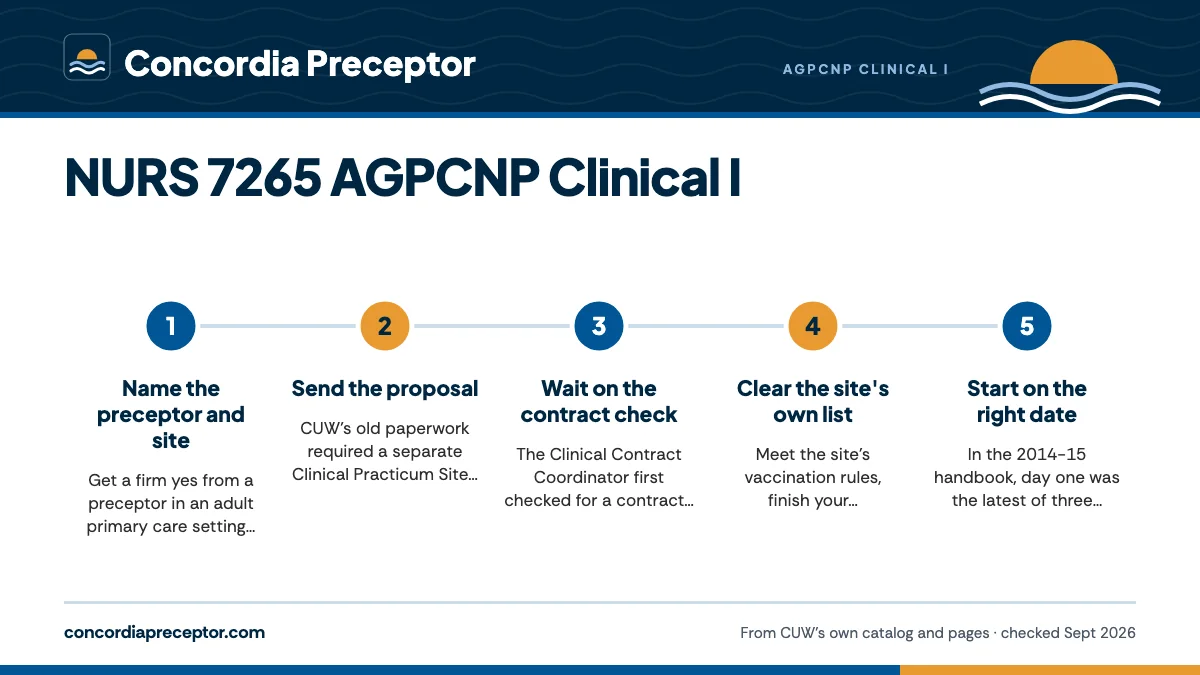
- Name the preceptor and siteGet a firm yes from a preceptor in an adult primary care setting, plus the site's agreement to host you.
- Send the proposalCUW's old paperwork required a separate Clinical Practicum Site Proposal and Preceptor Information form for every preceptor-site pair each term, due four weeks before the first clinical day. Details are on the proposal form page.
- Wait on the contract checkThe Clinical Contract Coordinator first checked for a contract CUW already held with that site. Drafting a fresh agreement ran as long as 12 weeks, and you could see no patients until it was signed.
- Clear the site's own listMeet the site's vaccination rules, finish your CastleBranch items and complete any orientation or computer training the site sets.
- Start on the right dateIn the 2014-15 handbook, day one was the latest of three events: contract in place, documents approved, semester begun.
What the first clinical looked like in CUW's archived handbook
CUW's 2014-15 NP clinical handbook describes the first clinical, then called APN I, in detail. It dates from the 600-hour era and used Typhon for logs, so read it as a picture of expectations rather than today's syllabus.
- Course objectives drawn from NONPF competencies, which the adjunct approved and the preceptor then signed
- A weekly reflective journal during the first clinical
- A caseload of roughly five to eight patients daily by mid-course
- Hours paced through the whole term, wrapping up no sooner than two weeks before its close, with orientation or shadowing capped at 8 hours
- A midterm visit from the clinical adjunct, who watched at least one patient encounter
Newer CUW sources agree on the visit: the 2022 blog and FAQ both describe at least one faculty site visit a semester. Which log system and evaluation forms apply now is a question for your course faculty; the logs and evaluations page tracks what is known.
Is Clinical I an 8-week course or a full semester?
CUW's sources point two ways. The February 2024 progression plans label each AGPCNP clinical "8 week," while the catalog's plan grid tags other courses by session and leaves the clinicals untagged, which reads like a full 16-week semester.
The gap matters for your preceptor. Spread over 16 weeks, 250 hours is roughly 16 a week; packed into 8 weeks, it is more than 31. Ask your course faculty which calendar your section follows before you promise a clinic a schedule, and see the pacing guide for how CUW's 2022 guidance spread the hours across a semester.
On an 8-week calendar, look for a preceptor able to offer three or four full clinic days a week, every week of the session.
How we set up NURS 7265 for CUW students
Clinical I is where a well-built placement pays off for the whole program, and it is the best moment to bring us in. We begin the search while you are still in Health Assessment, look for adult and gerontology primary care preceptors near home, and stay within the states CUW's disclosure marks as meeting requirements for the MSN.
Before anything reaches CUW's graduate faculty, we gather the preceptor's license, board certification and CV along with the site details a proposal needs, and we warn you early when a site looks likely to require a fresh clinical contract. We map Clinical II and III in the same pass, and if a preceptor steps away mid-semester, your placement advisor begins lining up a replacement at once.
Share your progression plan year and home ZIP code in the form below, or send us a message.
Questions CUW students ask
Can a physician precept me in NURS 7265?
CUW's current pages list no preceptor types. The 2014-15 NP handbook accepted MDs and DOs alongside NPs, PAs and certified nurse midwives, but expected 50 or more of a student's program hours to be spent with a nurse practitioner. Because today's rules come from graduate faculty, confirm with the Graduate Clinical Coordinator before proposing a physician, and consider logging NP hours early.
Do CAGE AGPCNP students take NURS 7265?
The CAGE certificate lists NURS 7265 through NURS 7267 with a 750-hour minimum, and the 2026-27 catalog leaves room to credit clinical hours from a previous advanced practice degree, judged one student at a time. Whether any earlier hours reduce what you owe is settled in your individualized plan. The CAGE certificate page covers that review.
What was NURS 7265 called before?
The course has carried three numbers. The 2020-21 catalog listed the AGPCNP clinicals as MSN 865 to MSN 867, at least 240 hours each and 720 in total. The 2021-22 catalog renumbered them NURS 765 to NURS 767, the 2022-23 catalog raised the track to 750 hours, and four-digit numbers arrived in 2024-25.
Does Clinical I need a preceptor who sees many older adults?
Not necessarily. The catalog frames NURS 7265 around episodic and chronic conditions across the adult lifespan, while the older-adult emphasis belongs to Clinical III, NURS 7267, whose catalog focus is older adults seen as outpatients. A broad adult panel suits Clinical I; a practice that also sees many older patients may serve later courses too.
Can I split NURS 7265 hours between two preceptors?
CUW's 2014-15 handbook let a student use two preceptors per semester before any special approval was needed, with a separate proposal for every preceptor and site. The current limit is not published, so ask the Graduate Clinical Coordinator. A second preceptor can protect your hours if one clinic's schedule thins out.
Related pages
Last checked 2026-09-26
We check these pages against CUW's own academic catalog, program pages and published nursing documents. Your course faculty and the Graduate Clinical Coordinator have the final word.
- Concordia University Wisconsin 2026-27 catalog: MSN Primary Care Nurse Practitioner
- Concordia University Wisconsin 2026-27 catalog: graduate NURS course descriptions
- Concordia University Wisconsin: MSN Adult-Gerontology Primary Care Nurse Practitioner
- CUW MSN NP progression plan, 3-year fall start (Feb 2024)
- CUW NP Student Clinical Practicum Handbook 2014-2015 (archived copy)
CUW asks you to secure your preceptors. We make the search the easy part.
Tell us your CUW track, your city and your next clinical course. We line up preceptors who fit the NURS course, gather the license, board certification and site details CUW's graduate faculty review, and flag early whether the site needs a new clinical contract.
- Preceptors matched to the course: primary care for FNP and AGPCNP, mental health settings for PMHNP, an agency mentor for DNP projects
- Preceptor license, certification, CV and site details ready for CUW's approval
- All three clinical courses planned together, close to home in a state CUW's disclosure lists for your program
Start your placement plan
Track, city and next clinical course is all we need to begin.