NURS 7266 Advanced Primary Care Clinical II - AGPCNP: the middle 250 hours
NURS 7266 Advanced Primary Care Clinical II - AGPCNP is the middle course in Concordia University Wisconsin's adult-gerontology clinical sequence, taking you from 250 to 500 supervised hours. It opens only after NURS 7265 (or its older numbers, MSN 865 and NURS 765), and the catalog turns the lens toward primary health care settings and prevention built through community partnerships. The decision that shapes this course is whether to stay with your Clinical I preceptor or bring in a new one.
Get your placement plan
Tell us your CUW program and where you live. A placement advisor replies with the preceptor and site options that fit your course.
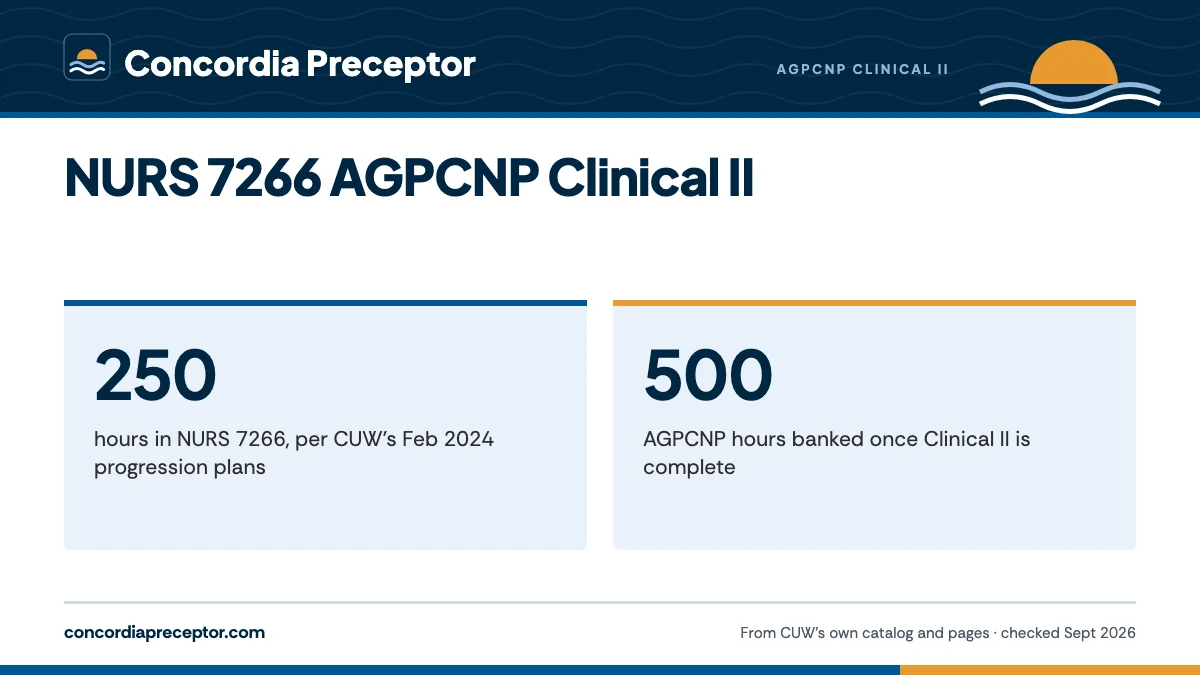
Where Clinical II falls in your plan
In the catalog's sample plan for the MSN AGPCNP, clinicals occupy semesters 5, 7 and 8. That leaves one semester with no clinical between Clinical I and Clinical II, and then no gap at all before Clinical III. The quiet semester is the best planning window you will get for both remaining placements.
The separate progression plans CUW posts (3, 3.5 and 4 years) can move those semesters, and CAGE certificate students follow individualized plans, so take the semester numbers from your own plan. The prerequisite is fixed: the catalog lists NURS 7266 as requiring MSN 865, NURS 765 or NURS 7265, and a student registered early is dropped if that course is not completed successfully.
| Semester | Course | Hours | Running total |
|---|---|---|---|
| 5 | NURS 7265 Clinical I | 250 | 250 |
| 6 | No clinical course | 0 | 250 |
| 7 | NURS 7266 Clinical II | 250 | 500 |
| 8 | NURS 7267 Clinical III | 250 | 750 |
What the catalog asks of Clinical II
The course description moves away from the adult-lifespan framing of Clinical I and toward primary health care settings, the common problems seen there, and community-level prevention carried out through community partnerships. A site that runs screening days, outreach clinics or joint work with local programs gives you real material for that part of the course, although CUW names no required activity.
One quirk is worth knowing. The NURS 7266 description repeats the FNP Clinical II text almost word for word, including the phrase "across the life span." Read it next to CUW's AGPCNP page, which places the clinicals in adult or gerontology primary care settings; an adult practice remains the natural fit. If a site's patient mix leaves you unsure, ask your course faculty before you propose it.
Keep your Clinical I preceptor or add a new one?
Staying put has an obvious pull: the preceptor knows your level, the site already passed CUW's review, and any contract is in place. Under CUW's archived rules, though, one preceptor could not carry you through both courses. The 2014-15 NP handbook capped the hours with any single preceptor at 400 across the program, and two full courses at 250 each come to 500.
By that old cap, a student who logged all 250 Clinical I hours with one preceptor could add at most 150 more with that person. CUW's current handbook is not public, so ask the Graduate Clinical Coordinator whether a per-preceptor cap still applies before you build a plan around it.
Reasons students add a second preceptor in Clinical II
- A per-preceptor hour cap, if one still applies
- A wider case mix before the older-adult focus of Clinical III
- A clinic with community outreach for the prevention side of the course
- A backup in case the main clinic cuts student days
Each added preceptor meant another proposal in the archived process: the undated proposal form called for one form per preceptor and site every semester, and the 2014-15 handbook permitted a second preceptor in a semester without special sign-off. A returning preceptor still needed a fresh form for the new term.
A returning site moves faster through contracts
In the 2014-15 handbook, every proposal passed to the Clinical Contract Coordinator, who checked whether CUW already held an agreement with the site. With a contract already on file, a student could begin once documents cleared and the semester opened; building a new agreement took 8 to 12 weeks, and patient care had to wait until it was done.
That makes a site you used in Clinical I the low-risk choice for at least part of Clinical II, even when a different preceptor at the same site takes the hours. A brand-new site works too, as long as it is proposed early in the gap semester. Large systems add their own layers, and some Wisconsin systems publish that they are not signing new affiliation agreements, a pattern covered on the health systems page. The contracts page holds the full archived detail.
Two preceptors, two sets of records
Splitting Clinical II means splitting the paperwork. In CUW's 2014-15 process, each preceptor signed a separate Documentation of Hours form, preceptors evaluated the student at midterm and at the end, and the grade was held if an hours form or the end-term checklist was missing. Keep a copy of every signed form yourself.
Faculty oversight carried on as well. CUW's 2022 blog and FAQ each mention a clinical instructor visit at least once a semester, more when needed. With two sites, ask early which one faculty plan to visit, and keep your own running tally of hours by preceptor so the totals match at the end. CUW has not named its current hour-logging system; see the logs and evaluations page for the pieces on record.
Why AGPCNP students bring us Clinical II
Clinical II is where the program gets crowded: Clinical III follows with no break, and a preceptor change here ripples forward. We treat the gap semester as planning time and line up Clinical II and Clinical III together, so both proposals can reach CUW's graduate faculty well before either start date.
Our search stays inside adult and gerontology primary care close to home, limited to states that CUW's disclosure table clears for the MSN. We gather each preceptor's license, board certification and CV, point out early any site that may need a fresh agreement, and map out hour splits across preceptors whenever a split makes sense. If a Clinical II preceptor drops, your placement advisor moves on a replacement at once; the preceptor dropped out page walks through it. Start with the form below.
Questions CUW students ask
Can I do NURS 7266 at the clinic where I work?
Under CUW's archived rules, your employer could host you but your own department could not, and hours logged on your own unit did not count. The 2022 CUW blog also cautioned that working for a health system does not by itself open a clinical spot there. Current pages add nothing, so check with the Graduate Clinical Coordinator; the workplace page has the detail.
What if I finish Clinical I short of 250 hours?
Under CUW's grading policy, incomplete work is due within three weeks of the term's final day, up to six weeks in some cases, before it may become a failing grade. Because NURS 7265 is the prerequisite for NURS 7266, an unresolved Clinical I can hold up Clinical II. Raise the shortfall with course faculty as soon as you see it coming.
Does "across the life span" mean I need pediatric patients in Clinical II?
The phrase comes from the FNP Clinical II description, which the AGPCNP course repeats. CUW's AGPCNP page places the clinicals in adult or gerontology primary care settings, so an adult practice remains the fit. If a site's patient mix leaves you unsure, ask your course faculty before the proposal goes in.
Is NURS 7266 the same course as the FNP Clinical II?
No. The FNP track's second clinical is NURS 7152. The two catalog descriptions read almost alike, but NURS 7266 belongs to the AGPCNP track, including the CAGE AGPCNP option, and its prerequisite is the AGPCNP Clinical I. Both carry 250 hours in CUW's February 2024 progression plans.
When should I propose my Clinical II site?
CUW's current pages publish no due date. Working backward from archived rules, a new site needs its proposal in at least four weeks before the start and, if it lacks a CUW contract, up to twelve weeks for one; proposing it early in the semester before Clinical II covers both. The deadlines page lays out a working calendar.
Related pages
Last checked 2026-09-26
We check these pages against CUW's own academic catalog, program pages and published nursing documents. Your course faculty and the Graduate Clinical Coordinator have the final word.
- Concordia University Wisconsin 2026-27 catalog: graduate NURS course descriptions
- Concordia University Wisconsin 2026-27 catalog: MSN Primary Care Nurse Practitioner
- Concordia University Wisconsin: MSN Adult-Gerontology Primary Care Nurse Practitioner
- CUW MSN NP progression plan, 3.5-year fall start (Feb 2024)
- CUW NP Student Clinical Practicum Handbook 2014-2015 (archived copy)
CUW asks you to secure your preceptors. We make the search the easy part.
Tell us your CUW track, your city and your next clinical course. We line up preceptors who fit the NURS course, gather the license, board certification and site details CUW's graduate faculty review, and flag early whether the site needs a new clinical contract.
- Preceptors matched to the course: primary care for FNP and AGPCNP, mental health settings for PMHNP, an agency mentor for DNP projects
- Preceptor license, certification, CV and site details ready for CUW's approval
- All three clinical courses planned together, close to home in a state CUW's disclosure lists for your program
Start your placement plan
Track, city and next clinical course is all we need to begin.