Doing your CUW practicum where you already work
Concordia University Wisconsin's archived NP rules allow clinicals with your own employer but not in your own department or unit. CUW's 2022 MSN FAQ said an employer site can be used if it meets CUW's credential requirements, and CUW's 2022 blog added that holding a job in a health system does not by itself earn you a clinical spot there. Treat your employer as a strong lead that still needs a plan B.
Get your placement plan
Tell us your CUW program and where you live. A placement advisor replies with the preceptor and site options that fit your course.
Same employer yes, same unit no
Two CUW sources set the boundary. The 2014-15 NP clinical handbook and the undated proposal form both say you may train with the organization that employs you, but never on your home unit. Students caught training there lost the placement, and none of those hours counted.
The 2022 program FAQ approached it from the other side: an employer site may be used as long as the employer meets CUW's credential requirements. In other words, your workplace goes through the same faculty review as any other site, with the same preceptor standards and the same setting rules.
CUW's current pages say nothing about employer placements either way. Treat the archived boundary as the working rule and confirm it with your course faculty before you ask your own organization for anything.
Why a job is no automatic placement
Being on the payroll helps, but it does not open every door. CUW's 2022 blog on MSN clinicals noted that many sites only take students who are their own employees, and made clear that a paycheck from a health system is not a pass into its clinics. The 2014-15 handbook likewise said big systems take only a handful of students and advised keeping a fallback.
Wisconsin systems' own pages show why. Aurora Health Care says it currently takes APRN rotation requests only from its own employees attending one of its named core academic partner schools; the list says "Concordia" without saying which Concordia, and CUW publishes no such relationship. Aurora also requires the school to submit the request and says students may not schedule directly with preceptors.
UW Health gives priority to UW-Madison partners and then to its own employees in affiliated programs, and it is not accepting new affiliation agreements. In both cases, employment is one condition among several, and the school-to-system agreement is the one you cannot supply yourself. The health systems guide has each system's rules.
How to approach your own employer
If your organization is a good fit, work the request the way its student office expects. These steps follow the rules CUW and the systems publish.
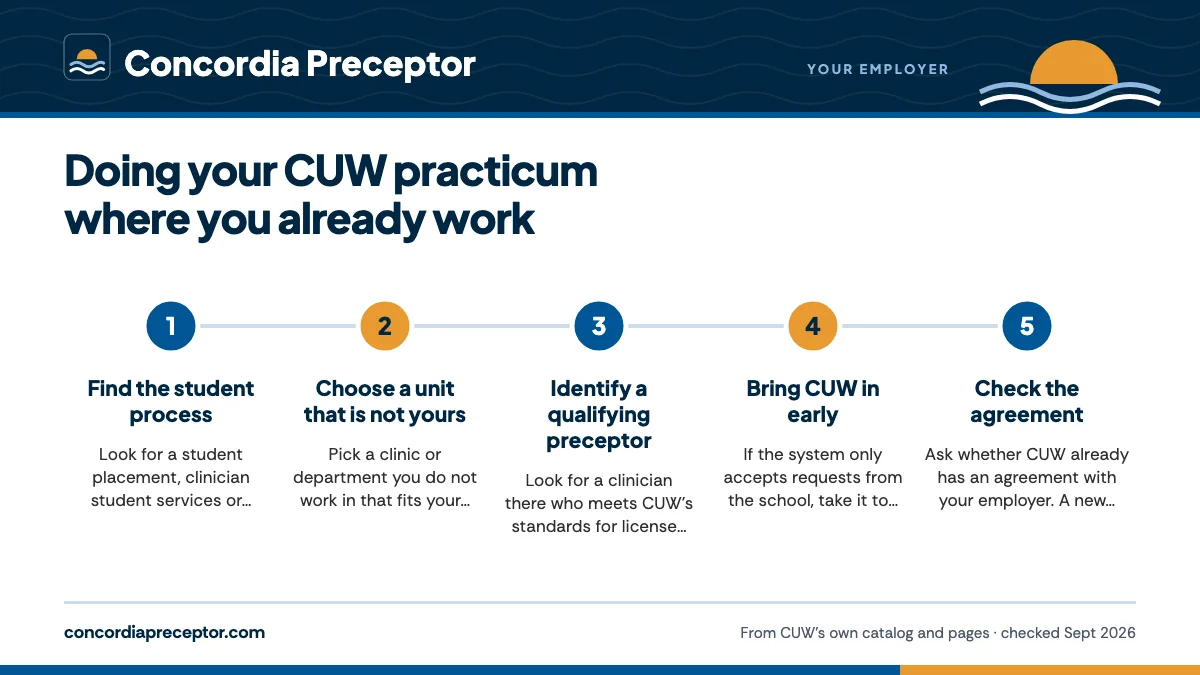
- Find the student processLook for a student placement, clinician student services or education office, and read its published steps and deadlines before you speak to any clinician.
- Choose a unit that is not yoursPick a clinic or department you do not work in that fits your course: outpatient primary care for FNP and AGPCNP, a mental health setting for PMHNP.
- Identify a qualifying preceptorLook for a clinician there who meets CUW's standards for license, certification and experience; see the preceptor requirements guide.
- Bring CUW in earlyIf the system only accepts requests from the school, take it to the Graduate Clinical Coordinator with the system's deadlines attached.
- Check the agreementAsk whether CUW already has an agreement with your employer. A new one could take 8 to 12 weeks in CUW's archived process; the contracts guide explains.
- Keep a second site in viewCarry an outside option until the employer placement is approved and cleared.
Fitting clinical days around your shifts
A clinical at your employer can make scheduling easier, but the hours still have to look like a clinical, not an extension of your job. CUW's 2022 FAQ described 250 clinical hours a semester as about thirty shifts of eight to ten hours, usually finished within 13 weeks and spread across the term.
The 2014-15 handbook added two pacing rules: hours spread evenly through the semester, and none finished more than two weeks before the semester ends. It also capped orientation, shadowing and pre-approved conference time at 8 hours a semester, which matters if your employer requires onboarding for students.
Keep your paid shifts and your clinical days clearly separate on your calendar and in your logs. Your preceptor signs for your clinical hours, and in the archived process that meant a signed hours record from each preceptor when the term closed. The pacing guide covers the rhythm in more detail.
Your employer can host your clinical, but your own unit cannot: CUW's archived rule removed students found training on their own unit and did not count those hours.
Program differences: RN to BSN and the DNPs
The workplace rules above are for the graduate NP clinicals. CUW's RN to BSN works differently: its online landing page says you complete the required clinical hours where you work as an RN, and the catalog describes experiential opportunities in work and community settings. That program is covered on its own RN to BSN page.
The DNPs sit in between. The Post-MSN DNP has you complete residency hours in areas of your choice with an agency mentor. Its program page in 2022 asked for a minimum of 500 residency hours inside the program, counting toward a 1,000-hour doctoral total, and capped indirect patient care outside your current practice at 120 of them. That note no longer appears on the live page, so confirm how residency hours in your own practice count today.
The Post-BSN to DNP's NURS 9030 to NURS 9032 immersions run alongside a mentor at a health care agency chosen for the project. CUW does not say whether that agency can be your employer; ask your course faculty.
Why CUW students choose us alongside their employer
Your employer can be a strong first call, and we help you make it count. Your placement advisor checks your organization's published student process, finds a unit and a clinician outside your own team that fit your CUW course, and gathers the license, certification and CV your proposal needs.
At the same time we line up an outside site that matches your track and state, so a slow agreement or a system-wide policy does not cost you the term. We plan the employer placement and the backup across all three clinical courses, and if your employer's answer changes midway, your advisor already has the next option moving. When both are ready, you choose, and CUW's faculty approve. Our service overview explains each step; use the contact form to share your employer, track and term.
Questions CUW students ask
Can I do my CUW FNP clinicals at the hospital where I work?
At the same employer, yes, but not on your own unit, and not with an inpatient unit as your primary site. CUW's archived rules allow the same employer while excluding your own department, and FNP and AGPCNP primary sites must be primary care. An outpatient primary care clinic in your system is the kind of site that fits.
Does my employer need a contract with CUW?
Expect one. Your employer counts as a site like any other, and CUW's 2013 preceptor handbook described a formal agreement for every site a student put forward. Ask the Graduate Clinical Coordinator whether one already exists, because a new agreement could take 8 to 12 weeks.
Can a coworker precept me at a different clinic in my organization?
CUW's archived rules exclude your own unit, not your colleagues, so a clinician in a different clinic or department who meets CUW's preceptor standards fits the written rules. Mention the working relationship on your proposal so faculty can weigh it.
Is Aurora Health Care a CUW clinical partner?
CUW publishes no such relationship. Aurora's own page lists "Concordia" among its core academic partner schools for employee rotations but does not say which Concordia, and several universities share that name. Ask the Graduate Clinical Coordinator before relying on an Aurora placement.
Can RN to BSN students do clinical hours at work?
Yes. CUW's RN to BSN landing page says students complete the required clinical hours where they work as RNs, which is different from the graduate NP rule that keeps you out of your own unit. The catalog builds clinical experience into courses such as NURS 3540 Population Health.
Related pages
Last checked 2026-09-26
We check these pages against CUW's own academic catalog, program pages and published nursing documents. Your course faculty and the Graduate Clinical Coordinator have the final word.
- Concordia University Wisconsin Academic Catalog 2026-2027: MSN Primary Care Nurse Practitioner
- Concordia University Wisconsin MSN program page with FAQs, 2022 (archived)
- Concordia University Wisconsin blog: MSN Clinicals, What are they like? (2022)
- Concordia University Wisconsin NP Student Clinical Practicum Handbook 2014-2015 (archived)
- Aurora Health Care: Nurse practitioner students (Clinician Student Services, archived 2026)
CUW asks you to secure your preceptors. We make the search the easy part.
Tell us your CUW track, your city and your next clinical course. We line up preceptors who fit the NURS course, gather the license, board certification and site details CUW's graduate faculty review, and flag early whether the site needs a new clinical contract.
- Preceptors matched to the course: primary care for FNP and AGPCNP, mental health settings for PMHNP, an agency mentor for DNP projects
- Preceptor license, certification, CV and site details ready for CUW's approval
- All three clinical courses planned together, close to home in a state CUW's disclosure lists for your program
Start your placement plan
Track, city and next clinical course is all we need to begin.