CUW's online RN to BSN, and where its clinical hours happen
Concordia University Wisconsin's online RN to BSN, which CUW also calls BSN Completion, lets working nurses finish a 120-credit bachelor's degree in 8-week courses, and CUW's own materials say the required clinical hours can be completed where you already work as an RN. Two courses carry the clinical element, NURS 3540 Population Health and the NURS 4599 capstone. CUW publishes no hour count, so your course faculty set the details.
Get your placement plan
Tell us your CUW program and where you live. A placement advisor replies with the preceptor and site options that fit your course.
The program at a glance
The RN to BSN sits in CUW's catalog with the extended-campus nursing programs and runs fully online. It is built for associate-degree nurses who are licensed and working, and it keeps them working: CUW requires RN employment throughout the program.
| Item | What CUW publishes |
|---|---|
| Degree | Bachelor of Science in Nursing, online |
| Admission basis | Associate degree in nursing and an RN license (the 2025-26 catalog also accepted a diploma) |
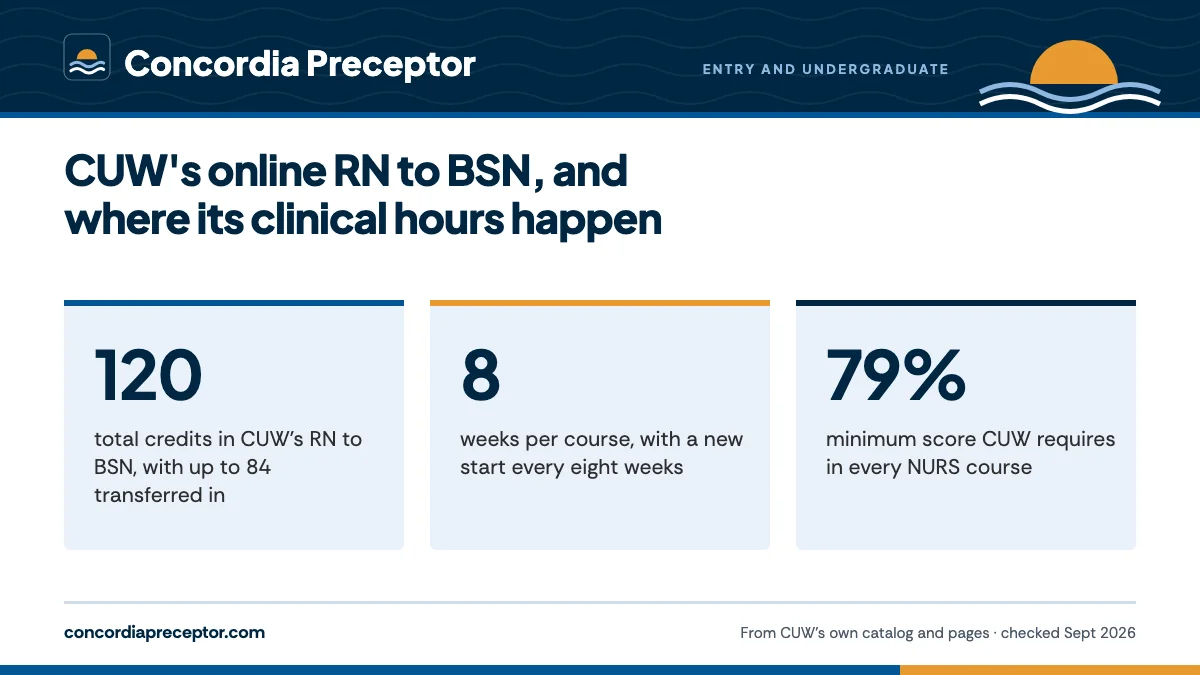
| Total credits | 120, with at least 36 taken at CUW and up to 84 transferred |
| Nursing credits | 18 NURS credits |
| Course format | 8-week online courses, with start dates every eight weeks |
| Length | Catalog: as few as 18 months. Program page: 18 to 24 months. The 2025-26 catalog said as few as 24 months |
| Grade rule | 79% or higher in every NURS course |
| Work rule | RN employment required throughout |
| Clinical element | NURS 3540 Population Health and NURS 4599 Seminar in Contemporary Nursing |
| Institutional accreditation | Higher Learning Commission |
The catalog's sample plan spreads the 36 CUW credits over five semesters. The length figures differ between sources, so plan from the one your advisor gives you.
Clinical hours where you already work
Three CUW sources point the same way. The catalog describes the program's learning as "experiential opportunities in work and community settings." CUW's RN to BSN landing page says you can complete the required clinical hours where you work as an RN. The program page itself embeds a video titled with the question students ask first: "Can I complete my clinical hours where I work now?"
That makes your workplace the default setting, which is the opposite of the graduate NP model. You are not hunting for a clinic that will host you; you are applying course objectives inside a job you already hold. The practical questions shift to documentation: which activities count, who confirms them, and how you record the time.
CUW does not publish an hour count for the RN to BSN, and the catalog course descriptions give none either. The answers live in each course's syllabus and with your course faculty, so read the clinical section of NURS 3540 before the course opens rather than in week three of eight.
An 8-week course leaves little slack: sort out how your clinical time is documented before the first week, not after.
The two courses with a clinical element
Only two of the RN to BSN's nursing courses describe clinical experience, and neither lists a prerequisite in the catalog. They pull in different directions: one outward into the community, one along a single patient's path through care.
| Course | Credits | What the catalog describes |
|---|---|---|
NURS 3540 Population Health | 3 | Immersion in the role of the community-based nurse through clinical experience |
NURS 4599 Seminar in Contemporary Nursing | 3 | The final capstone: following a patient or family with chronic illness from diagnosis to end of life, with clinical experience evaluating patient-centered transitions, including discharge planning |
NURS 3540 is the course most likely to reach beyond a hospital unit, since its focus is the community-based nurse. If your job is inpatient, ask early whether your faculty want a community-facing experience and how it fits your schedule. NURS 4599 suits almost any setting where patients move between levels of care, from discharge planning on a medical floor to home health.
What CUW has not published, and who answers
Several practical details are missing from CUW's public pages: the number of clinical hours, the form used to log them, whether a supervisor or preceptor signs off, and what liability coverage applies. Your course faculty and the course syllabus are the sources for each.
Older documents show how CUW handled these questions before. The BSN Completion Program for RNs Handbook from August 2010 said students at required clinical sites were covered by CUW's liability and malpractice insurance, and it kept a physical exam form and CPR proof on file. That is a 2010 rule, not confirmation of today's practice.
One state rule is worth knowing if a preceptor is involved in Wisconsin. Wisconsin Administrative Code N 1.08(6) applies to schools of professional nursing at the bachelor's level too: a clinical preceptor needs an unencumbered Wisconsin license or privilege at or above the level the student is preparing for, and the school's faculty approve the preceptor.
Your state and the RN to BSN table
The RN to BSN has its own row on CUW's Distance Education Disclosures page, and it does not match the nurse practitioner tables. California, Delaware and Hawaii meet requirements for the RN to BSN but not for the graduate programs, while Idaho, South Carolina, Utah, Washington and Wyoming go the other way.
| Status | States |
|---|---|
| Meets Requirements (24) | Arkansas, California, Colorado, Delaware, Florida, Hawaii, Illinois, Indiana, Iowa, Kansas, Maine, Michigan, Minnesota, Missouri, Montana, Nevada, New Hampshire, New Mexico, North Carolina, North Dakota, Ohio, Texas, Virginia, Wisconsin |
| Does Not Meet Requirements (26) | Alabama, Alaska, Arizona, Connecticut, Georgia, Idaho, Kentucky, Louisiana, Maryland, Massachusetts, Mississippi, Nebraska, New Jersey, New York, Oklahoma, Oregon, Pennsylvania, Rhode Island, South Carolina, South Dakota, Tennessee, Utah, Vermont, Washington, West Virginia, Wyoming |
Boards also treat post-licensure students differently from pre-licensure ones. Texas's approval rule for out-of-state programs covers pre-licensure programs, and North Dakota's distance recognition is not described as covering RN to BSN programs. Iowa still expects post-licensure students in clinicals to hold an active Iowa or multistate license. Washington's list of approved out-of-state programs does include RN to BSN programs, yet CUW's table marks Washington "Does Not Meet" for its own; an archived 2022 CUW page had listed the RN to BSN among its Washington approvals. The full comparison is on the licensure disclosure page.
From BSN to nurse practitioner at CUW
Many RN to BSN graduates look next at CUW's online NP programs, which admit nurses with a BSN and an RN license. The clinical model changes completely at that step. The 2026-27 catalog says graduate NP students "will identify and secure clinical preceptors," whom the graduate faculty then approve for appropriateness, with the Graduate Clinical Coordinator available to assist.
The numbers grow too. The MSN FNP and AGPCNP each require 750 clinical hours in three 250-hour courses, the PMHNP MSN requires 500, and the Post-BSN to DNP totals 1,008 hours, 750 of them clinical. MSN applications are due July 1 for fall and November 1 for spring.
Your RN to BSN years are the ideal time to start building that network. The nurse practitioners and physicians you already work beside are the people a future preceptor search begins with.
Why RN to BSN nurses start with us
CUW keeps your RN to BSN clinical work close to home, and we keep it moving. If your faculty want a community experience your employer cannot offer in NURS 3540, your placement advisor finds public health, school or clinic settings near you and hands you complete details to take to your course faculty for approval.
Our bigger role comes next. CUW nurses planning an NP program choose us because we map preceptors for all three clinical courses before the first one opens, collect each preceptor's license, board certification and CV so the file reaches CUW's graduate faculty complete, and stay on call to replace anyone who drops mid-course. The steps are on how it works, and your plans reach us through the contact form.
Questions CUW students ask
Can I complete CUW RN to BSN clinical hours where I work?
Yes, that is how CUW describes it. Its RN to BSN landing page says the required clinical hours can be completed where you work as an RN, and the catalog speaks of experiential learning in work and community settings. Your course faculty confirm what counts, especially in NURS 3540 Population Health, which centers on community-based nursing.
How many clinical hours does CUW's RN to BSN require?
CUW does not publish a number. Neither the program page, the catalog nor the course descriptions for NURS 3540 and NURS 4599 state clinical hours. Ask your course faculty or check the syllabus before each course starts, since the 8-week format leaves little room to catch up if the requirement surprises you.
How long does CUW's online RN to BSN take?
The 2026-27 catalog says as few as 18 months, and the program page says 18 to 24 months. The previous catalog said as few as 24 months, so the shorter figure is new. Your pace depends on how many of the 84 transferable credits you bring and how many 8-week courses you take at once.
Can I take CUW's RN to BSN if I live outside Wisconsin?
CUW's disclosure lists 24 states where the RN to BSN meets requirements, including neighbors Illinois, Iowa, Michigan and Minnesota, and 26 where it does not, such as Washington, Utah and New York. Check your state's row, and ask CUW admissions about anything unclear before you enroll.
Do I have to keep working as a nurse during CUW's RN to BSN?
Yes. The 2026-27 catalog requires RN employment throughout the program, which fits the model: your clinical hours are designed to happen where you work. If your job changes mid-program, tell your advisor and course faculty early so your clinical plan can move with you.
Related pages
Last checked 2026-09-26
We check these pages against CUW's own academic catalog, program pages and published nursing documents. Your course faculty and the Graduate Clinical Coordinator have the final word.
CUW asks you to secure your preceptors. We make the search the easy part.
Tell us your CUW track, your city and your next clinical course. We line up preceptors who fit the NURS course, gather the license, board certification and site details CUW's graduate faculty review, and flag early whether the site needs a new clinical contract.
- Preceptors matched to the course: primary care for FNP and AGPCNP, mental health settings for PMHNP, an agency mentor for DNP projects
- Preceptor license, certification, CV and site details ready for CUW's approval
- All three clinical courses planned together, close to home in a state CUW's disclosure lists for your program
Start your placement plan
Track, city and next clinical course is all we need to begin.