Clinical contracts at CUW: the agreement behind every site
Before a Concordia University Wisconsin NP student sees a patient at a site, CUW needs a signed agreement with that site. CUW's 2014-15 NP handbook said a new contract could take 8 to 12 weeks and that no patient care happens until one is in place. Current CUW pages publish no lead time, so find out early whether your site already has an agreement.
Get your placement plan
Tell us your CUW program and where you live. A placement advisor replies with the preceptor and site options that fit your course.
What a clinical contract is
A clinical contract, which health systems usually call an affiliation agreement, is a document between Concordia University Wisconsin and the organization hosting you. CUW's 2013 NP preceptor handbook said CUW sets up formal agreements with each site a student proposes, covering the responsibilities of each party and liability, and that the agency signs it before the student is placed.
That makes the contract different from everything else in your placement. Your preceptor's yes is personal, and the proposal form asks CUW to approve a person and a practice. The contract binds two institutions, so it is signed by whoever speaks for the site: a practice owner, an administrator, an education office or a legal department.
CUW's 2014-15 handbook drew the line plainly: the proposal form is not a contract. You can have an approved preceptor and still be waiting on the agreement.
CUW's archived timeline: 8 to 12 weeks
In the 2014-15 NP handbook, the proposal went first to the Clinical Education Coordinator, who forwarded it to the Clinical Contract Coordinator. That coordinator checked whether a contract with the site already existed. If not, a new one "may take 8 to 12 weeks."
Two rules followed. No patient care was allowed until a contract was in place, for liability reasons, and the Clinical Contract Coordinator told the student when clinicals could begin. The undated proposal form said the same in shorter form: contracts may take up to 12 weeks, and the student may not go to the site until the Clinical Contract Coordinator approves.
Today the catalog names a Graduate Clinical Coordinator instead, and no current CUW page gives a contract lead time. Plan with the archived figures until your coordinator tells you otherwise.
The contract is often the longest wait in a CUW placement. Ask about it the day a new site says yes, not the week the proposal is due.
New site or existing agreement: how to find out
The fastest placements use a site that already has an agreement with CUW. There is no public list of those sites, so the question has two halves.
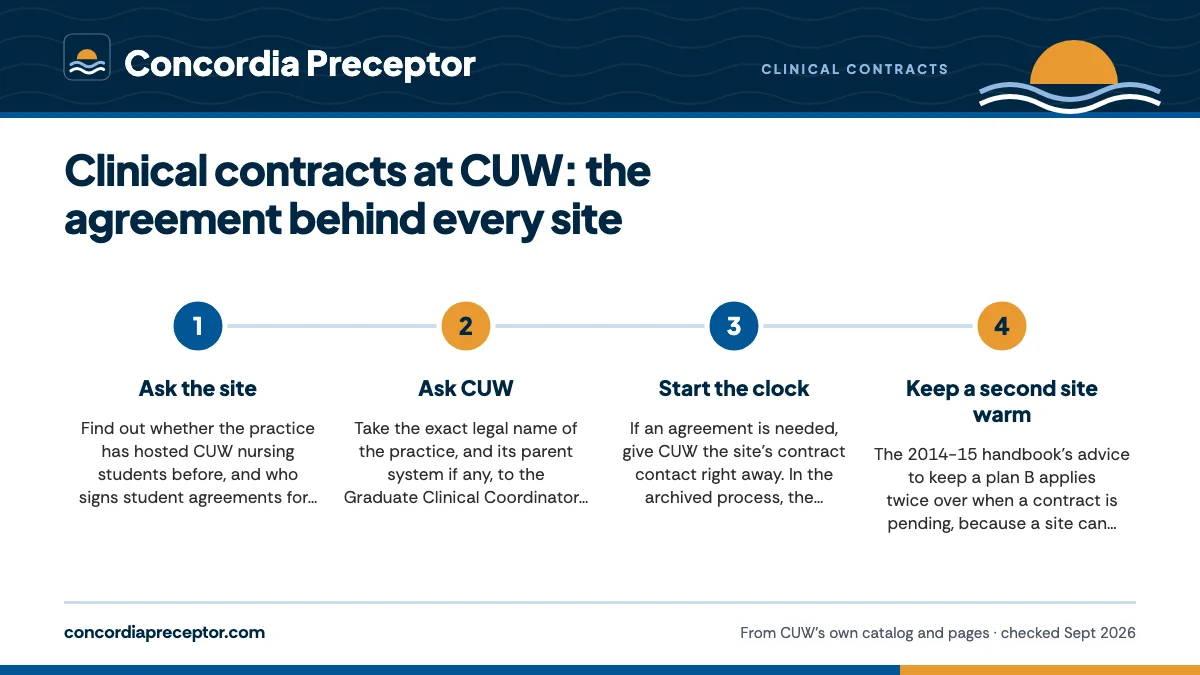
- Ask the siteFind out whether the practice has hosted CUW nursing students before, and who signs student agreements for it. If the clinic belongs to a health system, ask whether the system's student or education office handles agreements.
- Ask CUWTake the exact legal name of the practice, and its parent system if any, to the Graduate Clinical Coordinator and ask whether an agreement is already on file.
- Start the clockIf an agreement is needed, give CUW the site's contract contact right away. In the archived process, the contract coordinator took it from there.
- Keep a second site warmThe 2014-15 handbook's advice to keep a plan B applies twice over when a contract is pending, because a site can decline to sign.
The proposal form guide shows how the form's 4-week deadline and the contract's longer window run side by side.
Health systems that run their own agreements
Large Wisconsin systems publish their own rules for student agreements. None of them is described here as a CUW partner; this is each system's own wording, from dated captures of its pages.
| System | What its own pages say about agreements | Who sends the request |
|---|---|---|
| Froedtert ThedaCare with the Medical College of Wisconsin | An affiliation agreement and program memorandum for each student experience; MCW says it is not creating new affiliation agreements with additional programs at this time | One NP application through the MCW process |
| Ascension Wisconsin | Agreements can take 4 to 8 weeks and sometimes longer; requests due at least 8 weeks before the start | The school coordinator or designee |
| Children's Wisconsin | An affiliation agreement renewed every three years and a program agreement renewed yearly | A faculty member |
| UW Health | Not accepting new affiliation agreements at present | The school placement coordinator |
| Marshfield Clinic | A contract with the school must be in place before placement; applications due four months ahead | An application, with eligibility approved by its Division of Education |
The pattern is consistent: the agreement is school-to-system, and the request usually comes from the school rather than the student. The systems guide has the deadlines and eligibility rules.
What to do while a contract is pending
Waiting on a contract is not idle time. Everything else that sets your start date can move forward in parallel, so the agreement is the only thing left when it lands.
Keep your Castle Branch record current and meet the site's vaccination requirements; CUW's 2022 blog notes that CUW grants no waivers or exemptions for vaccines a site requires. Confirm your CPR card is current, and ask the site now about its own orientation, badge or computer training. The clinical requirements guide lists what CUW asks for.
What has to wait is patient care: the 2014-15 handbook barred it until the contract was in place. If the agreement drags close to the start of the term, tell your course faculty early, while a second site or a later session is still an option.
Why CUW students choose us when a contract is involved
A contract can add up to 12 weeks to a CUW placement, so we treat it as part of the search from the first call. In the first conversation with a site, your placement advisor asks whether it has hosted CUW students, who signs its student agreements and how long its review usually takes, and you hear the answer as soon as we do.
Where a contract is needed, we gather the site's legal name, parent system and contract contact so the Graduate Clinical Coordinator can act on it at once. We give priority to sites that fit your course and can move quickly, and we keep a second option in view until your agreement is signed. Read how it works, or share your course and start date.
Questions CUW students ask
Do I sign the clinical contract myself?
No. The contract is between CUW and the site. CUW's 2013 NP preceptor handbook described CUW setting up the agreement, covering responsibilities and liability, and sending it to the agency for signature before placement. Your part is to connect CUW with the person at the site who signs student agreements.
Can I start clinical hours while the contract is being signed?
Plan on no. CUW's 2014-15 handbook allowed no patient care until a contract was in place and had the Clinical Contract Coordinator tell each student when clinicals could begin. Use the waiting time for clearance and site onboarding instead, and confirm the current rule with your course faculty.
Does a small private practice need a contract with CUW?
Plan on it. CUW's archived preceptor handbook said CUW sets up formal agreements with each site a student proposes, without an exception for small practices. A solo practice may sign faster than a health system, but the step still has to happen before patient care.
Does a CUW contract carry over to the next semester?
CUW has not published how long its agreements last. Health systems vary: Children's Wisconsin, for example, renews its affiliation agreements every three years and program agreements yearly. Even with an agreement in place, CUW's archived form required a new proposal each semester, so ask the coordinator before assuming a site is ready.
What if a health system says it is not signing new agreements?
Take it at face value and look elsewhere. UW Health and the Medical College of Wisconsin have both said on their own pages that they are not adding new affiliation agreements. Community and independent practices set their own policies and are worth asking; our guide for when you can't find a preceptor walks through the options.
Related pages
Last checked 2026-09-26
We check these pages against CUW's own academic catalog, program pages and published nursing documents. Your course faculty and the Graduate Clinical Coordinator have the final word.
- Concordia University Wisconsin Academic Catalog 2026-2027: MSN Primary Care Nurse Practitioner
- Concordia University Wisconsin NP Student Clinical Practicum Handbook 2014-2015 (archived)
- Concordia University Wisconsin Nurse Practitioner Preceptor Handbook, 2013 (archived)
- Concordia University Wisconsin Clinic Practicum Site Proposal and Preceptor Information Form (archived)
- Medical College of Wisconsin: APP student preceptorships
CUW asks you to secure your preceptors. We make the search the easy part.
Tell us your CUW track, your city and your next clinical course. We line up preceptors who fit the NURS course, gather the license, board certification and site details CUW's graduate faculty review, and flag early whether the site needs a new clinical contract.
- Preceptors matched to the course: primary care for FNP and AGPCNP, mental health settings for PMHNP, an agency mentor for DNP projects
- Preceptor license, certification, CV and site details ready for CUW's approval
- All three clinical courses planned together, close to home in a state CUW's disclosure lists for your program
Start your placement plan
Track, city and next clinical course is all we need to begin.