What must be in place before a CUW clinical site can start you
Concordia University Wisconsin keeps its own clinical requirements short and lets each site set the rest. You meet every vaccination rule your clinical site sets, and CUW's 2022 blog says CUW grants no waivers or exemptions for any vaccine. You also hold current CPR, meet CUW's Technical Standards for Registered Nurses and comply with the Student Responsibilities Agreement.
Get your placement plan
Tell us your CUW program and where you live. A placement advisor replies with the preceptor and site options that fit your course.
Vaccines: the site's list is the one that counts
Every CUW graduate nursing page carries the same sentence: in clinical experiences, students work in healthcare systems or clinics and "must comply with any vaccination requirements of the clinical sites." CUW publishes no graduate vaccine list of its own. The list that applies is the one your site hands you, and it can change between your first, second and third clinical.
CUW's 2022 blog on MSN clinicals filled in the rest. Most clinical partners required immunizations, COVID-19 among them. CUW itself did not require vaccines, but it granted no waivers or exemptions for any vaccine, which leaves each site's rule standing.
For comparison, the 2013-14 Graduate Nursing Program Student Handbook asked for a health certificate before placement: a TB skin test, MMR or titers, and the Hepatitis B series or a waiver. Today the site's own requirements take that role.
CUW grants no vaccine waivers or exemptions (2022 blog). If a site requires a vaccine you have not had, you meet that rule or you choose a different site.
Requirements side by side, by program
CUW states its requirements program by program. The graduate NP and DNP programs share one short list, and the two pre-licensure programs add more.
| Requirement | Graduate NP and DNP programs | Direct Entry MSN | Traditional BSN |
|---|---|---|---|
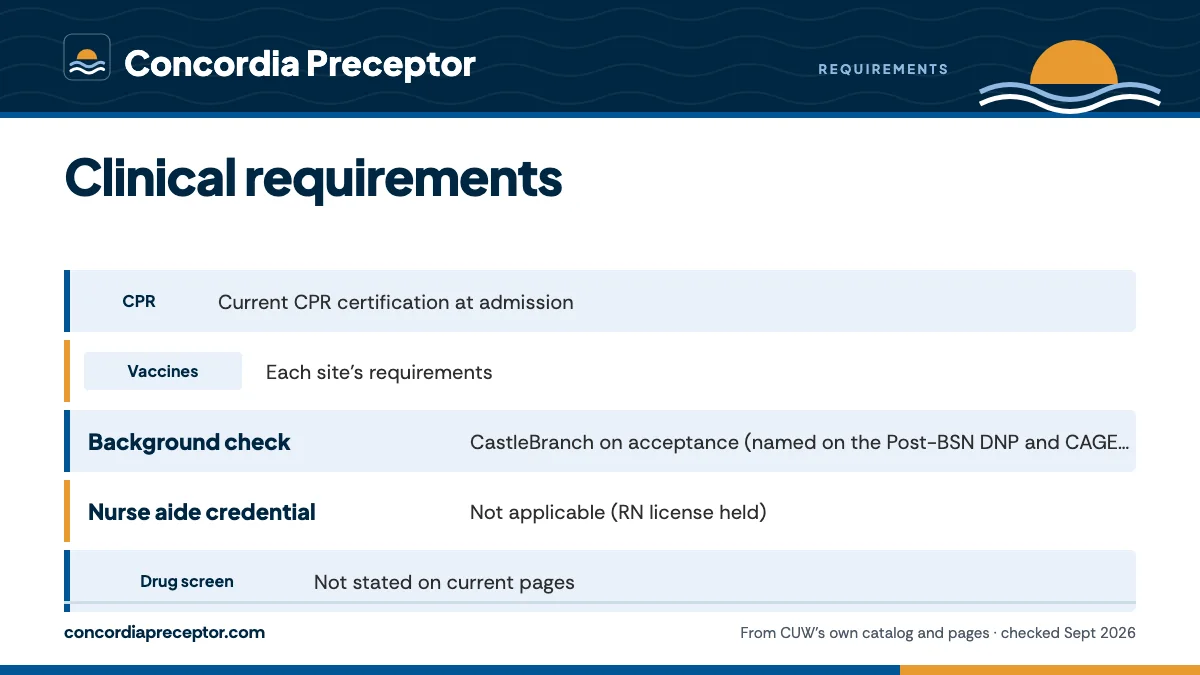
| CPR | Current CPR certification at admission | AHA BLS for Healthcare Professionals | AHA BLS for Healthcare Providers, kept current |
| Vaccines | Each site's requirements | Each site's requirements | All partner vaccination requirements |
| Background check | CastleBranch on acceptance (named on the Post-BSN DNP and CAGE pages) | Not stated | A clear, certified background check |
| Nurse aide credential | Not applicable (RN license held) | CNA certification or proof of completion; EMT or LPN may count | State CNA certification |
| Drug screen | Not stated on current pages | Not stated | Urine drug screen before the first clinical course |
| License | Unencumbered RN; unencumbered NP prescribing license for the PMHNP certificate and PMHNP DNP | Pre-licensure | Pre-licensure |
The Traditional BSN's items follow the Clinical Requirements Timeline in the School of Nursing's Clinical Resource Guide, which is not public. For the license row, see your RN license and clinicals; for the background check, see CastleBranch at CUW.
CPR: what CUW asks for, and what sites may add
The 2026-27 catalog asks for current CPR certification at admission to the MSN, the Post-BSN to DNP, the CAGE certificates, the PMHNP DNP and the PMHNP certificate. It names no course provider for graduate students. The pre-licensure programs are specific: American Heart Association BLS for Healthcare Professionals in the Direct Entry MSN, and AHA BLS for Healthcare Providers, kept current throughout, in the Traditional BSN.
Two practical points follow. Renew before your card lapses, since a card that expires mid-program can stall a site's onboarding. And a site can name its own course, so ask before you book a renewal. CUW's 2013-14 graduate handbook, for comparison, asked for yearly adult, child and infant CPR plus HIV/AIDS (OSHA) training. Keep a digital copy of your current card with your clinical records so it is ready the moment a site asks.
Two documents CUW names but does not publish
The catalog requires NP and DNP applicants to meet the "Technical Standards for Registered Nurses". CUW has not posted the text, so you read it in the materials CUW provides. Keep a copy with your clinical records, and ask the Graduate Clinical Coordinator if anything in it bears on a particular site.
The catalog also says MSN, Post-BSN to DNP and CAGE students must comply with the Student Responsibilities Agreement. Its text is not public either. Read it before you sign, keep your signed copy, and ask your course faculty about any clause that touches clinical conduct, attendance or hours.
The same is true of a current graduate nursing handbook, clinical practicum handbook and preceptor handbook: CUW refers to them, but none is posted. That is why every archived handbook detail on this site carries its date.
Questions CUW's current pages leave open
Some items students expect on a requirements list appear on no current CUW page. The dated sources below are the best available signal; the Graduate Clinical Coordinator has the current answer.
- Drug screens: not mentioned for graduate students today. The 2022 program FAQ listed drug testing among the extra expenses of clinicals, alongside lodging for the on-campus health assessment, background checks and immunizations.
- Liability insurance: no current statement. The 2013-14 graduate handbook advised students to buy malpractice insurance, and the 2010 BSN completion handbook said CUW's liability coverage applied at required clinical sites.
- Health insurance: the 2013-14 handbook contradicted itself, calling it not mandated on one page and required of all students on another.
- Employment status: the same handbook said students at clinical sites are not employees and are not covered by workers' compensation.
Site extras that arrive after approval
Once faculty approve a site, the site's own onboarding begins. CUW's archived proposal form told students to ask each site about extra paperwork, orientation and computer training, and the 2014-15 handbook would not start a clinical until any competencies the site required were complete.
Large systems publish their own versions. Ascension Wisconsin wants student information, cleared background checks and required training 4 weeks before the start; Children's Wisconsin wants its certification form 30 days ahead; Aurora requires a current Wisconsin RN license from every student. Those are each system's own rules, gathered on sites with their own processes. The deadlines guide shows how the dates stack. Ask about these steps as soon as a site says yes, so onboarding runs alongside CUW's review instead of after it.
Why CUW students choose us for requirement checks
We collect each site's onboarding list before you commit to it and compare it line by line with what you already hold: vaccines, CPR, background check, drug screen and training. A vaccine rule with no waiver surfaces at the start of the search, while switching to another site is still easy, not the week before your first shift.
Your placement advisor keeps the preceptor's license, board certification and CV in the same file as your clearances, so the proposal CUW's graduate faculty review is complete and consistent. Because we plan all three clinicals at once, we also compare each new site's list with the last one, so you know which items carry over and which are new before the term begins. Start with your track and start term or read how it works.
Questions CUW students ask
Does CUW allow vaccine exemptions for clinicals?
CUW's 2022 blog says CUW itself does not require vaccines but grants no waivers or exemptions for any vaccine, and every graduate program page says you must meet your clinical sites' vaccination requirements. In practice the site decides. If you cannot meet a site's vaccine rule, start looking for a different site early.
Do CUW graduate nursing students need a drug test?
CUW's current graduate pages do not mention one. The 2022 program FAQ listed drug testing among the extra expenses students might meet in clinicals, which suggests some sites ask for it. The Traditional BSN, by contrast, requires a urine drug screen before its first clinical course. Ask each site and the Graduate Clinical Coordinator.
Which CPR course does CUW accept for NP students?
The catalog asks graduate applicants for current CPR certification without naming a provider. CUW's pre-licensure programs specify American Heart Association BLS, and your clinical site may name a course too. Check the site's rule before you renew, and keep the card current through all of your clinical courses.
Where can I read CUW's Student Responsibilities Agreement?
Nowhere public. The catalog requires MSN, Post-BSN to DNP and CAGE students to comply with it, but CUW has not posted the text. You receive it through the program; keep your signed copy and ask your course faculty or the Graduate Clinical Coordinator about any clinical clause you are unsure of.
Do I need my own malpractice insurance for CUW clinicals?
CUW's current pages do not say. Its 2013-14 graduate handbook advised students to buy malpractice insurance, while a 2010 BSN completion handbook described CUW coverage at required sites. Because the rule may have changed, ask the Graduate Clinical Coordinator, and check whether your site expects students to carry their own coverage.
Related pages
Last checked 2026-09-26
We check these pages against CUW's own academic catalog, program pages and published nursing documents. Your course faculty and the Graduate Clinical Coordinator have the final word.
- Concordia University Wisconsin Academic Catalog 2026-2027: MSN Primary Care Nurse Practitioner
- Concordia University Wisconsin: MSN Family Nurse Practitioner
- Concordia University Wisconsin: Direct Entry MSN
- Concordia University Wisconsin Academic Catalog 2026-2027: Traditional BSN
- Concordia University Wisconsin blog: MSN Clinicals, What are they like? (2022)
CUW asks you to secure your preceptors. We make the search the easy part.
Tell us your CUW track, your city and your next clinical course. We line up preceptors who fit the NURS course, gather the license, board certification and site details CUW's graduate faculty review, and flag early whether the site needs a new clinical contract.
- Preceptors matched to the course: primary care for FNP and AGPCNP, mental health settings for PMHNP, an agency mentor for DNP projects
- Preceptor license, certification, CV and site details ready for CUW's approval
- All three clinical courses planned together, close to home in a state CUW's disclosure lists for your program
Start your placement plan
Track, city and next clinical course is all we need to begin.