CUW's Direct Entry MSN: clinicals the School of Nursing arranges
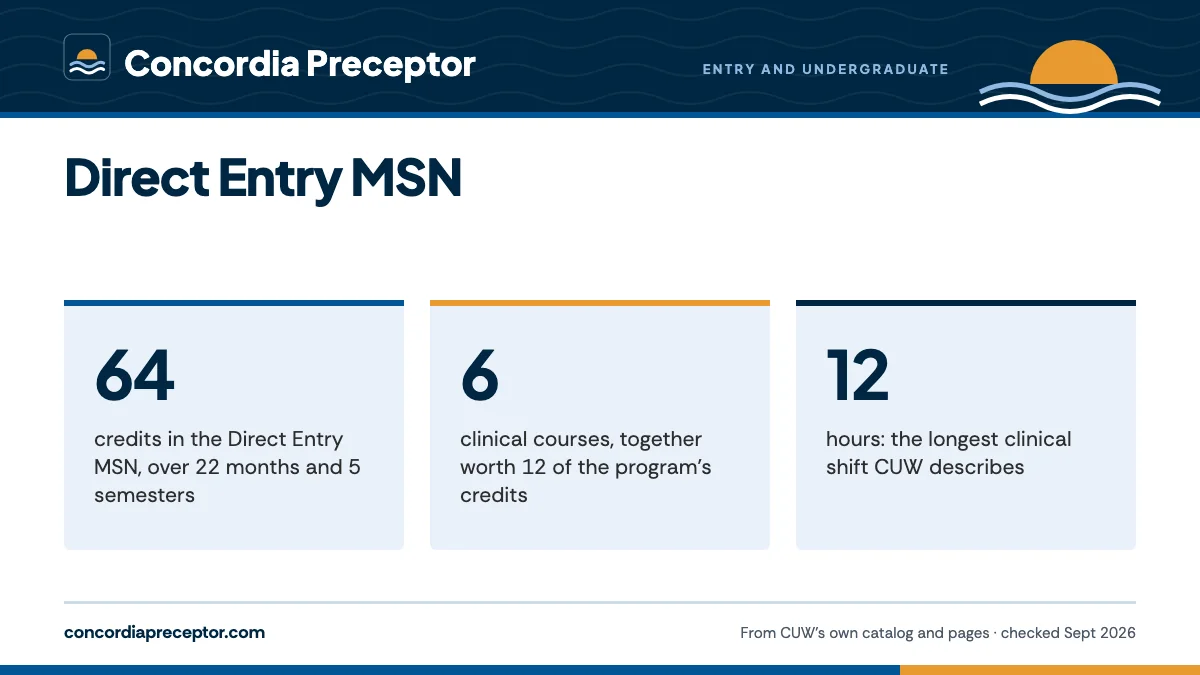
Concordia University Wisconsin's Direct Entry MSN takes a bachelor's degree in any field to an MSN and eligibility for the NCLEX-RN in 64 credits over 22 months, with the first cohort starting in fall 2026. Unlike CUW's nurse practitioner programs, this one secures every clinical placement for you. Your part is arriving cleared and certified, and being able to reach labs and clinicals near either the Mequon or the Ann Arbor campus.
Get your placement plan
Tell us your CUW program and where you live. A placement advisor replies with the preceptor and site options that fit your course.
The program in brief
The Direct Entry MSN is new in the 2026-27 catalog. CUW announced it as a 64-credit, 22-month program for career changers, framed as a response to the nursing shortage, and its program page invites applicants to start as soon as August 24, 2026.
| Item | What CUW publishes |
|---|---|
| Who it is for | Holders of a bachelor's degree in any field who complete the prerequisites |
| Outcome | A Master of Science in Nursing and eligibility for the NCLEX-RN |
| Credits and length | 64 credits over 22 months, in 5 semesters |
| First cohort | Fall 2026; application deadline July 1 |
| Coursework | Online |
| Labs and simulation | On campus at CUW in Mequon, Wisconsin, or CUAA in Ann Arbor, Michigan |
| Clinicals | Nearby healthcare facilities, alongside licensed RNs, arranged by the School of Nursing |
| Shifts | Weekday and weekend clinical shifts of up to 12 hours |
CUW's program page adds one condition worth reading twice: students must be able to attend clinicals and on-campus lab experiences at either the CUW or the CUAA campus. Plan your housing and transportation around both before you commit.
How placement works in this program
Here CUW does the finding. The program page states it directly, "We secure your placements," and adds that "Our School of Nursing arranges clinical sites." You do not approach hospitals, negotiate contracts or recruit a preceptor; CUW assigns you to nearby facilities where you work alongside licensed RNs, with clinical teaching by licensed, experienced nurses.
That model is the reverse of CUW's online nurse practitioner programs, where the catalog asks students to identify and secure their own preceptors. It is closer to the Traditional BSN, where CUW also places students with area healthcare partners; the BSN clinicals page covers that program.
What remains yours is readiness. Each clinical site sets its own vaccination rules and CUW expects you to meet them, and 12-hour shifts on weekdays or weekends mean your work and family schedule has to bend. If you are placed at a Wisconsin site, Wisconsin's rule N 1.08(6) also applies: any preceptor needs an unencumbered Wisconsin license or privilege at or above the RN level and the approval of CUW's faculty.
The six clinical courses
Each clinical course runs alongside a paired theory course, and the catalog prints no prerequisites for any of them. Together they account for 12 of the program's 64 credits.
| Course | Credits | Focus | When in the plan |
|---|---|---|---|
NURS 5622 Chronic Health Care Conditions Clinical | 2 | Assessment and care of patients with chronic conditions | Semester 2, 8-week Session I, with NURS 5620 |
NURS 6632 Population & Community Health Nursing Clinical | 1 | Individuals and families of all ages in diverse settings | Semester 3, 6-week Session I, with NURS 6630 |
NURS 6642 Acute Health Care Conditions Clinical | 2 | Patients with acute conditions | Semester 3, 8-week Session II, with NURS 6640 |
NURS 7612 Complex & Transitional Care Clinical | 2 | Complex conditions and transitional care needs | Semester 4, 8-week Session I, with NURS 7610 |
NURS 7622 Nursing Care of the Childbearing Woman, Infant, & Child Clinical | 2 | Children and childbearing women | Semester 4, 8-week Session II, with NURS 7620 |
NURS 7642 Integrating Professional Nursing Care & Leadership Clinical | 3 | The culminating clinical: care for a team of patients and interdisciplinary transitional care planning | Semester 5, 8-week Session II, with NURS 7640 |
Two details stand out. NURS 6610 Mental Health Nursing is a 2-credit course with no paired clinical in the catalog plan. And CUW publishes no clock hours for any of these courses, so the hour load of each rotation comes from your course faculty, not from the catalog. NURS 6038 Advanced Health Assessment also sits in the curriculum, in semester 4 of the catalog plan.
Getting cleared for your first clinical
The first clinical, NURS 5622, arrives in semester 2, so clearance work starts early. CUW's Direct Entry materials name these requirements:
- Certified nursing assistant (CNA) certification, or proof you completed the training; a current unencumbered EMT certification or LPN license may count instead.
- American Heart Association BLS for Healthcare Professionals.
- Every vaccination the clinical site requires, since CUW defers to each site's rules.
The public Direct Entry pages do not say whether a background check, drug screen or specific compliance vendor applies. CUW names Castle Branch for background checks on its Post-BSN to DNP and CAGE pages and requires a drug screen before the Traditional BSN's first clinical, but neither statement is made for this program. Ask admissions for the full clearance list and its deadlines when you are accepted.
The CNA requirement catches career changers off guard: check whether your EMT or LPN credential counts before you book a CNA course.
Mequon or Ann Arbor, and your license afterward
The Direct Entry MSN is the one CUW nursing program tied to both campuses. Concordia University Ann Arbor is part of the same university, and the catalog describes the two as residential campuses of one institution. Your labs may be in Mequon or Ann Arbor, and your clinicals at facilities near them.
Where you will be licensed matters after graduation. CUW's Distance Education Disclosures page has no table for this program yet, so ask CUW which states it meets requirements for before relying on a license outside Wisconsin or Michigan. A Wisconsin license can be multistate, since Wisconsin is a compact member, and that privilege carries into the other compact states. Michigan is outside the compact, and its RN license comes with its own checklist, including a criminal background check, training on spotting human trafficking and implicit bias training.
For context, CUW's earlier accelerated BSN, which no longer appears in the catalog, did all of its clinicals in Wisconsin, according to a 2024 archived page. No CUW source says the Direct Entry MSN replaced it.
The step after: from RN to nurse practitioner
An MSN earned through Direct Entry prepares you as a registered nurse, not a nurse practitioner. If NP practice is the long-term goal, the CUW route that matches a new MSN holder on paper is the CAGE certificate in FNP or AGPCNP, which admits nurses with an MSN or DNP and an RN license and requires 750 clinical hours across three courses. Confirm your own eligibility with CUW admissions, since the catalog says credit requirements vary with prior academic work.
At that stage the placement model flips. CAGE students, like every CUW graduate NP student, find and secure their own preceptors, and CUW's graduate faculty approve each one for appropriateness. The full process is on the clinical placement process page.
Where our help fits for Direct Entry students
Your Direct Entry clinicals belong to CUW, and they are in good hands there. Our service is built for the moment you move into advanced practice, when the preceptor search becomes yours. Direct Entry graduates choose us because we already know CUW's NP process inside out: primary care preceptors for FNP and AGPCNP courses, complete license, certification and CV files for the graduate faculty, and early warning when a site will need a new clinical contract.
The best time to talk is a year before your first NP clinical. Your placement advisor maps preceptors near home for all three clinical courses at once and stays on call if one drops. Read how finding your own preceptor works at CUW, then reach us through the contact form.
Questions CUW students ask
Does CUW find clinical placements for Direct Entry MSN students?
Yes. CUW's program page says "We secure your placements" and that the School of Nursing arranges clinical sites at nearby healthcare facilities, where students work alongside licensed RNs. That sets the Direct Entry MSN apart from CUW's online nurse practitioner programs, where students identify and secure their own preceptors for faculty approval.
Where are the Direct Entry MSN labs held?
Labs and simulation run on campus at CUW in Mequon, Wisconsin, or at Concordia University Ann Arbor in Michigan, and clinicals take place at healthcare facilities near them. CUW says students must be able to attend clinicals and on-campus lab experiences at either campus, so plan travel and housing with both locations in mind.
How long are Direct Entry MSN clinical shifts?
CUW describes clinical shifts of up to 12 hours, scheduled on weekdays and weekends. The exact pattern depends on the facility and the course. With six clinical courses spread across semesters 2 through 5, most students need a schedule that can absorb long shifts for most of the program's 22 months.
How many clinical hours are in CUW's Direct Entry MSN?
CUW does not publish clock hours for the program or for any of its six clinical courses. The catalog gives credits only: 12 clinical credits of the program's 64, ranging from 1 credit for community health to 3 for the leadership clinical. Your course faculty set the hours for each rotation.
Can I become a nurse practitioner after CUW's Direct Entry MSN?
Not directly, since the Direct Entry MSN prepares registered nurses. CUW's CAGE certificate in FNP or AGPCNP admits nurses holding an MSN or DNP and an RN license and requires 750 clinical hours, with students finding their own preceptors. Ask CUW admissions whether your background fits before you plan on it.
Related pages
Last checked 2026-09-26
We check these pages against CUW's own academic catalog, program pages and published nursing documents. Your course faculty and the Graduate Clinical Coordinator have the final word.
CUW asks you to secure your preceptors. We make the search the easy part.
Tell us your CUW track, your city and your next clinical course. We line up preceptors who fit the NURS course, gather the license, board certification and site details CUW's graduate faculty review, and flag early whether the site needs a new clinical contract.
- Preceptors matched to the course: primary care for FNP and AGPCNP, mental health settings for PMHNP, an agency mentor for DNP projects
- Preceptor license, certification, CV and site details ready for CUW's approval
- All three clinical courses planned together, close to home in a state CUW's disclosure lists for your program
Start your placement plan
Track, city and next clinical course is all we need to begin.