CUW Traditional BSN clinicals: what CUW arranges and what you bring
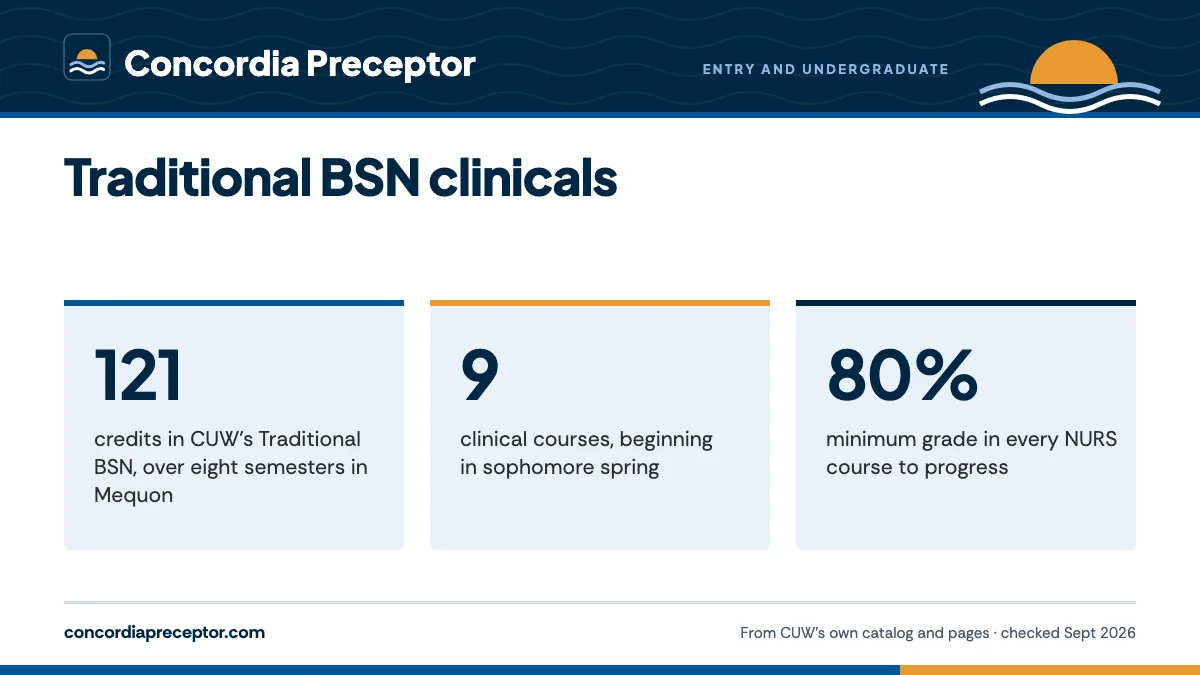
Concordia University Wisconsin arranges every clinical in its Traditional BSN, placing students with area healthcare partners from the spring of sophomore year through the senior leadership practicum. Nine clinical courses carry you from gerontology to pediatrics, and before the first one you need CNA certification, American Heart Association BLS, a clear background check and a urine drug screen. Your part is staying cleared and scoring at least 80% in every nursing course.
Get your placement plan
Tell us your CUW program and where you live. A placement advisor replies with the preceptor and site options that fit your course.
Who arranges the clinicals
In the Traditional BSN, CUW does. The catalog describes clinicals with "area healthcare partners," and CUW sizes each class to the clinical space those partners can offer. CUW's BSN page goes further: once students meet the progression requirements, their space in nursing courses and clinicals is held. Clinical teaching comes from licensed, experienced RNs.
Health systems' own pages show how school-arranged clinicals work. Ascension Wisconsin's published process, for example, accepts clinical requests only from a school coordinator or designee, at least 8 weeks before the start date, and southeastern Wisconsin nursing requests follow the SEWNA Nursing Student Placement Calendar. Students do not place requests themselves. The page on sites with their own processes describes how other systems handle students.
Where a preceptor is used, Wisconsin Administrative Code N 1.08(6) applies to bachelor's programs as well as graduate ones: the preceptor needs an unencumbered Wisconsin license or privilege at or above the RN level, and the School of Nursing's faculty approve the choice.
Nine clinical courses, semester by semester
Clinical courses begin in the second semester of sophomore year and run to the end of the program. The catalog lists them by credit, not by clock hours.
| Semester | Course | Credits | Focus |
|---|---|---|---|
| 4 (sophomore spring) | NURS 2122 Gerontologic Nursing Clinical | 2 | The first clinical: older adults, restorative and preventive care, palliative and hospice care |
| 5 | NURS 3022 Alterations in Adult Health: Chronic Conditions Clinical | 2 | Patients with chronic conditions |
| 5 | NURS 3132 Community Health Clinical | 1 | Individuals and families across the life span in a community setting (8 weeks) |
| 6 | NURS 3032 Psychological Wellness Clinical | 1 | Mental and behavioral health care in a variety of settings (8 weeks) |
| 6 | NURS 3122 Alterations in Adult Health: Acute Conditions Clinical | 2 | Patients with acute conditions |
| 7 | NURS 4012 Alterations in Adult Health: Complex Conditions Clinical | 2.5 | Complex conditions and transitional care needs |
| 7 | NURS 4032 Family-Centered Nursing: OB & Women's Health Clinical | 1 | Childbearing families and women's health (8 weeks) |
| 8 | NURS 4022 Family-Centered Nursing: Pediatrics Clinical | 1 | Childrearing families in a variety of settings and agencies (8 weeks) |
| 8 | NURS 4112 Leadership and Management Practicum: In an Evolving Healthcare System | 2.5 | Leadership and management skills in the clinical setting |
Two 1-credit skills courses, NURS 2110 Foundational Nursing Skills 1 and NURS 3010 Foundational Nursing Skills 2, reinforce the psychomotor work you use on the unit. Only NURS 4012 lists catalog prerequisites (NURS 3120 and NURS 3122, or their older numbers), but the progression rules below tie the whole sequence together. CUW publishes no clinical hour counts for any course, so your syllabus and clinical faculty give the hours.
Before your first clinical
The first clinical course falls in the Sophomore 2 semester, and CUW lists several requirements that must be in place before it starts:
- State nurse aide (CNA) certification.
- American Heart Association BLS for Healthcare Providers, kept current through the whole program.
- A clear background check (the Clinical Requirements Timeline calls for a certified background check).
- A urine drug screen before the first clinical course.
- Every vaccination your clinical partners require, since CUW follows the partners' rules.
- Adherence to all requirements set by CUW's healthcare partners.
The dates for each item come from the Clinical Requirements Timeline in the School of Nursing's Traditional Undergraduate Nursing Student Handbook and Clinical Resource Guide. CUW references that guide publicly but does not post it, so ask the School of Nursing for your copy. Keep copies of every certificate: partners can ask to see them, and BLS lapses in the middle of a semester are easy to miss.
BLS has to stay current for the entire program, not just at the first clinical: set a reminder well before your card expires.
Progression: the 80% line
The 2026-27 catalog sets a firm bar: sophomore, junior and senior students must earn at least 80% in every NURS course to progress. The 2023-24 and 2025-26 catalogs set it at 79%, so the line moved up one point this year. The handbook and Clinical Resource Guide hold the details of what happens below it.
Because the clinical courses are stacked semester by semester, a single missed grade can shift the rest of the sequence. The protected seat in clinicals described above also depends on meeting these progression requirements. If a course is slipping, talk to your faculty early, while there is still room in the semester to recover, and see your advisor before you drop or withdraw from any NURS course so you know how it changes the rest of your sequence.
Mequon, Ann Arbor and the fine print
The 2026-27 catalog lists the Traditional BSN at the Mequon campus only, marked (M). CUW's catalog carried a separate Concordia University Ann Arbor version, marked (A), through 2024-25, and it has been absent since. A CUW landing page still says the traditional BSN is available at both campuses, and a School of Nursing role title still refers to traditional undergraduate nursing at CUAA. If Ann Arbor matters to you, confirm the current offering with admissions.
On campus in Mequon, the catalog describes round-the-clock access to the skills lab and a multi-bed high-fidelity simulation lab. Transfer applicants apply by August 1 for fall. One more detail: the School of Nursing admissions page still cites older science course numbers (such as BIO 149 and CHEM 105), while the catalog uses the current ones (BIO 1600, BIO 1801, BIO 1802 and CHEM 1204). Follow the catalog.
After graduation, licensure travels well. CUW's disclosure lists the Traditional BSN as meeting requirements in all 50 states, a wider reach than any of its graduate programs; see the licensure disclosure page.
Where we fit for BSN students
CUW handles your BSN clinicals from start to finish, and that is exactly how the program should work. Our part begins when you look past the BSN toward advanced practice. CUW's online Post-BSN to DNP and its MSN programs such as the MSN FNP admit nurses with a BSN and an RN license, and in those programs the student identifies and secures each preceptor for graduate faculty approval.
BSN graduates who plan ahead choose us because we turn that search into a plan: primary care preceptors for FNP and AGPCNP courses, mental health settings for PMHNP practicums, complete license, board certification and CV files for CUW's graduate faculty, and a replacement lined up fast if a preceptor drops. Your first RN years are the time to start. See how it works or send your plans through the contact form.
Questions CUW students ask
When do CUW nursing students start clinicals?
In the Traditional BSN, clinical courses begin in the second semester of sophomore year with NURS 2122 Gerontologic Nursing Clinical. From there, a clinical course runs in every semester through senior year, ending with NURS 4022 in pediatrics and the NURS 4112 leadership practicum in semester 8.
Does CUW place BSN students in clinicals, or do they search on their own?
No. CUW arranges Traditional BSN clinicals with area healthcare partners and sizes each class to the clinical space available. Students who meet the progression requirements keep their seat in nursing courses and clinicals. The student-led preceptor search applies to CUW's graduate nurse practitioner programs, not to the BSN.
Does CUW drug test nursing students before clinicals?
Yes, for the Traditional BSN. The catalog requires a urine drug screen before the first clinical course in the Sophomore 2 semester, along with a clear background check, CNA certification and American Heart Association BLS. The Clinical Requirements Timeline in the School of Nursing's Clinical Resource Guide gives the dates.
What grade do CUW nursing students need to progress?
At least 80% in every NURS course for sophomore, junior and senior students, according to the 2026-27 catalog. Earlier catalogs (2023-24 and 2025-26) set the minimum at 79%. The Traditional Undergraduate Nursing Student Handbook explains how progression and retention are handled when a grade falls short.
Do I need CNA certification for CUW's Traditional BSN?
Yes. CUW requires state nurse aide (CNA) certification before clinicals begin, alongside the American Heart Association's BLS for Healthcare Providers and a clear background check. Plan the CNA course early, ideally before sophomore spring, so it is finished and documented before NURS 2122 starts.
Related pages
Last checked 2026-09-26
We check these pages against CUW's own academic catalog, program pages and published nursing documents. Your course faculty and the Graduate Clinical Coordinator have the final word.
CUW asks you to secure your preceptors. We make the search the easy part.
Tell us your CUW track, your city and your next clinical course. We line up preceptors who fit the NURS course, gather the license, board certification and site details CUW's graduate faculty review, and flag early whether the site needs a new clinical contract.
- Preceptors matched to the course: primary care for FNP and AGPCNP, mental health settings for PMHNP, an agency mentor for DNP projects
- Preceptor license, certification, CV and site details ready for CUW's approval
- All three clinical courses planned together, close to home in a state CUW's disclosure lists for your program
Start your placement plan
Track, city and next clinical course is all we need to begin.