Finding your own preceptor at Concordia University Wisconsin
In every Concordia University Wisconsin graduate NP program, the search for a preceptor and a clinical site belongs to the student. CUW's graduate faculty then judge whether what you found is appropriate, and the Graduate Clinical Coordinator can help along the way. A search that faculty approve starts from the course requirements, not from whichever clinic calls back first.
Get your placement plan
Tell us your CUW program and where you live. A placement advisor replies with the preceptor and site options that fit your course.
What "identify and secure" means at CUW
The 2026-27 academic catalog puts it in one line: "Students will identify and secure clinical preceptors which then need to be approved for appropriateness by the graduate faculty." Identifying means finding a clinician and a practice that fit the course. Securing means both have agreed to host you for the hours, on dates that work for the term.
CUW has said the same thing in different words for years. Its 2024 and 2025 MSN pages called students "ultimately" responsible for finding their own preceptors. The 2022 program FAQ answered yes to the question of whether students find their own, and told them to network in their communities. On today's PMHNP certificate page the placement is, in the end, the student's job, and the Clinical Contract Coordinator is named as the helper.
One page reads softer. CUW's FNP program page promises faculty input on choosing sites that match where you live and what you want to do. Read that as faculty support around a search you lead, since the catalog is CUW's rule of record, and ask the Graduate Clinical Coordinator what help your track offers.
Which CUW programs put the search on you
Every graduate nurse practitioner option at CUW works this way, including the doctoral and certificate routes. The only CUW nursing programs where the school arranges clinical sites are pre-licensure.
| CUW program | Clinical or practicum hours | Who secures the site |
|---|---|---|
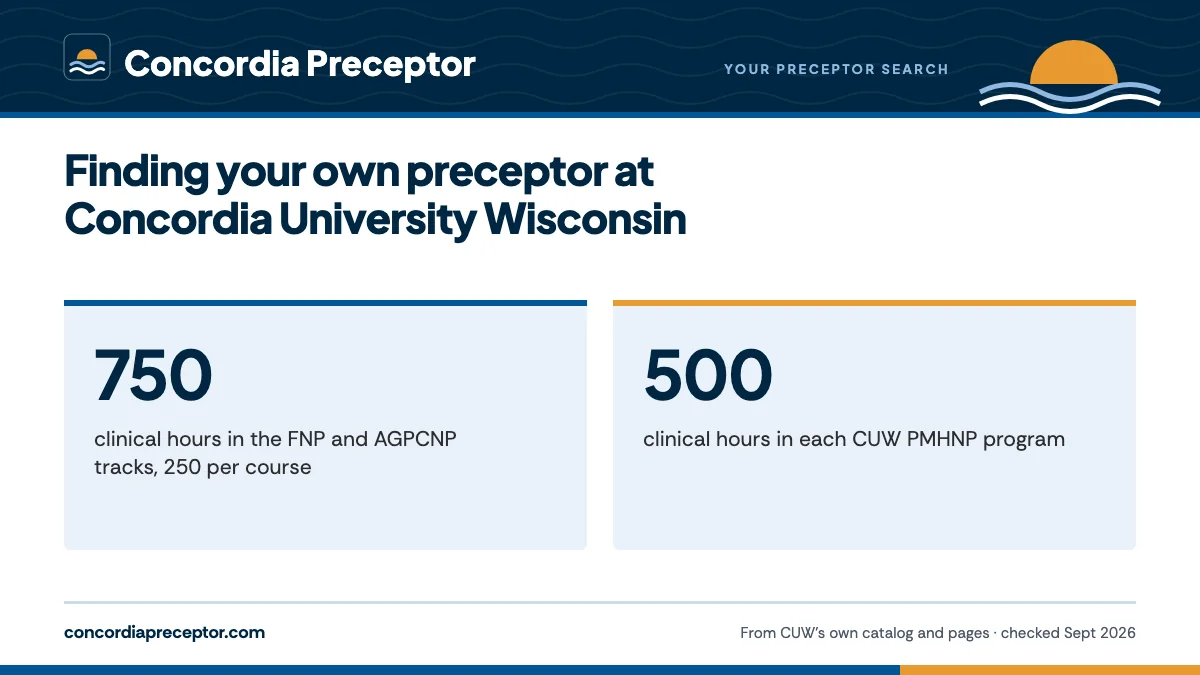
| MSN FNP, and the FNP dual degrees with the MBA or MPH | 750 | You |
| MSN AGPCNP | 750 | You |
| MSN PMHNP | 500 | You |
| Post-BSN to DNP (FNP or AGPCNP) | 1,008 (750 clinical, 258 leadership) | You, plus an agency mentor for the project hours |
| PMHNP DNP | 500 psychiatric, 200 leadership | You |
| Post-MSN DNP | Residency hours in areas of your choice | You, with an agency mentor |
| CAGE certificate, FNP or AGPCNP | 750 | You |
| PMHNP CAGE certificate | 500 | You |
| Direct Entry MSN and Traditional BSN | Not published | CUW |
| RN to BSN | Not published | Done at your own workplace |
Define the fit before you make a single call
A yes from a clinician CUW's faculty cannot approve costs you weeks. Write down what your course needs first, then look only for clinicians who match all of it.
- The course and its hours: 250 for each FNP or AGPCNP clinical; 125, 200 and 175 for the three PMHNP practicums on CUW's 2023 certificate plan.
- The setting: primary care for FNP and AGPCNP, with acute care ruled out as a primary site in CUW's 2022 blog. The site rules guide covers the limits.
- The patients: FNP Clinical III highlights children, older adults and women's health, while AGPCNP Clinical III centers on older adults in outpatient care.
- The state: CUW's disclosure has to list your program for the state where the clinic sits. Check the licensure disclosure guide.
- The clinician: licensed, board certified and experienced enough for CUW. See preceptor requirements.
- The calendar: the weeks you need, set against CUW's 2026-27 terms and the paperwork lead time.
A clinician who meets all six is worth more than three who meet four of them.
Where CUW students tend to look
Start with people who already know your work: NPs you have handed off patients to, providers in your employer's outpatient clinics outside your own unit, and clinicians from your RN years who have moved into primary care or mental health. Your own professional community is the network CUW's 2022 FAQ told students to use.
Independent and community practices set their own student policies, while the large Wisconsin systems publish formal student processes of their own. CUW's 2014-15 NP handbook noted that big health systems give very few placements and urged a plan B, and several Wisconsin systems now accept requests only from the school, on set calendars. The health systems guide lists those rules, and the Milwaukee guide covers southeast Wisconsin.
If your site is in Wisconsin, one more filter applies. The state's code for nursing schools (N 1.08(6)) expects a nurse who precepts to be cleared to practice in Wisconsin, without restrictions, at no lower a level than the role you are studying for, with the school's faculty signing off.
What to tell a clinician before they agree
Give a clinician the full picture before they agree, so the yes you get is one that lasts the semester. Cover these points in your first real conversation, and put them in writing afterward.
- The course number, the hours and the weeks, for example 250 hours across one CUW semester.
- The paperwork CUW has requested from preceptors before: proof of licensure, a résumé or CV, and national certification.
- The faculty contact: in CUW's 2022 descriptions, a clinical instructor came out to the practice at least one time each term.
- The evaluations: the 2014-15 handbook had preceptors sign off on your objectives, rate you at mid-term and at the end, and certify your hours.
- The site paperwork: the practice may need an agreement with CUW before you start.
If your plans change after a clinician has said yes, tell them promptly and in writing; CUW's older handbook wanted the Clinical Education Coordinator to get a copy. Closing the loop politely keeps the door open for the next CUW student.
How we run the search for you
Our placement desk starts where this page starts: with your CUW course, your hours and your state. We screen each clinician against CUW's dated preceptor standards and Wisconsin's license rule before you ever speak to them, and we confirm the practice offers the kind of patient care your track is built on.
Once a clinician commits, your advisor pulls together every attachment the proposal calls for and asks whether the practice has ever signed a CUW agreement. We line up all three clinical courses as a single plan, and if a preceptor falls through mid-term your advisor restarts the search right away.
CUW's faculty approve every preceptor and site; we hand you a match built to pass that review. Compare the routes on the placement options page, or start with your track and city.
Questions CUW students ask
Will CUW give me a list of available preceptors?
No public CUW source mentions a preceptor list or site database for graduate NP students. The catalog describes the Graduate Clinical Coordinator as available for assistance, so ask the coordinator directly what that help covers for your track, for example whether a site you are considering has hosted CUW students before.
How early should I start looking for a CUW preceptor?
Earlier than the paperwork suggests. The archived CUW form wanted a month's notice, and a practice that had never signed with CUW could add up to 12 weeks for its agreement. Add the weeks the search itself takes, and starting in the term before your clinical is sensible. Confirm the current due dates with the Graduate Clinical Coordinator.
What if I cannot find a preceptor before the deadline?
Tell the Graduate Clinical Coordinator early rather than on the due date. Under CUW's archived rules a missing proposal meant sitting out that semester's clinical and its paired course, which can push back later clinicals. See what to do when you can't find a preceptor.
Do DNP students need to find their own mentor for project hours?
Yes. CUW's catalog has Post-BSN to DNP students work with an agency mentor through the immersion courses, NURS 9030 to NURS 9032, and lets Post-MSN DNP students choose the areas for their residency. A proposal form from CUW's earlier DNP courses captured the mentor's degrees as well as the site.
Can I do my CUW clinicals near home in another state?
Often, yes. CUW's online programs allow clinicals outside Wisconsin, and the catalog leaves the eligibility check for that state to you. Check CUW's disclosure table for your program first, then read the destination state's board rules for visiting students and for the preceptors who supervise them.
Related pages
Last checked 2026-09-26
We check these pages against CUW's own academic catalog, program pages and published nursing documents. Your course faculty and the Graduate Clinical Coordinator have the final word.
- Concordia University Wisconsin Academic Catalog 2026-2027: MSN Primary Care Nurse Practitioner
- Concordia University Wisconsin: MSN Adult-Gerontology Primary Care Nurse Practitioner
- Concordia University Wisconsin: Psychiatric Mental Health Nurse Practitioner Certificate
- Concordia University Wisconsin MSN program page with FAQs, 2022 (archived)
- Concordia University Wisconsin NP Student Clinical Practicum Handbook 2014-2015 (archived)
CUW asks you to secure your preceptors. We make the search the easy part.
Tell us your CUW track, your city and your next clinical course. We line up preceptors who fit the NURS course, gather the license, board certification and site details CUW's graduate faculty review, and flag early whether the site needs a new clinical contract.
- Preceptors matched to the course: primary care for FNP and AGPCNP, mental health settings for PMHNP, an agency mentor for DNP projects
- Preceptor license, certification, CV and site details ready for CUW's approval
- All three clinical courses planned together, close to home in a state CUW's disclosure lists for your program
Start your placement plan
Track, city and next clinical course is all we need to begin.