The Graduate Clinical Coordinator and the other people behind your CUW clinical
At Concordia University Wisconsin, the Graduate Clinical Coordinator is the role the 2026-27 catalog names as available for assistance with clinical preceptors, while graduate faculty make the approval decision. Older CUW documents split the same work between a Clinical Education Coordinator and a Clinical Contract Coordinator. Knowing which role answers which question saves you round trips.
Get your placement plan
Tell us your CUW program and where you live. A placement advisor replies with the preceptor and site options that fit your course.
The role as CUW describes it today
The 2025-26 and 2026-27 catalogs place one sentence right after the rule that students secure their own preceptors: the Graduate Clinical Coordinator "is available for assistance." The catalog does not list what that assistance includes. The AGPCNP program page adds that clinical placement review and approval is part of the support students receive.
The title has changed more than the job. The 2023-24 catalog used Clinical Contract Coordinator, and the current PMHNP certificate page still does, saying that coordinator helps with the placement process. CUW's 2022 blog on MSN clinicals simply said Clinical Coordinator. Treat these as the same desk under different names, with Graduate Clinical Coordinator as today's title.
Public CUW pages name the role, not the person, and this guide does the same. Your course faculty or the School of Nursing can point you to whoever holds it this year.
Who handled what in CUW's archived process
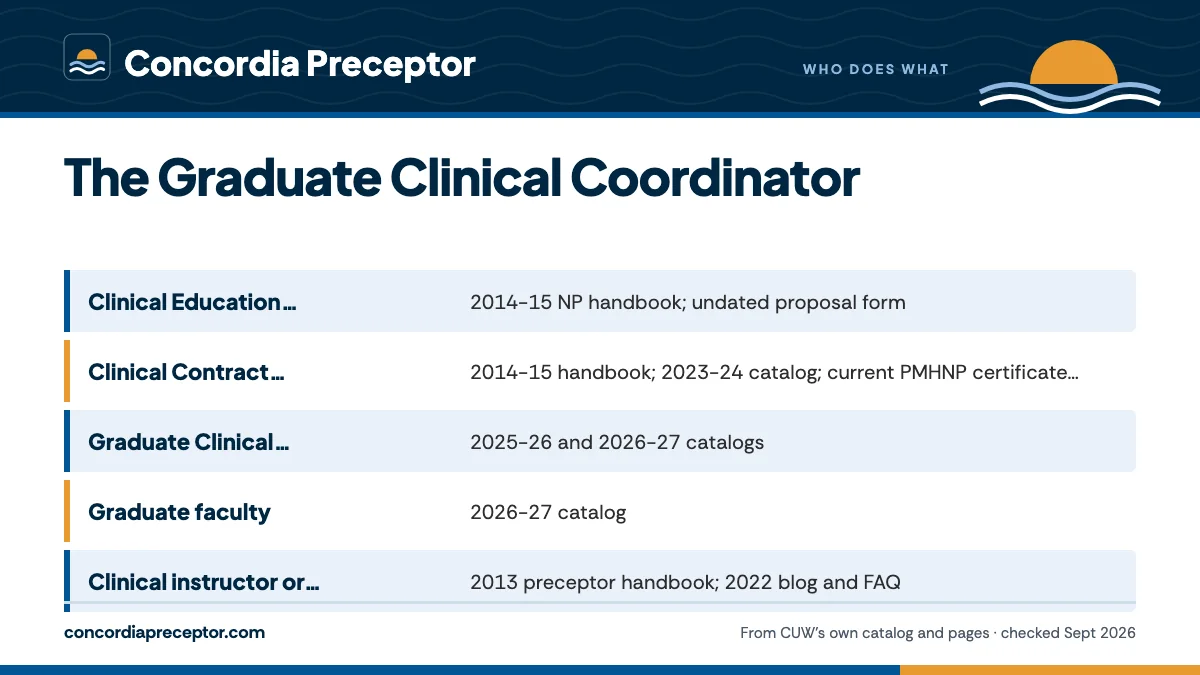
CUW's 2013-2015 NP documents describe a division of labor that explains why today's single title covers so much. Use the table to match your question to the role most likely to own it.
| Role | Where CUW names it | What it did |
|---|---|---|
| Clinical Education Coordinator | 2014-15 NP handbook; undated proposal form | First review of the proposal form; copied when a student released a preceptor who had agreed |
| Clinical Contract Coordinator | 2014-15 handbook; 2023-24 catalog; current PMHNP certificate page | Checked for an existing site contract, handled new ones, told students when clinicals could begin |
| Graduate Clinical Coordinator | 2025-26 and 2026-27 catalogs | Available for assistance with securing preceptors |
| Graduate faculty | 2026-27 catalog | Approve preceptors and sites for appropriateness |
| Clinical instructor or adjunct clinical faculty | 2013 preceptor handbook; 2022 blog and FAQ | Visits the site at least once a semester; evaluates the student |
| Graduate Nursing Department | 2009 preceptor handbook | Received the practicum proposal for approval |
CUW's faculty page also lists a Director of Graduate Nursing and a Psychiatric Coordinator. Their clinical duties are not described publicly, so ask your course faculty whether PMHNP placement questions go to a different person.
Graduate faculty make the approval decision
The coordinator helps, but approval sits with faculty. The catalog says preceptors must be "approved for appropriateness by the graduate faculty," and the AGPCNP page says sites are reviewed and approved by CUW's nursing faculty. The 2022 program FAQ described what that review checks: that the preceptor is properly credentialed and that the site lets you meet the course objectives.
Wisconsin law points the same way for schools in the state. Rule N 1.08(6) of the Wisconsin Administrative Code says clinical preceptors shall be approved by the faculty of the school of nursing, so for a Wisconsin school, faculty approval is a state requirement as well as CUW policy.
Your course faculty also shape the clinical once it starts. In the 2014-15 handbook the adjunct approved your learning objectives before the preceptor signed them, and faculty visited the site each semester. The logs and evaluations guide covers that side.
What to bring to your first coordinator conversation
A focused first message gets a focused answer. Send it from your CUW Webmail so the thread stays in one place, and include the facts the coordinator needs to act.
- Your program and track, and the exact clinical course, for example
NURS 7265orNURS 7515. - The term and session you are placing, from CUW's 2026-27 calendar.
- The city and state of the site, and whether it belongs to a health system.
- The preceptor's role and credentials: license, national board certification and years in practice.
- Whether the site is your employer, and if so, which unit you work on.
- Any paperwork the site has already sent you.
Then ask the questions only CUW can answer: the current proposal form and due date, whether CUW already has an agreement with the site, the preceptor rules for your track, and how hours are logged this year. The placement process guide shows where each answer fits.
Questions that belong somewhere else
Not every clinical question is a coordinator question. Sending each one to the right place gets you a faster answer and keeps your coordinator thread about the placement itself.
Registration, course schedules and grades live in Self-Service Banner and Concordia Central, reached through the Portal at my.cuw.edu. Background-check status sits in your Castle Branch account; the Castle Branch guide explains what it tracks. Vaccination rules come from the site itself, since CUW asks students to meet each clinical site's requirements.
Licensure questions about another state start with CUW's Distance Education Disclosures and that state's board of nursing. CUW's catalog makes confirming out-of-state eligibility the student's responsibility, so bring the coordinator a specific question rather than an open one. The student systems guide maps the rest.
Why CUW students bring us in before that conversation
A coordinator conversation goes furthest when the placement behind it is already complete. Our placement desk gets you to that meeting with the hard part done: a preceptor matched to your CUW course and state, their license, board certification and CV in hand, and the site's details written up.
We also flag in advance whether the site is likely to need a new CUW contract, so you can raise it in your first message instead of your third. Across all three clinical courses we keep the plan moving, and if a preceptor drops out we restart the search at once. You remain CUW's point of contact and faculty make every decision. See how it works or start here.
Questions CUW students ask
Is the Graduate Clinical Coordinator the same as the Clinical Contract Coordinator?
It appears to be the same role under a newer title. The 2023-24 catalog said Clinical Contract Coordinator, the 2025-26 and 2026-27 catalogs say Graduate Clinical Coordinator, and the current PMHNP certificate page still uses the older name. If the two titles ever point to different people for your track, your course faculty can clarify.
Does the Graduate Clinical Coordinator find preceptors for students?
CUW's catalog puts the search on the student and describes the coordinator as available for assistance. It does not say the coordinator assigns preceptors. Ask directly what help is available for your track, and arrive with your own leads so the conversation can move to approval.
Who approves my preceptor at CUW, the coordinator or faculty?
Graduate faculty. The 2026-27 catalog says preceptors must be approved for appropriateness by the graduate faculty, and the 2022 FAQ says faculty check credentials and whether the site supports the course objectives. In the archived process, the coordinator roles handled review routing and contracts around that decision.
Who visits me at my clinical site?
A CUW clinical instructor. The 2022 blog and FAQ describe at least one site visit each semester, with more if needed, and the 2013 preceptor handbook said adjunct clinical faculty visited each student at least once a term. Your course faculty can tell you who holds that role this term.
How do I contact the Graduate Clinical Coordinator?
CUW's public pages name the role without listing a direct contact for it. Ask your course faculty or your academic advisor, and write from your CUW Webmail account so your placement messages stay together. Include your program, course number and term in the subject line.
Related pages
Last checked 2026-09-26
We check these pages against CUW's own academic catalog, program pages and published nursing documents. Your course faculty and the Graduate Clinical Coordinator have the final word.
- Concordia University Wisconsin Academic Catalog 2026-2027: MSN Primary Care Nurse Practitioner
- Concordia University Wisconsin: MSN Adult-Gerontology Primary Care Nurse Practitioner
- Concordia University Wisconsin: Psychiatric Mental Health Nurse Practitioner Certificate
- Concordia University Wisconsin 2023-2024 Graduate Catalog (Clinical Contract Coordinator wording)
- Concordia University Wisconsin NP Student Clinical Practicum Handbook 2014-2015 (archived)
CUW asks you to secure your preceptors. We make the search the easy part.
Tell us your CUW track, your city and your next clinical course. We line up preceptors who fit the NURS course, gather the license, board certification and site details CUW's graduate faculty review, and flag early whether the site needs a new clinical contract.
- Preceptors matched to the course: primary care for FNP and AGPCNP, mental health settings for PMHNP, an agency mentor for DNP projects
- Preceptor license, certification, CV and site details ready for CUW's approval
- All three clinical courses planned together, close to home in a state CUW's disclosure lists for your program
Start your placement plan
Track, city and next clinical course is all we need to begin.