Clinical logs, evaluations and site visits at CUW
Concordia University Wisconsin's current pages name no clinical logging system, so the detailed process comes from its 2013-2015 NP handbooks, which ran everything through Typhon. What has held steady across CUW's dated sources is the rhythm: hours your preceptor signs off, midterm and final evaluations, and a faculty site visit at least once a semester. Your course faculty tell you which system and forms apply now.
Get your placement plan
Tell us your CUW program and where you live. A placement advisor replies with the preceptor and site options that fit your course.
What CUW says about tracking today
Very little, in public. CUW's current program pages mention faculty review and approval of placements, and a search of the 2026-27 catalog returns nothing for Typhon, Exxat, ACEMAPP, Medatrax or InPlace. No current CUW nursing page names a clinical log system or an evaluation form.
Typhon is confirmed only for 2013 to 2015, when CUW's NP clinical handbooks ran logs, schedules, uploads and evaluations through the Typhon Group NP Student Tracking System. Whether CUW still uses it is not stated anywhere current. Ask your course faculty which system and forms your clinical uses before you log your first hour, and keep your own dated record from day one so nothing depends on a single platform.
The rhythm, though, has stayed consistent from the 2009 preceptor handbook to the 2022 blog: logged hours your preceptor signs, midterm and final evaluations, and at least one faculty visit a semester. Plan for that rhythm whatever the software turns out to be.
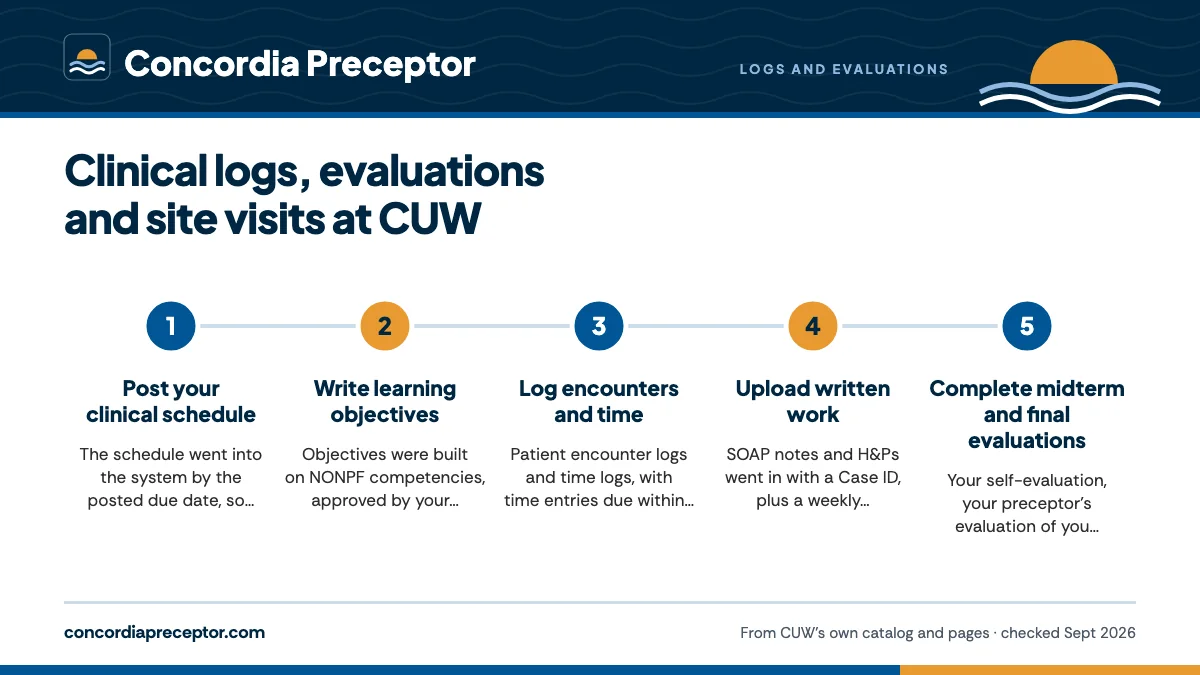
The archived Typhon workflow, step by step
This is how CUW's 2014-15 NP Student Clinical Practicum Handbook laid out a clinical semester. Read it as a picture of the workload, not as today's instructions.
- Post your clinical scheduleThe schedule went into the system by the posted due date, so faculty knew when and where you would be.
- Write learning objectivesObjectives were built on NONPF competencies, approved by your clinical adjunct, signed by your preceptor and uploaded again.
- Log encounters and timePatient encounter logs and time logs, with time entries due within seven days of the hours worked.
- Upload written workSOAP notes and H&Ps went in with a Case ID, plus a weekly reflective journal in the first clinical (APN I).
- Complete midterm and final evaluationsYour self-evaluation, your preceptor's evaluation of you (online, or on paper signed and uploaded) and your adjunct's evaluation.
- Close the termA Documentation of Hours form signed by each preceptor and an End-term Documentation Checklist. The grade was held if either one was missing.
Who evaluates whom
Evaluation at CUW has run in both directions. You are rated at midterm and at the end of the term, and you rate the people and places that taught you.
| Evaluation | Completed by | Timing |
|---|---|---|
| Student self-evaluation | You | Midterm and final |
| Evaluation of the student | Your preceptor | Midterm and final |
| Faculty evaluation of the student | Your clinical adjunct | Midterm and final |
| Evaluation of the preceptor | You | End of term |
| Evaluation of the site | You | End of term |
| Evaluation of CUW clinical faculty | You | End of term |
| Documentation of Hours | Signed by each preceptor | End of term |
The 2009 forms added a Planning and Tracking Form, a Patient/Student Log, Recommendations for Future Learning and three graded SOAP notes each semester. Your preceptor's share of this is worth explaining before they agree; the preceptor page is written for them.
The faculty site visit
Every CUW source that mentions the visit agrees on the minimum: at least one per semester. CUW's 2022 blog says the clinical instructor visits the site at least once a semester, the 2022 program FAQ adds that more visits happen when needed, and the 2013 preceptor handbook assigned each student's visit to the adjunct clinical faculty member.
The 2014-15 handbook timed the visit around midterm and had the adjunct observe at least one patient encounter. Give your preceptor and the office manager notice, pick a day with a typical patient mix, and bring your logs up to date beforehand.
CUW's sources do not say how visits work for students far from Mequon, including whether a visit can happen by video. Ask your course faculty early, so your site knows what to expect and can plan the day.
DNP residency logs and mentor checks
CUW's undated DNP residency forms, archived in 2023, used a Clinical Residency Log / Translational Research Project Log in which each entry was coded C for clinical work or T for translational project work. A separate Clinical Residency I and II Preceptor and Student Self-Evaluation rated DNP competencies.
For the Post-MSN DNP, the 2022 program page said faculty may contact your mentor at any time to verify hours, and capped indirect patient care outside your current practice at 120 of the 500 in-program hours. Current pages drop those numbers, so confirm the rule with your course faculty. Post-BSN to DNP students keep a parallel record for the project courses: NURS 9040 includes practicum hours tied to the DNP Project, and the NURS 9030 to NURS 9032 immersions pair you with a mentor from a health care agency. The DNP project practicum guide covers that mentor role.
Habits that keep every hour countable
- Log on the day you work. The archived rule allowed seven days, but late entries make a midterm evaluation harder to support.
- Get one signed hours record per preceptor. If a preceptor leaves mid-term, collect the signature before they go; preceptor dropped out covers the rest.
- Spread hours across the semester. The 2014-15 handbook wanted them evenly distributed and not wrapped up more than two weeks before the term ends.
- Keep orientation time small. The same handbook counted at most 8 hours a semester of orientation, shadowing or pre-approved conference time.
- Stay out of your own unit at work. Hours there did not count, and the student was pulled from the site.
- Keep copies of everything you sign or upload, outside any school system.
Pacing gets its own treatment on pacing clinical hours.
Why CUW students choose us: preceptors who know the workload
A preceptor who agrees without knowing about midterm and final evaluations, a signed hours form and a faculty visit is a preceptor more likely to step back halfway through. We brief every preceptor on CUW's evaluation rhythm before they commit, and we give them a written summary of what CUW will ask of them and when. Through the term we stay on call for you both, so a question about a form or an evaluation date gets settled before it turns into a problem.
If a preceptor does step away mid-course, we find the replacement and help you close out the first preceptor's signed hours so none of them are lost and your course faculty receive a clean record. See how it works or start your search.
Questions CUW students ask
Does CUW still use Typhon for clinical logs?
CUW has not said so publicly. Typhon is documented in CUW's NP handbooks for 2013 to 2015, and the 2026-27 catalog mentions neither Typhon nor any other clinical tracking product. Your course faculty will tell you which system your clinical uses; until then, keep your own dated record of hours and patient encounters.
How often does CUW faculty visit my clinical site?
At least once a semester, according to CUW's 2022 blog and program FAQ, with more visits when needed. The 2014-15 handbook scheduled the visit around midterm and had the clinical adjunct observe at least one patient encounter. Ask your course faculty how the visit will be arranged for your particular site.
What paperwork does my preceptor complete for CUW?
In CUW's archived handbooks, the preceptor signed your learning objectives, evaluated you at midterm and at the end of the term, and signed a Documentation of Hours form covering the time you spent together. Current forms come from your course faculty, so share them with your preceptor early.
What happens if my hours form is missing at the end of the term?
Under the 2014-15 handbook, the grade was held until the signed hours form and the end-term checklist were in. The 2026-27 catalog gives incomplete work three weeks after the term's final day, six in some cases, before it can become a failing grade. Collect every signature before your last shift.
Do CUW students evaluate their preceptors?
Yes, in every archived CUW handbook that covers evaluations. Students rated the preceptor, the clinical site and CUW's clinical faculty at the end of the term. Current forms may differ in format, so follow your course faculty's instructions, and keep your comments specific and fair.
Related pages
Last checked 2026-09-26
We check these pages against CUW's own academic catalog, program pages and published nursing documents. Your course faculty and the Graduate Clinical Coordinator have the final word.
- Concordia University Wisconsin: NP Student Clinical Practicum Handbook 2014-2015 (archived)
- Concordia University Wisconsin blog: MSN Clinicals, What are they like? (2022)
- Concordia University Wisconsin: MSN program page with FAQs (archived 2022)
- Concordia University Wisconsin: Nurse Practitioner Preceptor Handbook (archived)
- Concordia University Wisconsin: DNP Clinical Residency Log (archived)
CUW asks you to secure your preceptors. We make the search the easy part.
Tell us your CUW track, your city and your next clinical course. We line up preceptors who fit the NURS course, gather the license, board certification and site details CUW's graduate faculty review, and flag early whether the site needs a new clinical contract.
- Preceptors matched to the course: primary care for FNP and AGPCNP, mental health settings for PMHNP, an agency mentor for DNP projects
- Preceptor license, certification, CV and site details ready for CUW's approval
- All three clinical courses planned together, close to home in a state CUW's disclosure lists for your program
Start your placement plan
Track, city and next clinical course is all we need to begin.