Precepting a Concordia University Wisconsin NP student
A Concordia University Wisconsin nurse practitioner student has asked you to supervise their clinical hours, or may soon. The commitment is a set block of hours in your practice, an approval of your credentials by CUW's graduate faculty, a clinical contract between CUW and your organization, and a few evaluations along the way. Our placement desk handles the logistics around it, so your part stays focused on teaching.
Offer to precept a CUW student
Tell us your specialty, your practice's city and the terms you could host a student. Your placement advisor replies with what CUW will ask of you.
Who the student is and how many hours they need
CUW's online graduate nursing students are registered nurses, and in the PMHNP certificate and PMHNP DNP, nurse practitioners adding a psychiatric focus. Each one works through a set sequence of clinical courses and asks a preceptor to cover one course or part of one.
| Track | Courses | Hours per course | Setting |
|---|---|---|---|
| FNP (MSN, dual degrees, CAGE) | NURS 7151, NURS 7152, NURS 7153 | 250 each | Primary care across the lifespan |
| AGPCNP (MSN, CAGE) | NURS 7265, NURS 7266, NURS 7267 | 250 each | Adult and older-adult primary care |
| PMHNP (MSN, DNP, CAGE) | NURS 7510, NURS 7515, NURS 7520 | 125, 200, 175 | Psychiatric and mental health settings |
| Post-BSN to DNP | Primary Care Clinical Residencies I-III | 120 in Residency I; II and III not published | Primary care |
The PMHNP practicums ask for less time each term than the 250-hour primary care courses.
What CUW asks of a preceptor
CUW's current catalog asks one thing publicly: that its graduate faculty find each preceptor and site appropriate. It posts no credential checklist, so the student's course faculty and the Graduate Clinical Coordinator hold the current version. Older CUW documents, dated below, show what faculty have looked for.
- 2022 program FAQ: two or more years of clinical practice, plus a state license and board certification.
- 2014-15 NP clinical handbook: a nurse practitioner, physician assistant, certified nurse midwife or physician (MD or DO), in practice for at least a year, with national board certification for NPs, PAs and CNMs, working in primary care for the primary care tracks.
- Same handbook: at least 50 of the student's program hours with an NP, no more than 400 with any one preceptor, and at most two preceptors a semester without approval.
- Same handbook: the preceptor may not treat the student or the student's family as patients, and the student may not train on their own unit at work.
Wisconsin adds a rule for clinicals inside its borders: N 1.08(6) asks that a preceptor's Wisconsin license or privilege be unencumbered and at or above the student's intended level, with approval from the school's faculty. Psychiatric (PMHNP) preceptor standards have not been published by CUW. The fuller list, with its conflicts, is on CUW preceptor requirements.
The paperwork, and who carries it
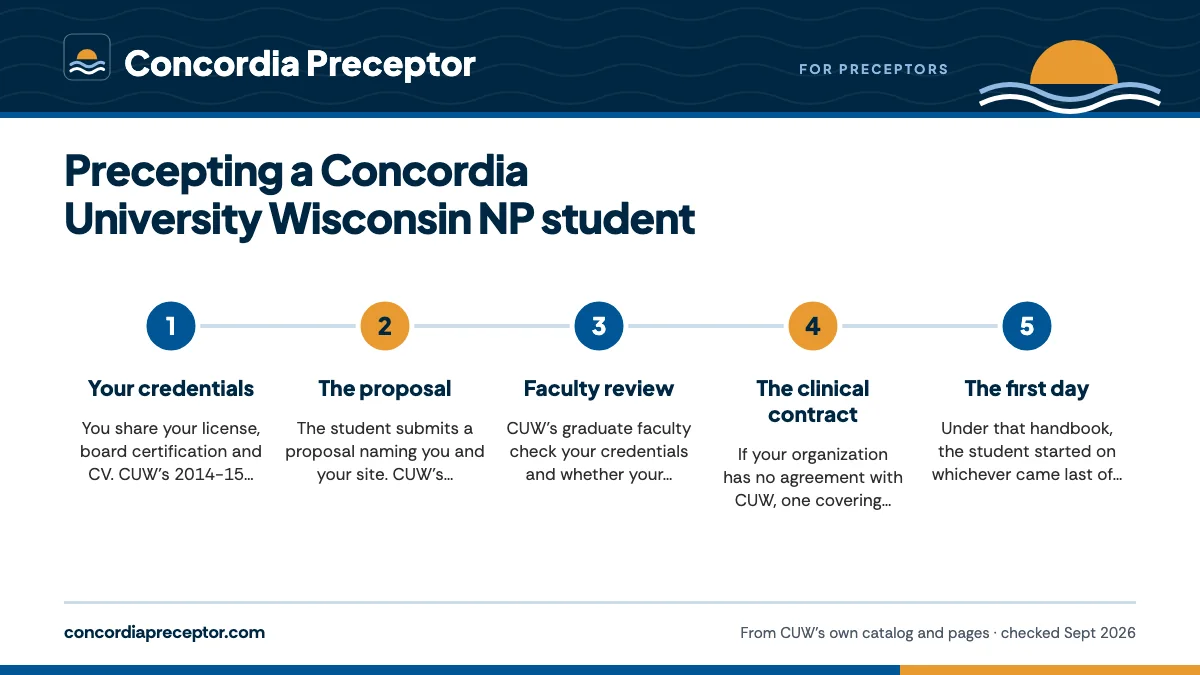
- Your credentialsYou share your license, board certification and CV. CUW's 2014-15 handbook asked preceptors for exactly these, and the archived proposal form noted that national certification was needed for accreditation purposes.
- The proposalThe student submits a proposal naming you and your site. CUW's archived form called for a new one every semester for each preceptor and site, filed four weeks ahead of clinicals or earlier; current dates come from the student's faculty.
- Faculty reviewCUW's graduate faculty check your credentials and whether your practice lets the student meet the course objectives.
- The clinical contractIf your organization has no agreement with CUW, one covering responsibilities and liability goes to your organization to sign. CUW's 2014-15 handbook said drafting and signing a new one could run eight to twelve weeks, and patient care waits until it is done.
- The first dayUnder that handbook, the student started on whichever came last of three events: a signed contract, approved documents, or the semester's first day.
How agreements are drafted and signed, and what to expect if your organization writes its own, is on clinical contracts.
What the semester looks like for you
CUW's archived handbooks describe a steady rhythm. The student drafts learning objectives with CUW faculty and you sign them. Hours are spread across the term rather than packed into the first weeks; the 2014-15 handbook asked that they not wrap up earlier than two weeks before the term's end. By the midpoint of the first clinical, the student was expected to be handling five to eight patients a day.
A CUW clinical faculty member comes to the site once a semester or more (per CUW's 2022 FAQ and blog), and in the 2014-15 process watched at least one patient encounter. You complete mid-term and final evaluations of the student and sign a record of the hours worked with you. Forms once ran through Typhon (2013-15); the student tells you how they arrive now. More on logs and evaluations.
Precepting a CUW student is unpaid, volunteer teaching. CUW's public pages mention no compensation or continuing-education credit for preceptors.
DNP mentors: a different role
DNP students also need a mentor for leadership and project hours. The catalog pairs DNP students with preceptors or mentors to grow their leadership and back their project, and the Post-BSN DNP's immersion courses (NURS 9030 to NURS 9032) place the student with a mentor in a selected health care agency.
An undated CUW DNP residency form set out the mentor's part: goal setting, guidance on leadership growth, regular meetings and contact with CUW faculty. A 2022 CUW page added that faculty could reach out to the mentor whenever they wished to confirm hours. If you lead a practice, quality program or service line, the project can serve your organization too. Details for mentors are on the DNP project practicum.
How we make precepting easy
Our placement desk exists so that saying yes costs you as little time as possible. Before a student reaches you, we confirm the course, the hours and the dates, and we check that your practice fits CUW's setting rules. We collect your license, certification and CV once and keep them ready for each term you host, and at our first conversation you learn whether your organization already has a CUW contract or needs one, so any review on your side can start early.
During the semester your placement advisor is the student's first call for scheduling and paperwork questions, which keeps those off your desk. If your availability changes, tell us and we find the student another preceptor, so no one is left short of hours. To offer your time, choose "I'm a preceptor (not a student)" in the form and tell us your specialty, location and the terms you could host.
Questions CUW students ask
Are preceptors paid to precept CUW students?
Precepting a CUW student is unpaid. CUW's public pages describe no compensation or continuing-education credit for preceptors. What we offer instead is less work around the teaching itself: the scheduling, the credential gathering and the contract question handled for you.
Can a physician or PA precept a CUW NP student?
CUW's 2014-15 NP handbook accepted physicians (MD or DO), physician assistants and certified nurse midwives as well as NPs, provided at least 50 of the student's program hours were spent with an NP. Current CUW pages list no credentials, so the student's faculty confirm what applies today, especially for PMHNP students.
How long does a clinical contract with CUW take?
A first contract took eight to twelve weeks in CUW's 2014-15 handbook, and its archived proposal form said up to 12. If your organization already has an agreement with CUW, this step may be short. We ask about it in our first conversation.
Do I need a Wisconsin license to precept a CUW student?
For clinicals in Wisconsin, yes. Rule N 1.08(6) looks for a Wisconsin license or privilege with no encumbrance, at the student's target level or higher. Wisconsin NPs now hold the APRN license that replaced the APNP credential on September 1, 2026. For clinicals elsewhere, that state's rules and CUW's faculty decide. See Wisconsin NP practice.
How many hours a week would a CUW student need?
It depends on the course. A 250-hour primary care course spread over about 13 weeks works out to roughly 19 or 20 hours a week, in line with CUW's 2022 picture of about 30 days of 8-10 hour shifts. PMHNP practicums run 125 to 200 hours, so their weekly load is lighter.
Related pages
Last checked 2026-09-26
We check these pages against CUW's own academic catalog, program pages and published nursing documents. Your course faculty and the Graduate Clinical Coordinator have the final word.
- Concordia University Wisconsin Academic Catalog 2026-27: MSN Nurse Practitioner
- Concordia University Wisconsin: NP Student Clinical Practicum Handbook 2014-2015 (archived)
- Concordia University Wisconsin: Nurse Practitioner Preceptor Handbook, 2013 (archived)
- Wisconsin Administrative Code ch. N 1 (preceptor rule N 1.08(6), archived)
- Concordia University Wisconsin blog: MSN clinicals, what are they like? (2022)
CUW asks you to secure your preceptors. We make the search the easy part.
Tell us your CUW track, your city and your next clinical course. We line up preceptors who fit the NURS course, gather the license, board certification and site details CUW's graduate faculty review, and flag early whether the site needs a new clinical contract.
- Preceptors matched to the course: primary care for FNP and AGPCNP, mental health settings for PMHNP, an agency mentor for DNP projects
- Preceptor license, certification, CV and site details ready for CUW's approval
- All three clinical courses planned together, close to home in a state CUW's disclosure lists for your program
Start your placement plan
Track, city and next clinical course is all we need to begin.