How to pace 250 clinical hours in one semester
Concordia University Wisconsin's 2022 program FAQ set the rhythm: at least 250 clinical hours a semester, spread across the term, which it pictured as roughly 30 shifts of 8 to 10 hours finished in about 13 weeks. That is roughly two clinic days a week beside your job. The weekly load jumps to about 31 hours if your clinical runs as an 8-week course, which is how CUW's progression plans label it, so settle the length before you promise a preceptor a schedule.
Get your placement plan
Tell us your CUW program and where you live. A placement advisor replies with the preceptor and site options that fit your course.
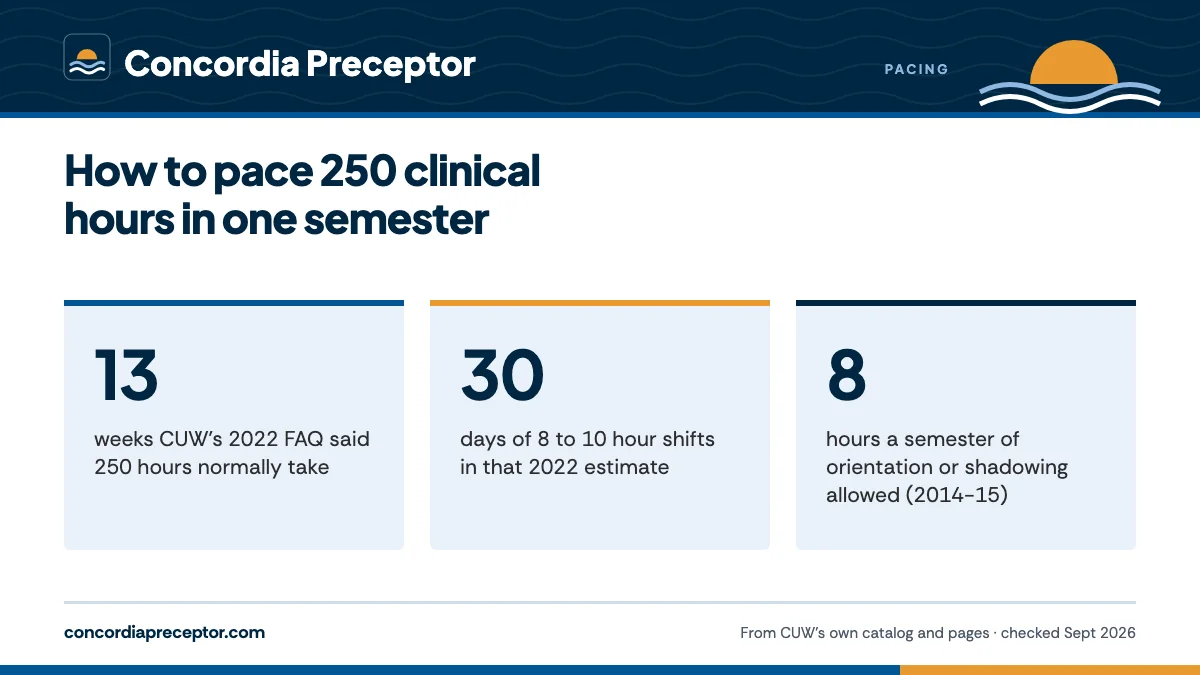
The rhythm CUW described
Two archived CUW sources describe how the hours should flow, and they agree. The 2022 MSN FAQ asked for at least 250 clinical hours a semester, spread across the semester rather than bunched together, and pictured the load as roughly 30 clinic days, each 8 to 10 hours long, typically wrapped up within 13 weeks. It added that clinical courses begin right after Health Assessment and follow one another in order.
The 2014-15 NP clinical practicum handbook went further. It wanted an even spread from start to finish, with the last hours falling inside the semester's final two weeks. Orientation, shadowing and approved conferences together could supply 8 hours a term at most. By the halfway mark of a first clinical, a student was expected to manage five to eight patients a day. Your current syllabus sets today's version of these rules.
Weekly targets at different course lengths
The math is simple, but it changes the ask you make of a preceptor. The table divides each course's hours by the number of clinical weeks. The figures are arithmetic, not CUW rules, and they assume you log every week.
| Course and length | Hours a week | 10-hour days a week |
|---|---|---|
| 250 hours over a 16-week semester | About 16 | 1 to 2 |
| 250 hours over 13 weeks (2022 FAQ) | About 19 | About 2 |
| 250 hours over an 8-week session | About 31 | About 3 |
PMHNP NURS 7510, 125 hours over 13 weeks | About 10 | About 1 |
PMHNP NURS 7515, 200 hours over 13 weeks | About 15 | 1 to 2 |
PMHNP NURS 7520, 175 hours over 13 weeks | About 13 | 1 to 2 |
For FNP and AGPCNP students the jump from 13 weeks to 8 is the one that matters: two days a week becomes three, a hard fit around full-time nursing shifts. The PMHNP courses carry lighter loads, with the heaviest in the middle practicum.
Eight weeks or a full semester?
CUW's own documents point both ways. The MSN progression plans from February 2024 label each primary care clinical, NURS 7151 to NURS 7153 and NURS 7265 to NURS 7267, an 8-week course. The 2026-27 catalog's sample plan tags other courses as 8-week sessions but gives the clinicals no session tag, which suggests they run the full semester. The program pages list course lengths of 8 to 16 weeks, and the 2022 FAQ talked about 13 weeks.
Ask your course faculty in writing before registration which length your clinical runs and whether hours may start before the course's first day. The answer decides how many days a week you ask of a preceptor, and it is much easier to agree on at the start than to renegotiate mid-course. The semester calendar shows where the 8-week sessions fall.
The 2026-27 calendar, gaps included
Fall 2026 runs August 24 to December 13, with Session II starting October 19. Its days off are Labor Day (September 7), the Seventh Friday Break (October 9) and Thanksgiving (November 25-27). Spring 2027 runs January 11 to May 9, with Session II from March 15 and days off for Martin Luther King Jr. Day (January 18), the Sixth Friday Break (February 19), spring recess (March 8-12) and Easter (March 25-28). Summer starts May 17, with a 14-week session ending August 22.
CUW's public pages do not say whether clinical hours may be logged during university breaks, and a preceptor's clinic may close on some of those days anyway. Count only the weeks you know you will be on site. A late contract also eats weeks. The 2014-15 handbook would not let a clinical begin before the contract was signed and every document approved, even if the semester was already under way.
Building a schedule a busy preceptor can keep
The best schedules are fixed early and written down. Agree on the same days each week, the shift length and the total you need by the course's midpoint, when evaluations happened under the archived process. Leave two or three spare weeks for illness, clinic closures and the site visit your clinical instructor makes at least once a semester.
Log as you go. In 2014-15 CUW gave students a week to enter each day's time, and at term's end every preceptor put a signature on the student's hours. If one clinician cannot give you enough days, a second is the answer: the archived rules let a student work with two in one term before faculty approval was needed, so two clinicians can share a three-day week. See clinical logs and evaluations for the tracking side.
When the pace slips
Falling behind is recoverable if you act before the term ends. An Incomplete buys a short window: CUW's grading rules expect the missing work three weeks after the term closes, six at the outside. Catalog language for two programs, the Post-BSN to DNP and the PMHNP certificate, adds that weaker performance can mean extra hours. And since each clinical unlocks the next one, a course left open can delay registration for the one that follows.
When the cause is a preceptor who can no longer give the days promised, the fix is a second clinician fast. Our placement desk plans for that before it happens: we confirm each clinician's weekly availability for the whole course before the introduction, and if a preceptor steps back, your advisor starts a replacement search at once. The behind on clinical hours and preceptor dropped out pages walk through recovery, and the form below reaches the desk.
Questions CUW students ask
How many hours a week are CUW NP clinicals?
It depends on the course length. CUW's 2022 FAQ expected 250 hours over about 13 weeks, which averages roughly 19 hours, or two 10-hour days, a week. If your clinical runs as an 8-week course, as the 2024 progression plans label it, the average rises to about 31 hours a week.
Can I finish my CUW clinical hours early?
Only slightly, under CUW's archived guidance. The 2014-15 handbook set a two-week limit: hours could wrap up at most two weeks ahead of the semester's end, after a steady pace throughout. The 2022 FAQ likewise wanted the hours spread over the term. Check with course faculty before building a front-loaded schedule.
Do orientation days count toward CUW clinical hours?
Only a little, under the archived rules. In the 2014-15 handbook, a term's orientation, shadowing and pre-approved conference time could add 8 hours to the count and no more. Site onboarding and computer training that a clinic requires may take longer than that, so schedule it before your counted clinical days begin.
Can I log clinical hours during Thanksgiving or spring recess?
CUW's public pages do not say. The 2026-27 calendar lists Thanksgiving break November 25 to 27 and spring recess March 8 to 12, and your preceptor's clinic may keep its own hours. Ask your course faculty whether break-week hours count before you plan on them.
How many preceptors can I use to reach 250 hours?
In CUW's 2014-15 handbook, a second preceptor in the same term needed no special permission, a third did, and no single preceptor could supervise more than 400 of a student's program hours. Splitting a course between two clinicians is a practical way to reach the weekly pace. The clinical hours page lists the other archived counting rules.
Related pages
Last checked 2026-09-26
We check these pages against CUW's own academic catalog, program pages and published nursing documents. Your course faculty and the Graduate Clinical Coordinator have the final word.
CUW asks you to secure your preceptors. We make the search the easy part.
Tell us your CUW track, your city and your next clinical course. We line up preceptors who fit the NURS course, gather the license, board certification and site details CUW's graduate faculty review, and flag early whether the site needs a new clinical contract.
- Preceptors matched to the course: primary care for FNP and AGPCNP, mental health settings for PMHNP, an agency mentor for DNP projects
- Preceptor license, certification, CV and site details ready for CUW's approval
- All three clinical courses planned together, close to home in a state CUW's disclosure lists for your program
Start your placement plan
Track, city and next clinical course is all we need to begin.