NURS 7151: Advanced Primary Care Clinical I - FNP
NURS 7151 is the first of three clinical courses in Concordia University Wisconsin's FNP track, worth 4 credits and 250 precepted hours in primary care under CUW's February 2024 progression plans. It opens after three foundation courses: pathophysiology, health assessment and pharmacotherapeutics. It is also the course where your first preceptor, your first site approval and possibly your first clinical contract all arrive at once.
Get your placement plan
Tell us your CUW program and where you live. A placement advisor replies with the preceptor and site options that fit your course.
What Clinical I covers
The 2026-27 catalog describes NURS 7151 as a didactic and clinical course on common episodic and chronic conditions "throughout the adult lifespan", with health promotion and disease prevention built in. The adult wording is a quirk of the description, since the FNP track prepares you for every age; Clinical II and III widen the range to the whole lifespan.
In practice, Clinical I rewards a practice with a steady adult panel and the mix of chronic, episodic and preventive visits that fills a family or internal medicine schedule. The course is shared by the MSN FNP, both FNP dual degrees (MBA and MPH) and the CAGE FNP certificate. It was numbered MSN 851 in 2020-21 and NURS 751 until the 2024-25 renumbering.
Prerequisites and where the course sits
Three courses must be finished first. The catalog lists them with their older numbers as alternatives:
- Advanced Pathophysiology:
NURS 536orNURS 6036 - Advanced Health Assessment:
NURS 638orNURS 6038, including its on-campus days - Pharmacotherapeutics:
BIO 542orNURS 6042
In the catalog's sample MSN FNP plan, Clinical I sits in semester 5, Clinical II in semester 7 and Clinical III in semester 8, directly after the health assessment intensive in semester 4. CUW's 2022 program FAQ put it the same way: clinical courses start straight after Health Assessment and run in sequence. The registration policy drops a student from a course whose prerequisites were not completed successfully, so a problem in any of the three can stall Clinical I.
One open question: CUW's February 2024 plans mark NURS 7151 as running 8 weeks, yet the catalog's semester grid leaves its session blank. Ask your course faculty which length applies, because 250 hours over 8 weeks is a very different weekly load from 250 over a full semester.
The preceptor and practice Clinical I calls for
Current CUW pages say only that preceptors are approved by the graduate faculty for appropriateness. The archived rules give a clear picture of what that meant. In 2022, CUW's program FAQ wanted preceptors with two or more years in practice, licensure in their state and board certification. Back in 2014-15, the handbook let an NP, PA, CNM, MD or DO precept, required national certification of the NPs, PAs and CNMs, and set aside a minimum of 50 program hours for time alongside an NP.
The site has to be primary care. CUW's 2022 blog ruled hospital, emergency and surgical settings out for FNP clinicals, and the 2014-15 handbook did not accept specialty clinics or inpatient units as a primary site. Starting Clinical I with a nurse practitioner covers the 50-hour NP rule early. Two conflicts to steer clear of: a clinician who treats you or a relative, and the unit where you are on staff. The preceptor requirements page gives the full dated list.
Clearing the paperwork before your first patient
CUW's current pages publish the approval model; the dates and forms below come from its archived handbook and proposal form, so confirm today's versions with the Graduate Clinical Coordinator.
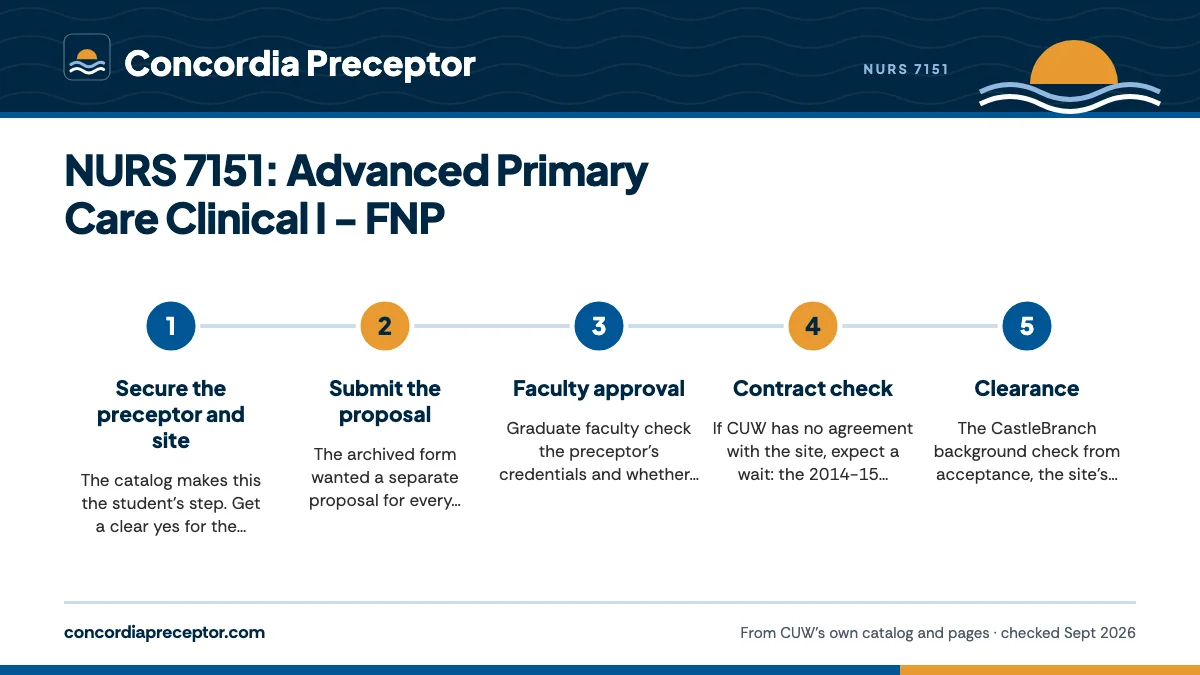
- Secure the preceptor and siteThe catalog makes this the student's step. Get a clear yes for the full 250 hours and the semester's dates.
- Submit the proposalThe archived form wanted a separate proposal for every preceptor and site pairing each term, filed at least four weeks ahead of the first clinical day. See the proposal form page.
- Faculty approvalGraduate faculty check the preceptor's credentials and whether the site can meet the course objectives.
- Contract checkIf CUW has no agreement with the site, expect a wait: the 2014-15 handbook put a fresh contract at eight to twelve weeks, and students saw no patients before it was signed.
- ClearanceThe CastleBranch background check from acceptance, the site's own vaccination rules and current CPR.
- Start dateIn 2014-15 the first clinical day was whichever came last: the signed contract, approval of every school and site document, or the opening day of the semester.
What a first CUW clinical asked of students
The 2014-15 NP handbook shows the expectations for the first clinical at the time, and they help you judge whether a practice is busy enough. Halfway through the course, students were carrying roughly five to eight patients a day.
- Course objectives drawn from the NONPF competencies, cleared by the clinical adjunct, then signed by the preceptor
- SOAP notes and histories and physicals uploaded for review
- A reflective journal each week of that first course
- Patient encounter logs and time logs, with each day's time entered inside a week
- A mid-term site visit in which the clinical adjunct watched at least one patient encounter
CUW's 2022 blog and FAQ confirm a site visit at least once a semester. CUW has not said publicly which tracking system courses use now; see logs and evaluations for the details on record.
Choosing a Clinical I preceptor with Clinical II in mind
Your first preceptor shapes the next two courses. The archived handbook held each preceptor to 400 hours of your program in total, so a clinician who takes all 250 hours of Clinical I has room for only 150 more. A practice that can host you again in NURS 7152 is likely to have its CUW contract in place by then, which takes the longest wait out of the next approval. If you split Clinical I between two clinicians, that fits the old handbook, which allowed a second preceptor in a term without asking and a third only with approval.
It pays to ask one more question up front: does the practice see children? Clinical II moves to problems across the life span, and Clinical III puts children, older adults and women's health issues in the foreground.
Why FNP students start Clinical I with our desk
Clinical I is where FNP students first feel how much lead time a placement takes. Our placement desk starts the search while you are still in Advanced Health Assessment, finds primary care clinicians near you who have the hours to give, and assembles each preceptor's license, certification and CV with a short profile of the practice, ready for faculty review.
We find out at the start whether CUW already has an agreement with the practice, so any contract time is built into your plan. Then we keep going: the Clinical II and III searches start before Clinical I ends. Tell us your start semester, your city and how far you will drive with the form below.
Questions CUW students ask
When do CUW FNP students take NURS 7151?
In the catalog's sample plan for the MSN FNP, NURS 7151 falls in semester 5, right after Advanced Health Assessment, with Clinical II and III in semesters 7 and 8. The three-year, three-and-a-half-year and four-year plans CUW posts move it around, so check the plan you were given at advising.
Can a physician precept NURS 7151?
Under CUW's 2014-15 handbook, yes: an MD or DO could precept, alongside NPs, PAs and CNMs, as long as 50 or more of the student's program hours were spent with a nurse practitioner. Current CUW pages publish no list, so the graduate faculty's approval of your specific preceptor decides it.
Is NURS 7151 the same course as NURS 751?
Yes. The first FNP clinical was MSN 851 in the 2020-21 catalog, became NURS 751 in 2021-22 and was renumbered NURS 7151 with the 2024-25 catalog. The 2026-27 catalog still accepts any of the three as the prerequisite for Clinical II. The hours rose from 240 to 250 in that time.
Can I do NURS 7151 hours in urgent care?
Primary care should carry the course. In CUW's 2014-15 handbook, urgent care was a secondary FNP setting limited to 100 hours over the entire program, and the 2022 blog kept emergency departments off the list altogether. Ask your course faculty before you propose any urgent care hours.
What if my NURS 7151 site needs a new contract?
Start earlier. CUW's 2014-15 handbook allowed eight to twelve weeks for a brand-new clinical contract, and students could not treat patients at the site until it was signed. Tell the Graduate Clinical Coordinator about the site as soon as the preceptor agrees, and read the clinical contracts page.
Related pages
Last checked 2026-09-26
We check these pages against CUW's own academic catalog, program pages and published nursing documents. Your course faculty and the Graduate Clinical Coordinator have the final word.
CUW asks you to secure your preceptors. We make the search the easy part.
Tell us your CUW track, your city and your next clinical course. We line up preceptors who fit the NURS course, gather the license, board certification and site details CUW's graduate faculty review, and flag early whether the site needs a new clinical contract.
- Preceptors matched to the course: primary care for FNP and AGPCNP, mental health settings for PMHNP, an agency mentor for DNP projects
- Preceptor license, certification, CV and site details ready for CUW's approval
- All three clinical courses planned together, close to home in a state CUW's disclosure lists for your program
Start your placement plan
Track, city and next clinical course is all we need to begin.