NURS 7152: Advanced Primary Care Clinical II - FNP
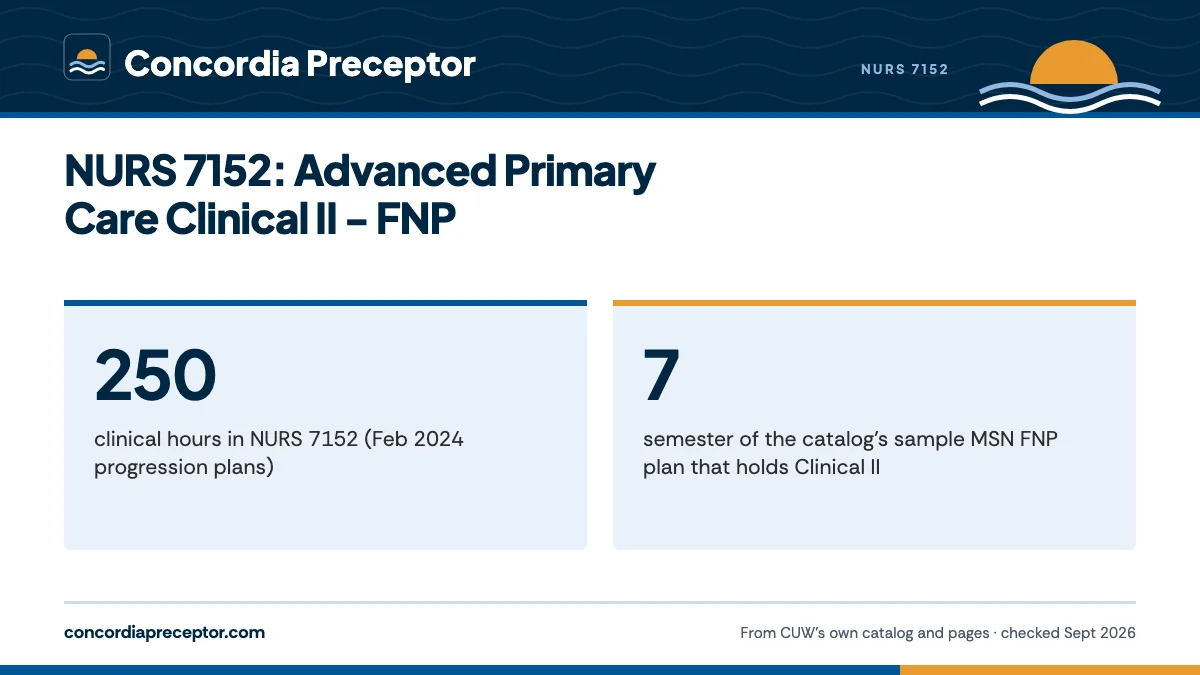
NURS 7152 Advanced Primary Care Clinical II - FNP is the middle course of Concordia University Wisconsin's three FNP clinicals: 4 credits and 250 hours under CUW's February 2024 plans. The patient range widens from Clinical I's adults to people of every age, and the course adds prevention at the community level through community partnerships. Both changes decide which practice fits.
Get your placement plan
Tell us your CUW program and where you live. A placement advisor replies with the preceptor and site options that fit your course.
How Clinical II differs from Clinical I
The catalog calls NURS 7152 a graduate didactic and clinical nursing course set in primary health care settings. Where Clinical I dealt with conditions across the adult years, Clinical II takes on common health problems across the life span, so infants, children and teenagers enter your caseload alongside adults. It also brings in a population view: prevention at the community level, carried out through community partnerships.
That second thread is easy to overlook when you choose a site. A family practice that runs outreach, screening events or school and employer partnerships gives you material for the community piece without leaving primary care. A clinic that sees adults only can still host hours, but it covers less of the description.
The same catalog text appears under the AGPCNP's NURS 7266, including the life span phrase, even though that track's sites are adult and gerontology primary care. FNP students follow the FNP course.
Prerequisite, timing and the risk of a stalled Clinical I
The only listed prerequisite is Clinical I, printed as MSN 851, NURS 751 or NURS 7151. In the catalog's sample MSN FNP plan, Clinical II lands in semester 7, with semester 6 between the two clinicals. The 3, 3.5 and 4-year progression plans move that spacing, and those plans label the course 8 weeks long, which the catalog grid does not confirm.
The chain is strict. CUW's registration policy removes a student from a course when a prerequisite was not completed successfully. An Incomplete in NURS 7151 has to be resolved within three weeks after the term ends, or six in justified cases, before it can turn into a failing grade. The 2025-26 catalog also required at least a B in every course; the 2026-27 pages do not restate it, so confirm the current rule with your advisor. If Clinical I hours are running short, act early; the behind on hours page lays out the options.
Stay with your Clinical I preceptor, or move?
Both routes work under CUW's archived rules, and each has a trade-off. Staying keeps a relationship that already works and a site whose paperwork CUW has already processed. Moving gives you a new panel, a new teaching style and, for many FNP students, the children Clinical I may not have included.
| Rule | What it means for Clinical II |
|---|---|
| No more than 400 program hours with one preceptor | A preceptor who gave you 250 hours in Clinical I can give at most 150 more |
| At most two preceptors a semester without prior approval | A split between your old preceptor and a new one fits the limit |
| One proposal per preceptor and site each semester | A returning preceptor still goes through a new proposal |
| Reviewers check whether a contract already exists | A returning site with a contract on file avoids the 8 to 12 week wait for a new one |
One plan that fits all four: stay for part of the semester and add a second, lifespan-focused preceptor for the rest. Confirm the current limits with your course faculty.
Finding a practice that sees every age
The cleanest fit for Clinical II is a family medicine practice with a genuine pediatric panel. Internal medicine offices and adult-only clinics usually leave a gap in the younger ages the course expects.
If your main practice sees few children, CUW's archived rules allowed secondary sites. Pediatrics, urgent care, women's health and geriatrics were each capped at 100 hours for the whole FNP program, so a pediatric office could add depth without taking over the course. Hours you spend there now reduce what remains for NURS 7153, which leans harder on pediatrics and women's health. The main site must stay in primary care, since CUW's 2022 blog excluded hospitals, emergency departments and surgery.
Second-semester paperwork
A new semester means a fresh round of approvals even when little has changed. Under the archived process, each preceptor and site needed its own proposal every semester, due no later than 4 weeks before the clinical start. After approval, students asked the site about any extra paperwork, orientation or computer training.
Site requirements also move on their own schedule. Vaccination rules belong to each clinical site, and CUW's 2022 blog noted that CUW grants no waivers or exemptions for them, so a new pediatric office may ask for records your Clinical I practice did not. Your CastleBranch record, CPR card and site onboarding should all be current before the first day. Build in time for a second contract if you add a site, because the proposal clock and the contract clock run separately. The clinical deadlines page puts the lead times on one calendar.
How our desk sets up Clinical II
We start on NURS 7152 while you are still in Clinical I. Your placement advisor asks your current preceptor whether they can continue and for how many hours, then searches for family practices near you with the pediatric volume and community reach the course describes.
Every new clinician comes with the license, board certification, CV and site details CUW's graduate faculty review, and we tell you early whether the practice will need a new clinical contract. If a preceptor withdraws mid-semester, we move straight to a replacement so your hours keep adding up. The same plan already covers who will take you for Clinical III. Send your track, city and Clinical II semester through the form below.
Questions CUW students ask
Does NURS 7152 need a pediatric preceptor?
The catalog asks for common problems across the life span in primary health care settings, not a separate pediatric rotation. A family practice that sees children fits well. Under CUW's 2014-15 handbook a separate pediatric office counted as a secondary site, capped at 100 hours for the program. Confirm the current rule with course faculty.
Can my NURS 7151 preceptor also take me for NURS 7152?
Under CUW's archived rules, yes, up to a limit: no preceptor could supervise more than 400 of your program hours, so after a full 250-hour Clinical I the same clinician can give about 150 more. Current CUW pages publish no cap, so the graduate faculty's approval of your plan settles it.
What was NURS 7152 called before?
It was MSN 852 in the 2020-21 catalog and NURS 752 from 2021-22 until the 2024-25 renumbering. In the 2020-21 catalog the course carried at least 240 hours; the current plans give it 250. NURS 7153 still lists MSN 852 and NURS 752 as acceptable prerequisites.
Is there a break between NURS 7151 and NURS 7152?
In the catalog's sample MSN FNP plan there is one semester between them: Clinical I in semester 5 and Clinical II in semester 7. Faster and slower progression plans change the spacing. Use any gap to secure the Clinical II preceptor and clear a new contract if the site needs one.
How do the community partnerships in NURS 7152 work?
The catalog names community-level prevention through community partnerships as part of the course but publishes no assignment details. Your syllabus and course faculty define the work. Choosing a practice with outreach or local partnerships gives you more to draw on. The primary care sites page covers the setting rules.
Related pages
Last checked 2026-09-26
We check these pages against CUW's own academic catalog, program pages and published nursing documents. Your course faculty and the Graduate Clinical Coordinator have the final word.
- Concordia University Wisconsin academic catalog 2026-27: graduate NURS course descriptions
- Concordia University Wisconsin academic catalog 2026-27: MSN Primary Care NP
- Concordia University Wisconsin graduate registration policy
- CUW Clinic Practicum Site Proposal and Preceptor Information Form (archived)
CUW asks you to secure your preceptors. We make the search the easy part.
Tell us your CUW track, your city and your next clinical course. We line up preceptors who fit the NURS course, gather the license, board certification and site details CUW's graduate faculty review, and flag early whether the site needs a new clinical contract.
- Preceptors matched to the course: primary care for FNP and AGPCNP, mental health settings for PMHNP, an agency mentor for DNP projects
- Preceptor license, certification, CV and site details ready for CUW's approval
- All three clinical courses planned together, close to home in a state CUW's disclosure lists for your program
Start your placement plan
Track, city and next clinical course is all we need to begin.