Behind on clinical hours this semester? Start with the math
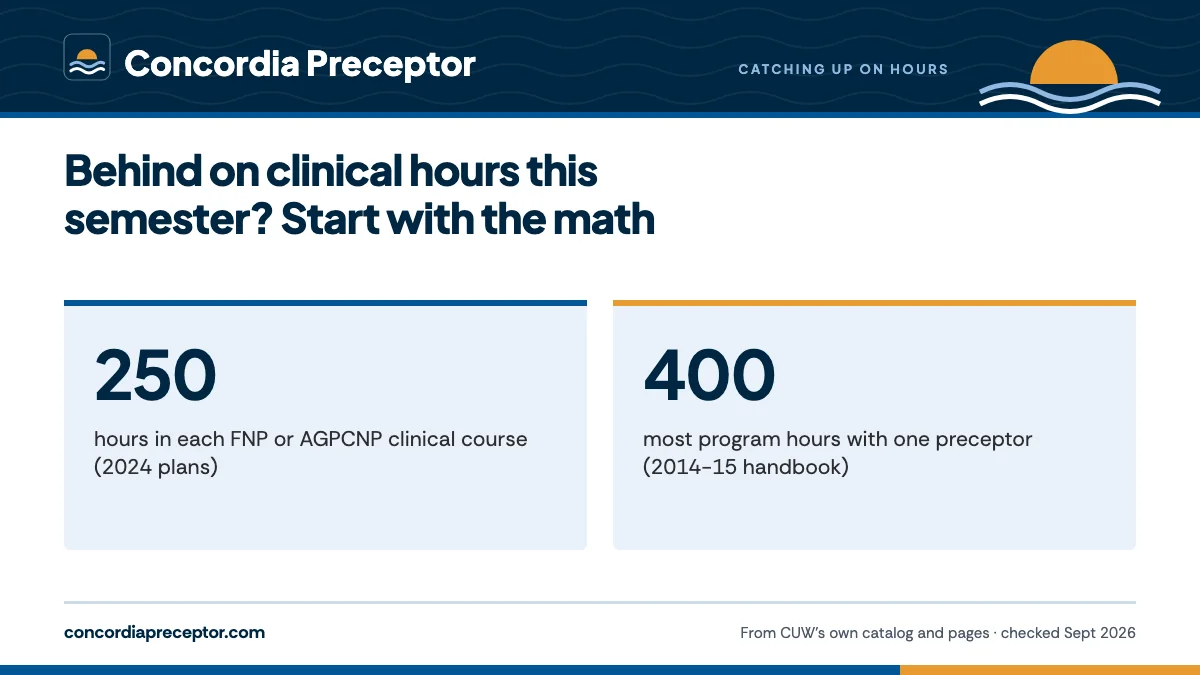
Each FNP and AGPCNP clinical at Concordia University Wisconsin carries 250 hours under CUW's 2024 progression plans, and the PMHNP practicums carry 125, 200 and 175 under the certificate plan. If you have fallen behind, work out the weekly pace you now need, tell your course faculty while the gap is still small, and add supervised time through extra days or a second approved preceptor.
Get your placement plan
Tell us your CUW program and where you live. A placement advisor replies with the preceptor and site options that fit your course.
Find the pace you need now
In CUW's 2022 program FAQ, a 250-hour clinical meant about 30 shifts, each 8 to 10 hours long, typically completed within 13 weeks. That averages about 19 hours a week. When you are behind, the useful number is the hours remaining divided by the weeks remaining. The table shows how quickly that climbs.
| Hours left | Weeks left | Hours a week | Shifts a week |
|---|---|---|---|
| 250 | 13 | about 19 | about 2 |
| 200 | 10 | 20 | 2 |
| 150 | 8 | about 19 | about 2 |
| 150 | 5 | 30 | 3 to 4 |
| 100 | 4 | 25 | about 3 |
| 80 | 3 | about 27 | about 3 |
Check your weeks against the real calendar. CUW's 2024 MSN progression plans label each clinical course 8 weeks, while the catalog's plan grid gives the clinicals no session tag, so confirm with your course faculty whether your course ends with the 8-week session or the full 16-week semester. The pacing guide covers the normal rhythm.
Rules that shape a catch-up plan
CUW's current pages do not publish pacing rules, so the details below come from archived documents; ask your course faculty which still apply. They matter because a plan that breaks them can leave hours that do not count.
- Spread the hours out. The 2014-15 handbook asked for an even spread, with your last clinical hours coming no earlier than two weeks before the term closed.
- Orientation has a ceiling. Orientation, shadowing and pre-approved conferences together could supply at most 8 hours in a semester.
- One preceptor has a cap. Any one preceptor could sign for 400 program hours at most, and adding a third preceptor within one semester needed permission first.
- Secondary sites have caps too. FNP hours in pediatrics, urgent care, women's health or geriatrics as a secondary site were limited to 100 each across the program.
- Your own unit never counts. Under the archived rules, hours logged in the department where you work did not count.
- Log promptly. Time entries were due within seven days of the shift in the Typhon years.
Safe ways to add hours
The cleanest fix is more time with the preceptor you already have: an extra weekday, a weekend clinic or longer shifts within the 8 to 10 hours CUW's 2022 FAQ described. Ask directly and early; a preceptor who knows your deadline can often open a day you did not know existed.
The second option is a second preceptor. Under the archived rules a second preceptor in the same term needed no advance permission, so a colleague at the same practice, or a nearby site that fits your course, can double your weekly capacity. The new preceptor still needs graduate faculty approval and, if the site is new to CUW, possibly a contract. Weigh that lead time before you count on the extra hours.
Why hours slip in the first place
Knowing the cause helps you pick the fix. A late start is one cause: the 2014-15 handbook held a clinical back until the contract, the approved paperwork and the semester's first day had all arrived, so a slow contract eats weeks before you see a patient. A preceptor's schedule can shrink with vacation, leave or a staffing change. Low volume is the quieter problem; the same handbook expected you to see about five to eight patients a day by the midpoint of your first clinical.
If the cause is a preceptor who has stepped away entirely, read what to do when a preceptor drops out. If it is a site that is too slow for your course level, a second preceptor at a busier practice may be the better fix.
When the term will end first
If the math says you cannot finish, tell your course faculty before the final weeks rather than after. Under the catalog's grading policy, an incomplete can turn into an F when the missing work is still outstanding three weeks after the term closes, though six weeks may be justified in some cases. Whether an incomplete fits is your faculty's call.
Clinical courses are chained: you cannot register for NURS 7152 without finishing NURS 7151, or for NURS 7153 without NURS 7152, and the AGPCNP and PMHNP sequences work the same way. The catalog also drops students from a class when a prerequisite is not completed. The catalog's BSN-DNP and PMHNP certificate entries add that performance may call for additional hours. See delayed graduation for the knock-on effects.
How we help CUW students catch up
When hours are behind, a second preceptor is often the fastest relief, and finding one is exactly what we do. Your placement advisor looks for a preceptor in your setting near your current site, collects the credentials and site information CUW's faculty will want to see, and flags right away whether a new contract would be needed. You see each candidate's schedule before you commit, so the extra hours are real hours.
We also look ahead: while you catch up on this course, we start lining up preceptors for the next one, so the new term opens on pace. Tell us your course, hours done and weeks left, and see the full clinical hours guide for your track.
Questions CUW students ask
How many clinical hours a week should a CUW FNP student plan for?
A 250-hour course spread over the 13 weeks CUW's 2022 FAQ described comes to about 19 hours a week, or two shifts of 8 to 10 hours. Over a full 16-week semester it is closer to 16 hours. Your course calendar decides which applies, so confirm your course's actual dates.
Can unfinished hours roll into my next clinical course?
CUW publishes no rule that lets hours move from one clinical course to the next, and each course carries its own hour total. The route the catalog describes for unfinished work is an incomplete grade, resolved within three weeks, or up to six in some cases. Your course faculty decide whether that fits.
Do orientation or conference hours count toward my total?
Under CUW's 2014-15 handbook, a semester's total could include no more than 8 hours drawn from orientation, shadowing or approved conferences. Anything beyond that did not. Current pages publish no figure, so ask your course faculty before you count a conference or an onboarding day.
Can I front-load hours to get ahead early?
Getting ahead is sensible, but CUW's archived handbook asked that hours be spread through the term and wrapped up no sooner than two weeks before the end. A steady lead of a few hours a week is safer than a burst at the start, and it leaves room for a lost week later.
Related pages
Last checked 2026-09-26
We check these pages against CUW's own academic catalog, program pages and published nursing documents. Your course faculty and the Graduate Clinical Coordinator have the final word.
- Concordia University Wisconsin Academic Catalog 2026-2027: MSN Primary Care Nurse Practitioner
- Concordia University Wisconsin Academic Catalog 2026-2027: Grading policy
- CUW MSN Nurse Practitioner Progression Plan, 3-year fall start (2024)
- CUW MSN program page with 2022 FAQs (archived)
- CUW NP Student Clinical Practicum Handbook 2014-2015 (archived)
CUW asks you to secure your preceptors. We make the search the easy part.
Tell us your CUW track, your city and your next clinical course. We line up preceptors who fit the NURS course, gather the license, board certification and site details CUW's graduate faculty review, and flag early whether the site needs a new clinical contract.
- Preceptors matched to the course: primary care for FNP and AGPCNP, mental health settings for PMHNP, an agency mentor for DNP projects
- Preceptor license, certification, CV and site details ready for CUW's approval
- All three clinical courses planned together, close to home in a state CUW's disclosure lists for your program
Start your placement plan
Track, city and next clinical course is all we need to begin.