Who cannot precept you in a CUW nurse practitioner clinical
Concordia University Wisconsin's archived NP rules name two conflicts: your own or an immediate family member's health care provider, and your own department or unit at work. Current CUW pages publish neither rule nor any other exclusion, so confirm them with your course faculty. Where CUW is silent, as with a relative or your own supervisor, ask before you approach the person.
Get your placement plan
Tell us your CUW program and where you live. A placement advisor replies with the preceptor and site options that fit your course.
The two conflicts CUW has written down
CUW's 2014-15 NP clinical handbook and its undated proposal form agree on two exclusions. First, you may not be precepted by your own health care provider or by the provider of an immediate family member; the handbook calls that a conflict of interest. Second, your clinical cannot sit on the unit or in the department where you are employed, although the same employer is fine.
Both rules come from documents that are now archived, and today's catalog does not repeat them. What the catalog does say is that graduate faculty rule on whether each preceptor and site is appropriate, and that judgment is where questions like these get decided now.
In practice, treat both rules as live until your course faculty tell you otherwise. They cost little to follow, and a placement that breaks one can cost you the hours already worked.
Your provider, or your family's
The first rule is about relationships. A preceptor grades your clinical performance and signs off on your hours, and CUW's archived handbook calls it a conflict of interest when that person also treats you or your family.
So if the NP who manages your own care, or your parent's or child's care, runs a practice you would love to train in, that clinician is out under the archived rule. The handbook says immediate family member without defining the term, so ask your course faculty where CUW draws the line for spouses, siblings and in-laws.
The rule names the provider, not the whole practice. Whether another clinician in the same clinic can precept you is not addressed in CUW's documents. Ask before you approach anyone there, and mention the connection on your proposal rather than leaving faculty to discover it.
Your own unit at work
The second rule separates your job from your clinical. Under CUW's 2014-15 rules your employer can host you, your own unit cannot, and the penalty for crossing that line was steep: removal from the site and the loss of every hour logged there.
The line is drawn at the unit, not the organization. If you work as an RN in a system's family medicine clinic, that clinic is out, but a different primary care clinic in the same system can qualify if it meets CUW's other rules. The workplace practicum guide covers employer placements in detail, including why a job there is no automatic placement.
A clinical in your own unit risks more than a rejected proposal: under CUW's archived rules the hours did not count and you were pulled from the site.
Settings that cannot be your primary site
Some clinicians are excluded not because of who they are but because of where they practice. For FNP and AGPCNP students, CUW's 2014-15 handbook approved only traditional-medicine primary care as a primary site. Specialty clinics, emergency departments and inpatient units did not qualify, and CUW's 2022 blog repeated that there are no clinical sites in acute care for these tracks.
That means a hospitalist, an emergency department NP or a cardiology specialist cannot serve as your main preceptor, however willing. The same handbook did leave room for specialty time: a student in the third clinical could propose 50 to 100 hours in a specialty setting, and each FNP secondary site, whether a pediatric, urgent care, women's health or geriatric practice, had a program-wide ceiling of 100 hours.
PMHNP settings are not defined beyond approved settings. The primary care sites guide sets out the site rules by track.
Limits that can rule a preceptor out later
A clinician who qualifies in your first course can stop qualifying as the hours add up. Watch these archived limits and state rules as you plan all three clinicals.
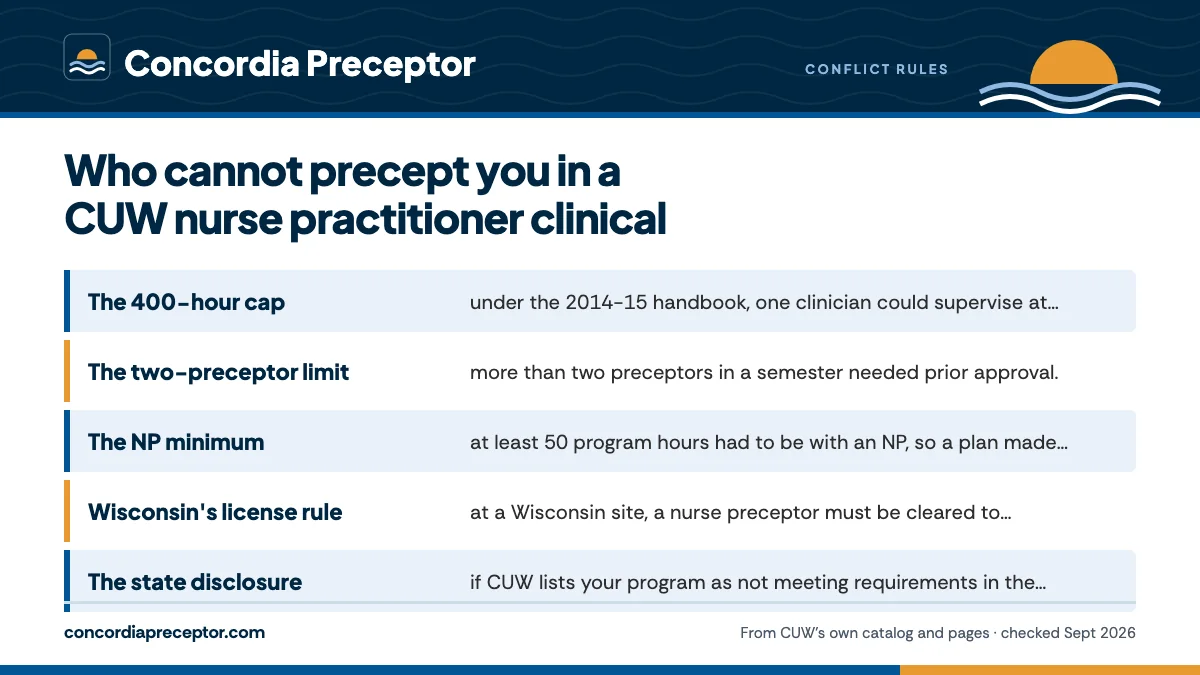
- The 400-hour cap: under the 2014-15 handbook, one clinician could supervise at most 400 of your program hours.
- The two-preceptor limit: more than two preceptors in a semester needed prior approval.
- The NP minimum: at least 50 program hours had to be with an NP, so a plan made only of physicians and PAs falls short.
- Wisconsin's license rule: at a Wisconsin site, a nurse preceptor must be cleared to practice in Wisconsin, without restrictions, at your target level or higher (N 1.08(6)).
- The state disclosure: if CUW lists your program as not meeting requirements in the clinic's state, the clinician's credentials cannot fix that. The disclosure guide lists the states.
What CUW has not published
Several common questions have no answer in any public CUW source. CUW's documents do not ban these outright in so many words, but that silence is not permission either.
- A relative as your preceptor, as opposed to a relative's provider.
- Your direct supervisor or manager, when the placement is outside your own unit.
- A close friend or a former classmate who is now a practicing NP.
- PMHNP preceptor types, such as a psychiatrist in place of a psychiatric NP.
- Supervision by telehealth for any track.
Send the question in writing to your course faculty or coordinator first, then approach the person, and keep the reply on file. If a conflict turns up after someone has agreed, CUW's 2014-15 handbook asked students to tell that provider and forward a copy of the email to the Clinical Education Coordinator.
Why CUW students choose us to screen for conflicts
Conflict questions are easy to miss when a willing clinician is in front of you. Our placement desk asks them at the first contact: whether the clinician treats you or your family, whether the site is your own unit, and whether the setting fits your track. We also track hours per preceptor across all three courses so the 400-hour cap and the NP minimum never catch you by surprise.
Each clinician we put forward arrives screened against CUW's archived conflict rules and Wisconsin's license rule, with the documents ready for your proposal and any connection you have to the practice noted up front. Where CUW's pages are silent, we prompt you to get your course faculty's answer in writing before the preceptor commits. Our service steps show the rest, and the contact form puts you in touch with a placement advisor.
Questions CUW students ask
Can a relative be my preceptor in a CUW clinical?
CUW has not published a rule that names relatives in those words. Its archived handbook excluded your own and your immediate family's health care providers as a conflict of interest, and a relative evaluating you raises the same kind of question. Ask your course faculty in writing before you approach a family member.
Can my manager precept me if the clinic is not my unit?
CUW's documents do not address supervisors directly. The archived rule already bars your own unit, so the question only arises if your manager also practices at a different site. Because a supervisor who also grades your clinical raises the same questions as the family rule, get your course faculty's view first.
Can I do clinicals at the practice where my family gets care?
The archived rule names the provider, not the practice. Your family member's own clinician is excluded, but CUW's documents are silent on other clinicians in the same office. Disclose the connection on your proposal and ask your course faculty before you commit to that site.
What happens if I do clinicals in my own unit anyway?
CUW's archived rules pulled the student from the site and struck the hours completed there. With 250 hours riding on each FNP or AGPCNP clinical course, that can mean redoing weeks of work at a new site, and possibly a later finish.
Can the same preceptor take me for more than one course?
Yes, within limits. With a 400-hour ceiling per clinician in the 2014-15 handbook, one preceptor could carry a whole 250-hour course plus a slice of the next, never the full 750. Check whether the current rule is the same with your course faculty.
Related pages
Last checked 2026-09-26
We check these pages against CUW's own academic catalog, program pages and published nursing documents. Your course faculty and the Graduate Clinical Coordinator have the final word.
- Concordia University Wisconsin Academic Catalog 2026-2027: MSN Primary Care Nurse Practitioner
- Concordia University Wisconsin NP Student Clinical Practicum Handbook 2014-2015 (archived)
- Concordia University Wisconsin Clinic Practicum Site Proposal and Preceptor Information Form (archived)
- Concordia University Wisconsin blog: MSN Clinicals, What are they like? (2022)
- Wisconsin Administrative Code ch. N 1 (schools of nursing), incl. N 1.08(6)
CUW asks you to secure your preceptors. We make the search the easy part.
Tell us your CUW track, your city and your next clinical course. We line up preceptors who fit the NURS course, gather the license, board certification and site details CUW's graduate faculty review, and flag early whether the site needs a new clinical contract.
- Preceptors matched to the course: primary care for FNP and AGPCNP, mental health settings for PMHNP, an agency mentor for DNP projects
- Preceptor license, certification, CV and site details ready for CUW's approval
- All three clinical courses planned together, close to home in a state CUW's disclosure lists for your program
Start your placement plan
Track, city and next clinical course is all we need to begin.