NURS 7267 Advanced Primary Care Clinical III - AGPCNP: older adults, final 250 hours
NURS 7267 Advanced Primary Care Clinical III - AGPCNP is the last clinical in Concordia University Wisconsin's adult-gerontology track, and the catalog gives it one focus: the older adult in the outpatient setting. Its 250 hours, per CUW's February 2024 progression plans, carry you to the track's 750-hour minimum. It follows NURS 7266 (or the older MSN 866 and NURS 766), in most plans with no break in between.
Get your placement plan
Tell us your CUW program and where you live. A placement advisor replies with the preceptor and site options that fit your course.
An outpatient course built around older adults
Clinical I covers the adult lifespan and Clinical II the wider primary care setting; the catalog then narrows Clinical III to the older adult seen in outpatient care. The strongest fit is an outpatient primary care practice where older adults fill much of the schedule, such as a geriatric primary care clinic or an internal medicine or adult practice with many older patients.
The word outpatient carries weight. CUW's archived sources kept NP students out of inpatient units, emergency departments and specialty clinics as primary sites (2014-15 handbook) and away from acute care as the main placement (2022 blog). A long-term care or rehabilitation setting may sound gerontological, yet it is not plainly outpatient primary care, so clear it with faculty before you propose it. The primary care sites page sets out the site rules by year.
Specialty hours: an archived allowance for the third clinical
CUW's 2014-15 NP handbook carried a rule tied to the third clinical, then called APN III: up to 100 hours, and no fewer than 50, could be proposed at a specialty site, with the primary care practice still carrying the course. For an adult-gerontology student, a specialty that serves many older adults would be the natural pick.
No current CUW page repeats that allowance, and the same handbook capped the FNP track's secondary sites at 100 hours each for the whole program. Treat it as history until the Graduate Clinical Coordinator or your course faculty confirm it. If they do, the specialty site goes through the same proposal and contract review as any other site, so name it at the same time as your main Clinical III practice rather than adding it late.
Back to back with Clinical II: plan both at once
In the catalog's sample plan, Clinical II falls in semester 7 and Clinical III in semester 8, one straight after the other. That squeezes the lead time. Two archived clocks run at once: the proposal was due no later than four weeks before the start, and a site new to CUW could need 8 to 12 weeks for its contract. A Clinical III site without an agreement should therefore be named before Clinical II is far along.
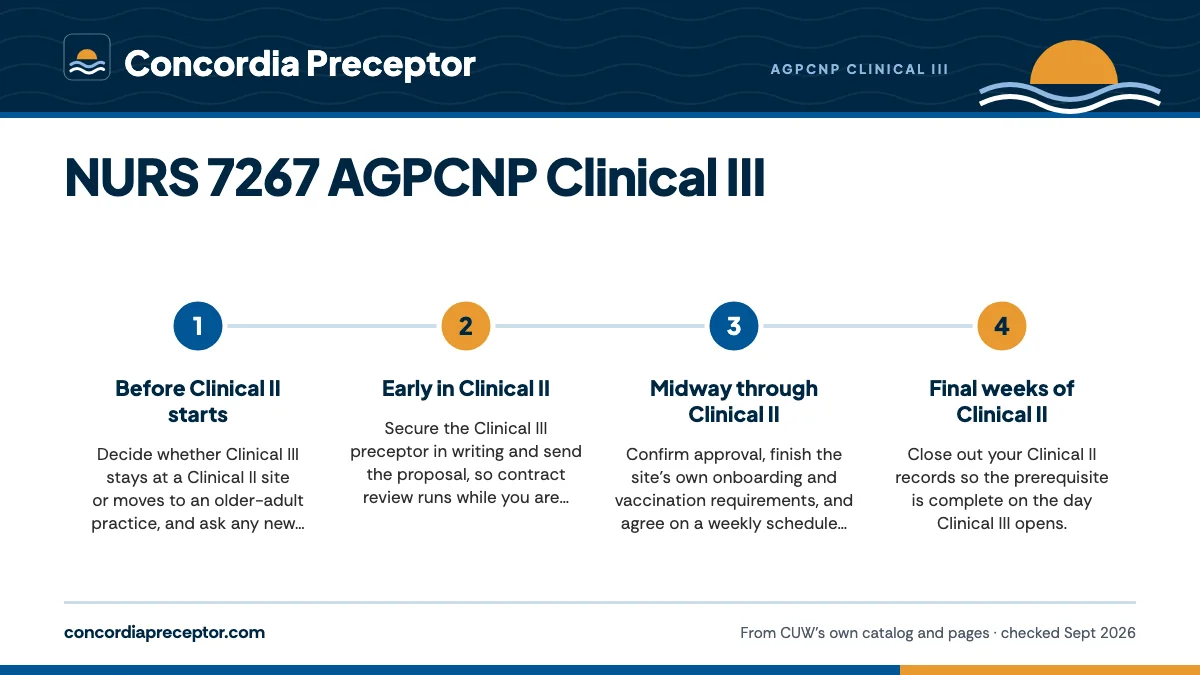
- Before Clinical II startsDecide whether Clinical III stays at a Clinical II site or moves to an older-adult practice, and ask any new site whether it has hosted CUW students before.
- Early in Clinical IISecure the Clinical III preceptor in writing and send the proposal, so contract review runs while you are still logging Clinical II hours.
- Midway through Clinical IIConfirm approval, finish the site's own onboarding and vaccination requirements, and agree on a weekly schedule with the preceptor.
- Final weeks of Clinical IIClose out your Clinical II records so the prerequisite is complete on the day Clinical III opens.
The deadlines page turns those archived lead times into a full calendar.
Finishing strong: the last 250 hours and the grade
The final clinical is where missing paperwork costs the most. CUW's 2014-15 process wanted hours paced across the whole term, with none wrapped up earlier than two weeks before its end, and it withheld the grade until every preceptor's signed hours form and the end-term documentation checklist arrived.
If hours fall short, CUW's graduate grading policy allows an incomplete, with the work due within three weeks after the term's last day and up to six weeks in some cases. MSN students must also finish every degree requirement within five years of their first course. For spring finishers, the 2026-27 calendar schedules graduate commencement for Friday, May 7, 2027, while spring classes formally run through May 9. The delayed graduation page covers what happens when a clinical slips.
Reaching 750 and what follows
Completing NURS 7267 finishes the 750 clinical hours CUW's catalog sets as the AGPCNP minimum. CAGE AGPCNP students work toward the same figure, though clinical hours from a previous advanced practice degree can be weighed individually, so their last clinical can look different. AGPCNP students in the Post-BSN DNP reach their clinical total another way, through NURS 8226 to NURS 8228 on the DNP residency page.
For graduates who will practice in Wisconsin, the credential itself changed in 2026. Under 2025 Wisconsin Act 17, the state replaced the APNP credential with an APRN license, with applications open from August 3, 2026, and a newly licensed APRN works in collaboration with a physician or dentist until meeting the independent-practice thresholds. The Wisconsin practice page explains the hour thresholds and the jurisprudence exam.
How we place CUW students in their final AGPCNP clinical
By Clinical III there is little room left for a late start, so we plan this course together with Clinical II rather than after it. We look for outpatient practices with a strong older-adult panel near home, in states listed as meeting requirements for the MSN on CUW's disclosure page, and we ask each site early whether it has hosted CUW students, a quick signal of whether a new contract may be needed.
Every proposal we prepare arrives with the preceptor's credentials (license, board certification, CV) and a full site description, so CUW's graduate faculty can review it in one pass. If a Clinical III preceptor falls through, your placement advisor starts the replacement search immediately, because a lost week in the final semester is hard to win back. Use the form below or contact us.
Questions CUW students ask
Can my NURS 7267 hours be in a nursing home?
CUW's catalog describes Clinical III as outpatient care of the older adult, and the archived 2014-15 handbook kept inpatient units out as primary sites. No CUW source found addresses long-term care directly, so ask your course faculty before proposing it. An outpatient practice with many older patients is the clear fit.
Can I stay with my Clinical II preceptor for Clinical III?
Possibly, but check the numbers first. CUW's 2014-15 handbook capped hours with one preceptor at 400 across the program, so a preceptor who supervised most of Clinical II could not take all 250 Clinical III hours under that rule. Put the current rule to the Graduate Clinical Coordinator; the Clinical II page works through the math.
What was NURS 7267 numbered before?
It began as MSN 867 in the 2020-21 catalog, when each AGPCNP clinical required at least 240 hours. The 2021-22 catalog renamed it NURS 767, and the current four-digit form dates from the 2024-25 edition. The catalog still accepts MSN 866 and NURS 766, the older Clinical II numbers, as prerequisites alongside NURS 7266.
Does AGPCNP Clinical III include pediatric or women's health hours?
The catalog does not frame it that way. Pediatrics and women's health appear in the FNP Clinical III description, NURS 7153, while NURS 7267 centers on the older adult in outpatient care. Keep your Clinical III search inside adult and gerontology primary care, and ask faculty about any site that mixes populations.
Do I need a Wisconsin RN license for a Clinical III site in Wisconsin?
CUW requires an unencumbered RN license throughout the MSN but does not say outright that it must come from the clinical state. Wisconsin belongs to the Nurse Licensure Compact, and at least one large Wisconsin system publishes that students need a current Wisconsin RN license. The RN license page sorts out the details.
Related pages
Last checked 2026-09-26
We check these pages against CUW's own academic catalog, program pages and published nursing documents. Your course faculty and the Graduate Clinical Coordinator have the final word.
- Concordia University Wisconsin 2026-27 catalog: graduate NURS course descriptions
- Concordia University Wisconsin 2026-27 catalog: MSN Primary Care Nurse Practitioner
- Concordia University Wisconsin: MSN Adult-Gerontology Primary Care Nurse Practitioner
- CUW MSN NP progression plan, 4-year fall start (Feb 2024)
- CUW NP Student Clinical Practicum Handbook 2014-2015 (archived copy)
CUW asks you to secure your preceptors. We make the search the easy part.
Tell us your CUW track, your city and your next clinical course. We line up preceptors who fit the NURS course, gather the license, board certification and site details CUW's graduate faculty review, and flag early whether the site needs a new clinical contract.
- Preceptors matched to the course: primary care for FNP and AGPCNP, mental health settings for PMHNP, an agency mentor for DNP projects
- Preceptor license, certification, CV and site details ready for CUW's approval
- All three clinical courses planned together, close to home in a state CUW's disclosure lists for your program
Start your placement plan
Track, city and next clinical course is all we need to begin.