CUW's PMHNP DNP: psychiatric practicums, a leadership residency and the 1,000-hour question
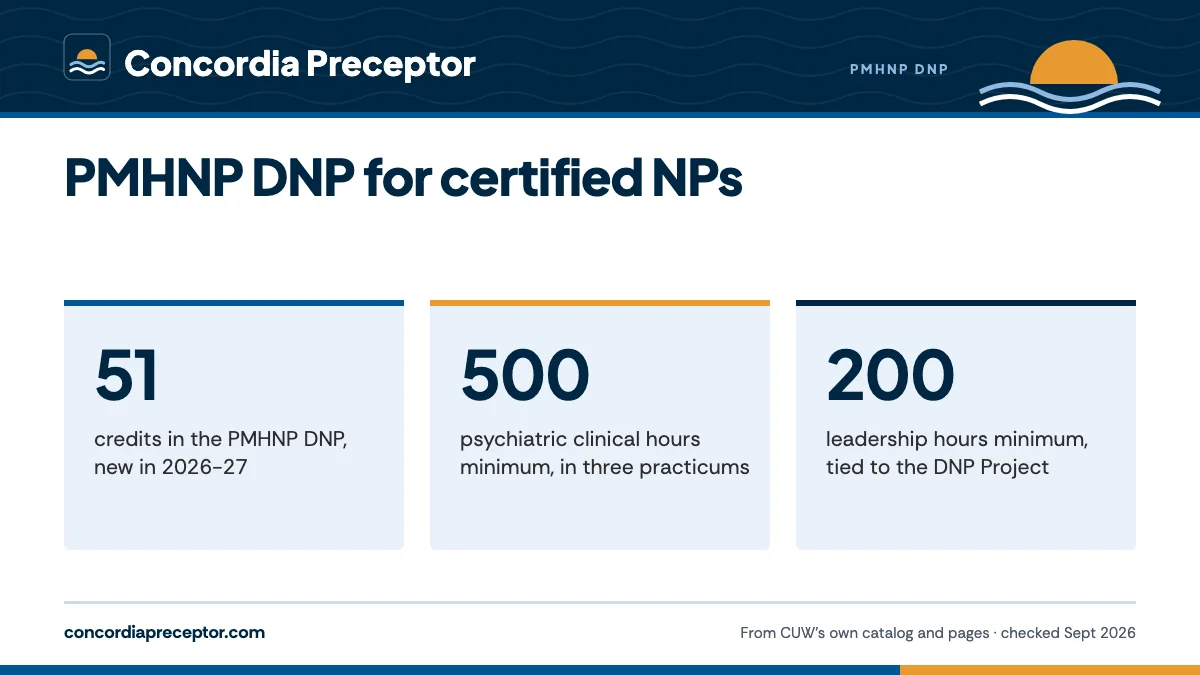
Concordia University Wisconsin's PMHNP DNP is a post-master's doctorate for nurse practitioners who already prescribe: 51 credits over about three years. The catalog asks for at least 500 psychiatric clinical hours and at least 200 leadership hours. The program page talks about 1,000 residency hours because verified hours from your earlier APRN degree can make up the rest. You secure the preceptors, and graduate faculty approve them.
Get your placement plan
Tell us your CUW program and where you live. A placement advisor replies with the preceptor and site options that fit your course.
Who the PMHNP DNP is for
The program admits nurse practitioners who hold an MSN and NP certification with prescriptive authority, and it expects that NP prescribing license to stay unencumbered for the whole program. It is new in the 2026-27 catalog and runs as an online cohort of 8-, 14- and 16-week courses over eight semesters, roughly three years, with a fall start and a July 1 application deadline.
It joins two pieces CUW uses elsewhere: the psychiatric practicum sequence shared with the MSN PMHNP and the PMHNP certificate, and the DNP Project courses. For an NP who wants both a psychiatric population focus and a doctorate, it is the one CUW route that delivers both at once.
The on-campus picture is split across two sources. The program page lists a 3-day on-campus workshop. The catalog adds a Zoom orientation before the start and a final cohort meeting on campus at graduation, where DNP projects are presented, and notes that Advanced Health Assessment (NURS 6038) can be transferred in if you took a lifespan course before. If you transfer it, ask whether the workshop still applies to you.
Two kinds of hours, two kinds of mentor
In the catalog's words, DNP residency work happens with preceptors or mentors who develop the student's leadership and support the DNP Project, and it says NURS 9040 includes practicum hours tied to the DNP Project. The two searches are separate: a clinician who supervises psychiatric patient care, and a mentor placed where your project can run.
For the practicums, the only per-course figures CUW has published come from its 2023 PMHNP certificate plan: 125 hours in Practicum I, 200 in Practicum II and 175 in Practicum III. Using that split for the DNP is an assumption to confirm with your faculty.
| Requirement | Courses | Minimum hours | Who supervises |
|---|---|---|---|
| Psychiatric clinical | NURS 7510, NURS 7515, NURS 7520 | 500 | A psychiatric preceptor approved by graduate faculty |
| Leadership | NURS 9040, NURS 9041 DNP Project I and II | 200 | A preceptor or mentor who supports the DNP Project |
| Prior degree | Verified hours from your earlier APRN program | The balance toward 1,000 | Documented from your prior program |
The 1,000-hour conflict, explained
The program page headline mentions 1,000 hours of supervised clinical practice. Its body text is more exact: 500 psychiatric clinical hours and 1,000 total post-baccalaureate residency hours, with the rest allowed to include verified clinical experience from a prior advanced practice nursing degree. The catalog sets the in-program floor at 500 psychiatric hours plus 200 leadership hours.
Read together, the supervised load inside the program is 700 hours, and 1,000 is a total that your earlier NP hours help reach. The headline overstates the in-program clinical work; the body and the catalog agree with each other.
The practical step is paperwork. Gather your prior program's record of supervised clinical hours before you start, and ask the Graduate Clinical Coordinator how CUW verifies them and what happens if they fall short of the difference. Knowing your number early tells you whether the 700 in-program hours are all you need. The wider hours picture across CUW programs is on clinical hours.
Finding a psychiatric preceptor as a practicing NP
You arrive licensed, prescribing and usually employed, and that changes the search. Colleagues in psychiatry are the natural first calls, but CUW's past NP rules drew lines worth respecting: the 2014-15 handbook barred training in your own department or unit and ruled out your own or a family member's provider as preceptor, while allowing a different part of the same employer. The details are on clinicals where you work.
CUW names the settings where its PMHNP graduates practice: inpatient psychiatric units, outpatient behavioral health, integrated primary care, community mental health centers and telehealth. With Practicum II asking for 200 hours of complex diagnosis and treatment, look for a practice whose caseload includes complex presentations, not only medication follow-ups.
No CUW source states PMHNP preceptor credentials. Whether faculty expect a board-certified PMHNP, a psychiatrist or either is a question for the Graduate Clinical Coordinator. The dated general rules, and the people CUW has excluded in the past, are on who cannot precept you.
The leadership residency and the DNP Project
The leadership hours call for a different kind of host. The mentor should sit where your project can actually happen: a clinic director, a quality lead or a senior clinician in an organization willing to host an organizational needs assessment and quality-improvement work, which is how the catalog describes NURS 9040. NURS 9041 is the capstone built from that experience.
CUW's undated DNP Residency Preceptor Proposal Form, from an earlier version of the doctorate, asked for the mentor's academic credentials and set out the role: help set goals, guide leadership development, meet regularly and keep in touch with CUW faculty. The current form is not public, so treat that as a preview rather than today's checklist. The Post-BSN DNP's version of this work is on DNP project practicum.
A larger mental health organization can sometimes serve both purposes, with your psychiatric preceptor on one service and a leadership mentor on another. Ask your faculty before planning one person for both roles.
State checks for the PMHNP DNP
CUW's Distance Education Disclosures have no PMHNP DNP table. The catalog makes the eligibility check yours whenever clinicals take place outside Wisconsin, and CUW's other doctoral tables show that doctoral programs can differ by state: the Post-MSN DNP is marked as not meeting requirements in North Dakota, the Post-BSN DNP in Washington. Wisconsin sits in the meeting-requirements column of every graduate NP table CUW publishes, and the Post-MSN DNP page adds a Washington approval, but neither statement names the PMHNP DNP.
With no row to read, get CUW's confirmation for your state before you secure a preceptor there. Your NP license must stay unencumbered, and CUW does not say in plain words whether a license in the practicum state is also needed; ask that in the same message. The state-by-state tables are on licensure disclosures.
Why PMHNP DNP students choose us
Working NPs rarely have spare hours to canvass practices. Our placement desk searches psychiatric settings near you for all three practicums, then lines up a leadership mentor in an organization that suits your DNP Project. Each preceptor comes with license, board certification, CV and site details gathered for graduate faculty, and we check early whether the organization has a clinical contract with CUW.
We also help you assemble the record of your prior degree's supervised hours, so your path to the 1,000-hour total is clear from the first term. Because the practicums run inside a 51-credit doctorate alongside project work, we plan each preceptor around your course load and reconfirm the next one a term ahead so every practicum opens on time. Use the form below and choose PMHNP DNP.
Questions CUW students ask
Is CUW's PMHNP DNP 500 or 1,000 clinical hours?
Both figures are CUW's. The catalog requires at least 500 psychiatric clinical hours plus 200 leadership hours in the program. The program page counts 1,000 total residency hours, letting verified hours from your earlier APRN degree fill the difference. Confirm your own count with the Graduate Clinical Coordinator before your first practicum.
Do I need to be a nurse practitioner to enter the PMHNP DNP?
Yes. CUW admits MSN-prepared nurse practitioners whose certification carries prescriptive authority, and your NP prescribing license has to remain unencumbered through the program. Registered nurses with a BSN who want the psychiatric role look at the MSN PMHNP instead. The DNP starts in fall, with a July 1 application deadline.
Can my leadership mentor also be my psychiatric preceptor?
CUW's pages do not address it. The roles ask for different things: patient care supervision for the practicums, project and leadership guidance for the DNP hours. Some clinicians can do both, but ask your faculty before planning one person for all 700 hours; CUW's 2014-15 MSN handbook capped any single preceptor at 400 hours.
How does the PMHNP DNP differ from the PMHNP certificate?
The certificate is 18 credits over about a year: the three psychiatric practicums and 500 hours, with fully online coursework. The DNP runs 51 credits over about three years and adds the DNP Project with at least 200 leadership hours, plus an on-campus workshop and graduation meeting. Both expect an existing NP prescribing license.
Is the PMHNP DNP fully online?
Nearly. Coursework is online, orientation runs on Zoom and the practicums are local. The program page lists a 3-day on-campus workshop, and the catalog requires a final cohort meeting on campus at graduation, where you present your DNP Project. The rest of the program happens at home and at practicum sites near you.
Related pages
Last checked 2026-09-26
We check these pages against CUW's own academic catalog, program pages and published nursing documents. Your course faculty and the Graduate Clinical Coordinator have the final word.
- Concordia University Wisconsin Academic Catalog 2026-27: Doctor of Nursing Practice (incl. PMHNP DNP)
- Concordia University Wisconsin: Psychiatric Mental Health Nurse Practitioner DNP
- Concordia University Wisconsin Academic Catalog: graduate NURS course descriptions
- Concordia University Wisconsin: Distance Education Disclosures
CUW asks you to secure your preceptors. We make the search the easy part.
Tell us your CUW track, your city and your next clinical course. We line up preceptors who fit the NURS course, gather the license, board certification and site details CUW's graduate faculty review, and flag early whether the site needs a new clinical contract.
- Preceptors matched to the course: primary care for FNP and AGPCNP, mental health settings for PMHNP, an agency mentor for DNP projects
- Preceptor license, certification, CV and site details ready for CUW's approval
- All three clinical courses planned together, close to home in a state CUW's disclosure lists for your program
Start your placement plan
Track, city and next clinical course is all we need to begin.