CUW nurse practitioner clinicals in Wisconsin
Wisconsin is Concordia University Wisconsin's home state, and every nursing table on CUW's disclosure page marks it as meeting requirements. Planning clinical hours here means working inside three sets of rules at once: CUW's own approval steps, Wisconsin's new APRN license and preceptor standard, and the student policies each large health system writes for itself.
Get your placement plan
Tell us your CUW program and where you live. A placement advisor replies with the preceptor and site options that fit your course.
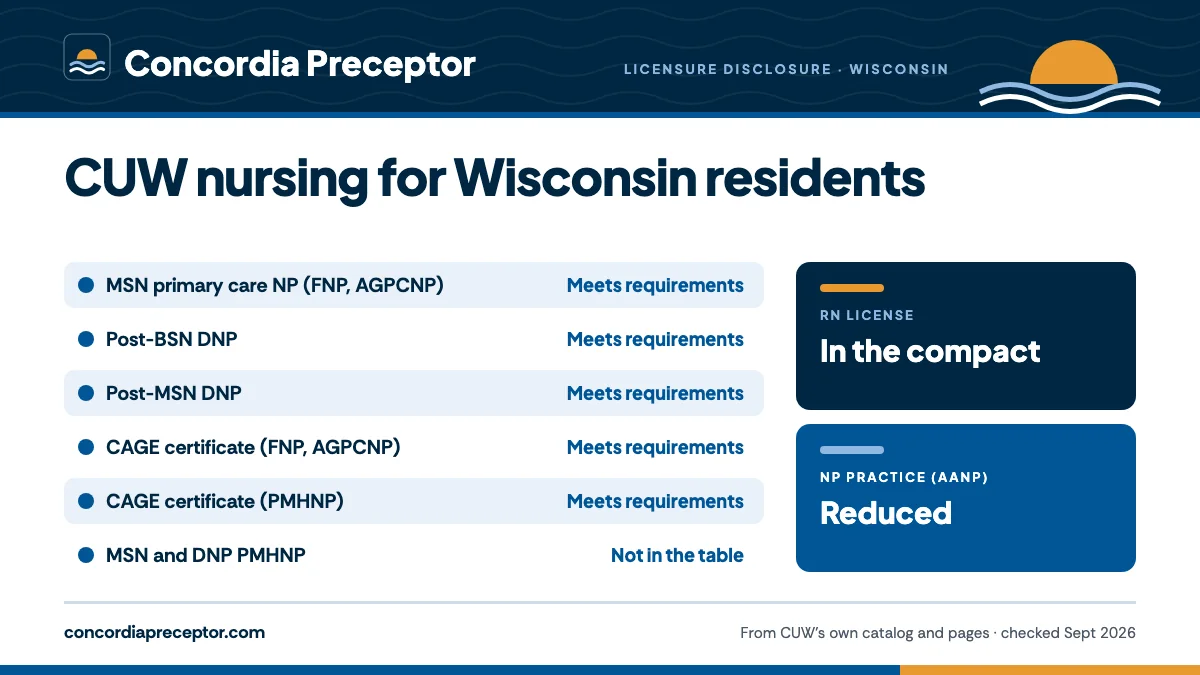
Wisconsin on CUW's disclosure page
Each School of Nursing table on CUW's Distance Education Disclosures places Wisconsin in the "Meets Requirements" column, from the online nurse practitioner programs through the RN to BSN and the campus BSN. Three programs on the School of Nursing's list have no table at all, so for them the page is silent rather than negative.
| CUW program, as the disclosure labels it | Wisconsin |
|---|---|
| Master of Science in Nursing - Primary Care Nurse Practitioner (FNP and AGPCNP tracks) | Meets Requirements |
| Doctor of Nursing Practice - Post BSN to DNP Program | Meets Requirements |
| Doctor of Nursing Practice - Post MSN to DNP Program | Meets Requirements |
| CAGE (FNP/AGPCNP) | Meets Requirements |
| CAGE (PMH NP) | Meets Requirements |
| MSN PMHNP and PMHNP DNP | No table on the page |
| RN to BSN Online Nursing Program (BSN Comp) | Meets Requirements |
Training at home also trims the checklist. CUW's catalog adds an extra eligibility check only when a clinical sits outside Wisconsin, so a Wisconsin site follows CUW's usual path: you line up the preceptor and site, graduate faculty judge whether they fit the course, and the Graduate Clinical Coordinator is there to help along the way. The disclosure guide reads the table for the other 49 states.
Mequon: the campus behind the online programs
The School of Nursing is based on CUW's Mequon campus at 12800 North Lake Shore Drive, just north of Milwaukee. CUW runs a second residential campus in Ann Arbor, Michigan, yet its online nurse practitioner programs tie their in-person sessions to Mequon, where CUW's nursing page describes a new School of Nursing wing of roughly 26,000 square feet plus 11,650 square feet of renovated space.
Time on campus depends on the program, and CUW's own pages give different counts. The MSN FNP and AGPCNP pages describe a three-day Advanced Health Assessment intensive (NURS 6038), the catalog says 2-3 days, and the Post-BSN to DNP page speaks of a four-day residency. The PMHNP MSN and DNP list a 3-day workshop, the DNPs close with an on-campus cohort meeting at graduation, and the PMHNP certificate runs fully online. The health assessment guide sorts out the differences.
For a Wisconsin student those campus days are a drive, not a flight, and the Milwaukee-Waukesha metro nearby, at about 1.58 million people, is the state's biggest clinical market.
Wisconsin's new APRN license in brief
The Wisconsin Board of Nursing works under the Department of Safety and Professional Services (DSPS), and nurses apply through the DSPS LicensE portal. 2025 Wisconsin Act 17 retired the Advanced Practice Nurse Prescriber credential and created a dedicated APRN license covering four roles: nurse practitioner, nurse-midwife, clinical nurse specialist and nurse anesthetist. DSPS began taking APRN applications on August 3, 2026, and on September 1 every existing APNP became an APRN under the same credential number.
When you finish at CUW, the APRN license is the one you will apply for.
What DSPS asks of a new APRN applicant
- A Wisconsin RN license, or a multistate RN license held through the Nurse Licensure Compact
- A completed accredited graduate or post-graduate APRN program in one of the four roles
- Current national certification in that role
- The malpractice coverage Wisconsin requires
- A pass on the new APRN jurisprudence exam, added by the Board's emergency rules
- For prescriptive authority, at least 45 contact hours of clinical pharmacology or therapeutics finished within the five years before you apply
Practice begins in collaboration with a physician or dentist. Independence takes Board approval after two separate 3,840-hour blocks, one as an RN and one as an APRN in your role, each spread across at least 24 months, and hours from your graduate program do not count toward the RN block. The Wisconsin APRN guide walks through both stages.
Who can precept you at a Wisconsin site
Wisconsin sets its own floor for clinical preceptors, separate from anything CUW adds. Under Wisconsin Administrative Code N 1.08(6), the preceptor for a nursing school's student must hold an unencumbered license, or a privilege, to practice nursing in Wisconsin at or above the level the student is working toward, and the school's faculty must sign off on that person. The chapter defines a school of professional nursing to include the graduate degree level, which brings CUW's NP students inside the rule.
Read plainly, a nurse practitioner who precepts you in Wisconsin should carry a current Wisconsin APRN license. The compact moves RN privileges across state lines, but Wisconsin has not enacted the APRN Compact. CUW's archived handbooks also accepted physicians and physician assistants; ask your graduate faculty how they apply the rule to those preceptors, and see CUW's preceptor standards for the experience and certification points.
Programs based in other states meet an extra gate: Board approval on Form 3067OEE before their students train here, and the DSPS approved list (revised August 3, 2026) names about 164 of them. CUW's Mequon address keeps it outside that definition. One listed school, Concordia University - St. Paul in Minnesota, is a different university, worth making clear if a practice manager mixes the two up.
An NP whose only license comes from Illinois, Michigan or Minnesota cannot meet N 1.08(6) for a Wisconsin clinical. Check the license state before you send anyone's name to CUW.
Compact status and the four neighbors
Wisconsin has been a Nurse Licensure Compact state since January 19, 2018, so a multistate RN license issued here carries RN practice into other compact states. Iowa is one of them. Illinois, Michigan and Minnesota sit outside the compact, and a Wisconsin multistate license opens nothing there. The APRN Compact is a separate agreement that NCSBN says starts only after seven states enact it, and Wisconsin has not.
| State | Nurse Licensure Compact | NP practice, as Wisconsin's Board summarized it | CUW's MSN primary care NP |
|---|---|---|---|
| Wisconsin | Member since Jan. 19, 2018 | Collaboration with a physician or dentist until the Board approves independent practice | Meets |
| Iowa | Member since Jan. 19, 2018 | ARNPs practice to the full extent of their education and training | Meets |
| Illinois | Not a member | Written collaborative agreement until full practice authority at 4,000 hours plus 250 CE hours | Meets |
| Michigan | Not a member | Non-scheduled prescribing alone; Schedule 2-5 prescribing delegated by a physician | Meets |
| Minnesota | Not a member | 2,080 post-graduate hours under a written collaborative agreement for new NPs | Meets |
Near a border? Each neighbor's guide, linked below, covers its board and its rule for programs from other states.
How Wisconsin's large systems handle NP students
Before you ask a clinician inside a big Wisconsin system, read that system's student page. Each summary below reflects the system's own policy as captured in 2026; CUW's pages name no partner systems for their NP programs.
- Froedtert ThedaCare Health with the Medical College of Wisconsin: one MCW application for NP students, and word from MCW that it is adding no new program agreements for now.
- Aurora Health Care: rotations currently open only to Aurora employees at its named partner schools, requested by the school, with a current Wisconsin RN license asked of every student.
- Ascension Wisconsin: a school coordinator files at least 8 weeks ahead of the start date; students may not file themselves.
- Children's Wisconsin: faculty requests only, one semester per placement, and a graduate form for final-semester MSN or DNP students.
- UW Health in Madison: no new affiliation agreements at present.
- Marshfield Clinic Health System: a contract with the school first and an application four months before the start.
The shared thread is that the school, not the student, opens each door, which usually adds weeks. The health systems guide lists their deadlines, and Milwaukee NP preceptors maps the southeast. Beyond Milwaukee, the Madison metro holds about 710,000 people, Green Bay about 337,000 and Appleton about 250,000, each with independent practices outside these system offices.
Why Wisconsin CUW students choose us
On paper Wisconsin is the easy state, since every CUW table says yes. In practice, the preceptor license rule, the switch to APRN credentials and the systems' school-only doors can slow a home-state search. Our placement desk works that ground for you. Every Wisconsin preceptor we bring forward is checked for an unencumbered Wisconsin APRN license at the right level, current APRN credential in hand, along with board certification and a CV, before the name reaches CUW's graduate faculty.
We start with practices that can sign with CUW on their own, flag early when a new clinical contract looks likely, and keep a system site in play only when its calendar fits yours. Your three clinicals (NURS 7151 to NURS 7153, or the AGPCNP or PMHNP sequence) get planned together as one set of placements near your home, whether that is Green Bay, Appleton, Milwaukee, Madison or somewhere else; if a preceptor drops out mid-course, the next search is already underway. Tell us your city and course to get started.
Questions CUW students ask
Does CUW's online FNP program meet Wisconsin licensure requirements?
Yes. CUW's current disclosure lists Wisconsin as meeting requirements in the MSN primary care NP table, which covers the FNP and AGPCNP tracks, and in both DNP and both CAGE tables. After graduation you apply to DSPS for the APRN license, which calls for national certification and the new jurisprudence exam.
Is Wisconsin a full practice state for nurse practitioners?
Not at the start. AANP classifies Wisconsin as reduced practice because new APRNs work in collaboration with a physician or dentist. Under 2025 Wisconsin Act 17, an APRN can apply to the Board for independent practice after the two 3,840-hour blocks, with approvals issued on or after September 1, 2026.
Do I need a Wisconsin RN license for CUW clinicals in Wisconsin?
CUW requires an unencumbered RN license for the whole program but does not name the state that must issue it. Because Wisconsin belongs to the compact, a multistate RN license from another member state carries a privilege to practice here. Sites can ask for more: Aurora's page asks every student for a current Wisconsin RN license. Confirm your own case with the Graduate Clinical Coordinator.
Does CUW place NP students at Wisconsin clinics or hospitals?
Not in the graduate NP programs. There you identify and secure your preceptor and site, and graduate faculty approve them. CUW arranges clinical sites itself only for the Direct Entry MSN and the Traditional BSN. None of CUW's NP pages names a partner health system, so check any system rotation with the Graduate Clinical Coordinator before you count on it.
Can my CUW clinical be in Madison or Green Bay instead of near Mequon?
Yes. CUW publishes no regional limit inside Wisconsin; the site has to suit your course and earn graduate faculty approval. Location changes the obstacles, though. UW Health in Madison is not signing new affiliation agreements, and Marshfield Clinic wants applications four months ahead. Independent practices in each metro fall outside those system rules.
Related pages
Last checked 2026-09-26
We check these pages against CUW's own academic catalog, program pages and published nursing documents. Your course faculty and the Graduate Clinical Coordinator have the final word.
CUW asks you to secure your preceptors. We make the search the easy part.
Tell us your CUW track, your city and your next clinical course. We line up preceptors who fit the NURS course, gather the license, board certification and site details CUW's graduate faculty review, and flag early whether the site needs a new clinical contract.
- Preceptors matched to the course: primary care for FNP and AGPCNP, mental health settings for PMHNP, an agency mentor for DNP projects
- Preceptor license, certification, CV and site details ready for CUW's approval
- All three clinical courses planned together, close to home in a state CUW's disclosure lists for your program
Start your placement plan
Track, city and next clinical course is all we need to begin.