What the best CUW placement service does for you
A placement service earns its place in a Concordia University Wisconsin program by doing the legwork CUW leaves to students, and doing it to CUW's rules: a preceptor who fits your NURS course, a site in a state where your program is listed, complete documents for graduate faculty, and an early answer on the clinical contract. That is the standard we hold ourselves to, and the one to measure any help against.
Get your placement plan
Tell us your CUW program and where you live. A placement advisor replies with the preceptor and site options that fit your course.
It starts from CUW's rules
CUW's model is clear in the 2026-27 catalog: the student finds and secures preceptors, graduate faculty approve them for appropriateness, and the Graduate Clinical Coordinator is available to assist. The best service works inside that model. It prepares what reaches CUW's faculty, leaves the approval where it belongs, and keeps you as the person CUW deals with.
It also knows the courses by number. An FNP student in NURS 7153 needs a primary care preceptor who sees patients across the lifespan, since the catalog highlights pediatric and older adult patients and women's health in that course. An AGPCNP student in NURS 7267 needs a practice focused on older adults in the outpatient setting. A PMHNP student in NURS 7515 needs a mental health setting with complex psychiatric cases, and a Post-BSN DNP student in NURS 9030 needs a mentor at a health care agency. Our how it works page shows how we build each search from the course up.
It checks the preceptor before CUW has to
Graduate faculty review each preceptor's credentials, so a strong service does that review first. Using CUW's own archived criteria, we confirm the preceptor type (NP, PA, CNM, or MD or DO in the 2014-15 handbook), a current unencumbered license, national board certification where CUW has asked for it, and enough years in practice. CUW's sources disagree on that last point, one year in 2014-15 and two in the 2022 FAQ, so we plan for the stricter figure unless your faculty say otherwise.
Conflict rules get the same attention. Your own health care provider, a family member's provider and your own unit at work were all excluded in CUW's archived rules. For Wisconsin clinicals, the preceptor also needs an unencumbered Wisconsin license or privilege at or above your target level under N 1.08(6). The preceptor requirements guide keeps each rule with its date.
It reads your row on CUW's disclosure
CUW's Distance Education Disclosures list the states where each program meets licensure requirements, and the rows differ by program. The MSN primary care NP is marked as meeting requirements in 26 states. The Post-BSN DNP drops Washington, the Post-MSN DNP drops North Dakota, and both CAGE certificates drop Texas and Washington. The MSN PMHNP and PMHNP DNP have no table at all.
When clinicals happen outside Wisconsin, CUW makes it the student's responsibility to confirm the program is eligible there. A careful service checks your exact row before it contacts a single practice in another state, and tells you when the answer needs a conversation with the Graduate Clinical Coordinator. The disclosure guide walks through every row.
It raises the contract question on day one
The clinical contract is where timelines break. CUW's 2014-15 handbook allowed 8 to 12 weeks for a new one and barred patient care until it was signed, and a clinical began only when the contract, the approved documents and the semester were all in place. Some Wisconsin systems add their own layer: school-only requests, early deadlines, and, at two large systems, no new affiliation agreements at all.
So the best service asks, before you commit, whether the site already has a contract with CUW or will need one, and whether the organization runs its own student process. You learn which sites can start this term and which belong in next term's plan, instead of finding out after the proposal is in. The contracts guide explains the archived process.
It plans the program, and stays after the match
One placement is rarely the whole job. FNP and AGPCNP students need 750 hours across three clinicals, PMHNP students 500 across three practicums, and Post-BSN DNP students 1,008 including leadership hours. With CUW's archived 400-hour cap per preceptor, most students need at least two preceptors, so a good plan covers every remaining course from the start. For PMHNP students the order matters too: CUW's 2023 certificate plan split the 500 hours into 125, 200 and 175 across NURS 7510, NURS 7515 and NURS 7520, so the heaviest term comes second.
It also stays on call. If a preceptor leaves partway through, the replacement search should start immediately, with documents gathered for CUW's review and a plan for the hours still owed. For CUW students who work with us, that replacement search is part of the service from day one.
Questions to ask before you choose
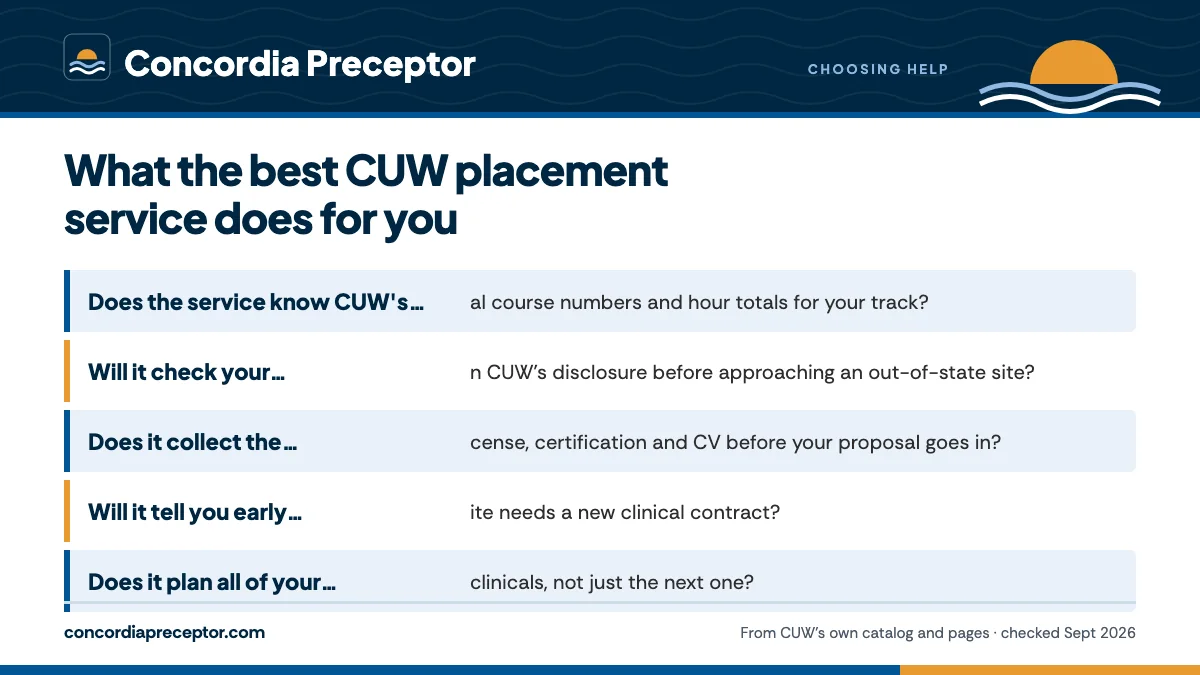
- Does the service know CUW's clinical course numbers and hour totals for your track?
- Will it check your program's row on CUW's disclosure before approaching an out-of-state site?
- Does it collect the preceptor's license, certification and CV before your proposal goes in?
- Will it tell you early whether a site needs a new clinical contract?
- Does it plan all of your remaining clinicals, not just the next one?
- Who finds the replacement if a preceptor leaves mid-course, and how quickly does that start?
We answer each of those the same way: we do it, from the first call, and that is why CUW students choose us. See what shapes a quote, compare the three routes to a preceptor, or tell us your track and start term.
Questions CUW students ask
Does CUW recommend a placement service?
CUW's public pages do not mention placement services at all. Its model has students identify and secure their preceptors, with graduate faculty approving each one and the Graduate Clinical Coordinator available to help. A service works alongside that process; it does not change who approves your preceptor.
Is a preceptor found by a service automatically approved by CUW?
No. CUW's graduate faculty approve every preceptor and site for appropriateness, however the preceptor was found. What a thorough service changes is the quality of what faculty receive: a preceptor who fits your course and CUW's rules, with the license, certification, CV and site details already assembled.
Can a placement service help with a DNP agency mentor?
Yes. CUW's NURS 9030 through NURS 9032 immersions pair you with a mentor at a selected health care agency, and the Post-MSN DNP asks for residency hours in areas of your choice. CUW's archived DNP form recorded the mentor's academic credentials, so we gather those along with the agency details.
What should I have ready when I contact a service?
Your program and track, the next NURS clinical course and its hours, the term start date, your home state and county, how far you will drive, and whether your CastleBranch background check is complete. With that, your placement advisor can start the search right away.
Does a service replace the Graduate Clinical Coordinator?
No. The Graduate Clinical Coordinator is CUW's own role and remains your point of contact for CUW's process, contracts and approvals. A placement service handles the search and the document gathering, so what you bring to the coordinator and graduate faculty is already complete.
Related pages
Last checked 2026-09-26
We check these pages against CUW's own academic catalog, program pages and published nursing documents. Your course faculty and the Graduate Clinical Coordinator have the final word.
- Concordia University Wisconsin Academic Catalog 2026-2027: MSN Primary Care Nurse Practitioner
- Concordia University Wisconsin Academic Catalog 2026-2027: Graduate nursing courses
- Concordia University Wisconsin Distance Education Disclosures
- CUW NP Student Clinical Practicum Handbook 2014-2015 (archived)
CUW asks you to secure your preceptors. We make the search the easy part.
Tell us your CUW track, your city and your next clinical course. We line up preceptors who fit the NURS course, gather the license, board certification and site details CUW's graduate faculty review, and flag early whether the site needs a new clinical contract.
- Preceptors matched to the course: primary care for FNP and AGPCNP, mental health settings for PMHNP, an agency mentor for DNP projects
- Preceptor license, certification, CV and site details ready for CUW's approval
- All three clinical courses planned together, close to home in a state CUW's disclosure lists for your program
Start your placement plan
Track, city and next clinical course is all we need to begin.