CUW nursing accreditation: what CCNE covers and what the page leaves out
Concordia University Wisconsin's nursing programs, from the BSN through the DNP and the post-graduate APRN certificate, carry accreditation from the Commission on Collegiate Nursing Education (CCNE), and the Higher Learning Commission accredits the university itself. The School of Nursing's page still shows a term ending December 31, 2024, and CUW has posted no result from its February 2024 CCNE visit, so get the current term from the School of Nursing whenever a board or employer asks.
Get your placement plan
Tell us your CUW program and where you live. A placement advisor replies with the preceptor and site options that fit your course.
Two layers: the nursing programs and the university
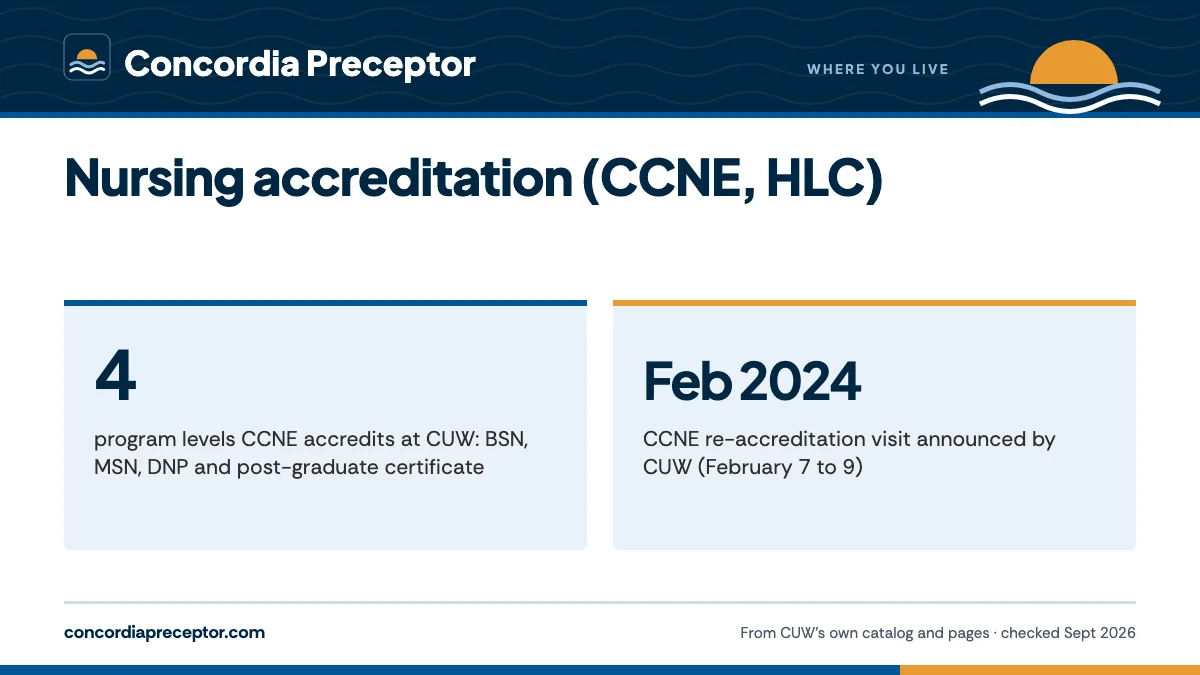
Accreditation at CUW comes in two layers. The School of Nursing's accreditation page names CCNE for four levels of nursing education: bachelor's, master's and DNP degrees, plus the certificate for nurses who already hold a graduate degree. The page describes these as programs at Concordia University Wisconsin.
The second layer covers the whole institution. CUW's catalog and program pages name the Higher Learning Commission, and the catalog describes the accreditation as held by Concordia University Wisconsin and Ann Arbor together, since the legal entity, Concordia University, Inc., runs both campuses. Programmatic accreditation speaks to nursing education standards; institutional accreditation speaks to the university as a whole.
For an NP student, the CCNE layer is the one that follows you into licensure and certification paperwork, so it is worth knowing exactly what the page says and where it falls short.
The December 31, 2024 date and the 2024 visit
The live accreditation page still reads that all programs are "accredited for 10 years extending to December 31, 2024." An archived copy from May 2026 shows the same words, and nothing on the page has been updated since that date passed.
Read that line carefully in both directions. It does not show that accreditation lapsed, because CUW scheduled a re-accreditation review before the term ran out. It also does not confirm the current term, because no newer end date appears anywhere on CUW's public pages.
If you need the current accreditation term for an APRN license application, a certification board, an employer's credentialing file or a preceptor's site, ask the School of Nursing for it in writing, or check the accreditor's own records directly. A dated reply is more useful to a licensing office than a screenshot of a stale page.
In a notice dated December 13, 2023, CUW announced a CCNE on-site evaluation for February 7 to 9, 2024, reviewing all four levels at once. The notice survives in archived 2024 copies of the accreditation page.
No CUW page reports the outcome. That is a gap in CUW's public information, not evidence of any problem, and the School of Nursing is the place to close it. Students who enrolled after 2024 can reasonably ask for the result and the new term during orientation or through their advisor.
The accreditation page's 2024 end date is out of date, not a verdict: confirm the current term before you quote it anywhere official.
Programs that arrived after the visit
Several programs are newer than the 2024 review. The 2026-27 catalog is the first to list the MSN PMHNP, the PMHNP DNP, the MSN FNP dual degrees with the MBA or the Master of Public Health, and the Direct Entry MSN. The PMHNP certificate is older, first appearing in the 2023-24 catalog.
CUW's accreditation page describes CCNE accreditation by degree level and does not list individual tracks, so it neither names nor excludes the new programs. How CCNE treats a new track inside an accredited degree is not explained on CUW's public pages. If an employer, a board or a certification body asks about a specific new program, the School of Nursing should be your source.
Some programs have also left the roster: the MSN Nurse Educator, the MSN Healthcare Informatics and the Accelerated Second Degree BSN are no longer in the catalog.
Why accreditation matters for your NP license
Under 2025 Wisconsin Act 17, a new APRN license in Wisconsin requires completion of an accredited graduate or post-graduate APRN program in one of the four recognized roles, plus current national certification, a Wisconsin or multistate RN license and the malpractice insurance Wisconsin requires. The Board of Nursing's emergency rules add an APRN jurisprudence exam. Our page on Wisconsin NP practice covers the rest of the new law.
Other states lean on accreditation too. Michigan's board recognizes out-of-state nursing programs for licensure through national accreditation, naming CCNE among the accreditors. Washington expects an out-of-state distance program to stay nationally accredited to keep its approval to place students there. Wisconsin, for its part, approves schools based elsewhere that send students into Wisconsin only when they hold home-state approval and accreditation from a body its board recognizes.
Where accreditation shows up in clinical paperwork
Accreditation reaches your preceptor file as well. CUW's undated Clinical Practicum Site Proposal and Preceptor Information form (archived in 2023) asked for proof of national board certification for NP and CNM preceptors and said it was needed "for our accreditation purposes." The 2022 program FAQ listed a state license and board certification among preceptor requirements, and the 2014-15 NP clinical handbook required national certification for NP, PA and CNM preceptors.
Current CUW pages publish no preceptor credential list, so today's rules sit with the Graduate Clinical Coordinator and your course faculty. Expect certification proof to stay on the list, since it ties back to accreditation. The dated history is on CUW preceptor requirements, and the archived form itself is covered on the practicum proposal form page.
Accreditation is not state authorization
Accreditation and state approval answer different questions. Accreditation says a program meets national education standards. CUW's Distance Education Disclosures page answers the state question, marking each program "Meets" or "Does Not Meet" licensure requirements state by state, and it currently has no table for the three newest programs.
Reciprocity is a third layer again. CUW's 2024 online-programs page said CUW was approved to participate in the national reciprocity agreement for distance education, though the live disclosure page does not mention it. Some states tie the two together: North Dakota's board, for example, asks distance programs for proof of reciprocity approval or state authorization before recognizing them. For the state-by-state picture, read the licensure disclosure page.
Where we fit
CUW students choose us because we build preceptor files the way an accredited program checks them. Every preceptor we bring you arrives with a current license from the state where they practice, national board certification, a CV and the site details, ready for CUW's graduate faculty to approve the first time.
We plan all three clinical courses at once, and if a preceptor leaves mid-course your advisor is already lining up the next one, so your hours keep moving toward the certification exam and the license that follow. The goal is simple: a file that reaches faculty review complete, early and in CUW's own terms. See how it works or start through the contact form.
Questions CUW students ask
Is Concordia University Wisconsin's nursing program accredited?
Yes. CUW's School of Nursing page names CCNE as the accreditor for every nursing level it offers, from the BSN to the DNP and the post-graduate certificate, and the Higher Learning Commission accredits the university. The page's end date of December 31, 2024 has not been updated, so ask the School of Nursing for the current term when you need it for paperwork.
Is CUW's CCNE accreditation still valid after December 2024?
CUW's public pages do not say. The accreditation page still shows the 10-year term ending December 31, 2024, and CUW announced a CCNE visit for February 2024 without posting the result. A stale page is not a lapse; request the current term in writing from the School of Nursing or check the accreditor's own records.
Who accredits Concordia University Wisconsin as a university?
The Higher Learning Commission. CUW's catalog describes the institutional accreditation as held by Concordia University Wisconsin and Ann Arbor together, because one legal entity, Concordia University, Inc., runs both the Mequon and Ann Arbor campuses. CCNE is the separate, program-level accreditor for nursing.
Is CUW's new PMHNP MSN accredited?
The accreditation page lists CCNE accreditation by degree level only and names no individual tracks, so it neither lists nor excludes the PMHNP MSN, which is new in the 2026-27 catalog. Ask the School of Nursing how the new track is covered before an employer or board asks you.
Does CUW's nursing accreditation cover the Ann Arbor campus?
The university's institutional accreditation is held jointly for Concordia University Wisconsin and Ann Arbor. On the nursing side, the 2022-23 catalog described Ann Arbor's nursing program as an additional campus location of CUW's baccalaureate program, and the Direct Entry MSN runs labs on both campuses. The School of Nursing can confirm current coverage.
Related pages
Last checked 2026-09-26
We check these pages against CUW's own academic catalog, program pages and published nursing documents. Your course faculty and the Graduate Clinical Coordinator have the final word.
CUW asks you to secure your preceptors. We make the search the easy part.
Tell us your CUW track, your city and your next clinical course. We line up preceptors who fit the NURS course, gather the license, board certification and site details CUW's graduate faculty review, and flag early whether the site needs a new clinical contract.
- Preceptors matched to the course: primary care for FNP and AGPCNP, mental health settings for PMHNP, an agency mentor for DNP projects
- Preceptor license, certification, CV and site details ready for CUW's approval
- All three clinical courses planned together, close to home in a state CUW's disclosure lists for your program
Start your placement plan
Track, city and next clinical course is all we need to begin.