North Carolina clinicals for Concordia University Wisconsin NP students
North Carolina residents can study in any Concordia University Wisconsin graduate NP program that has a disclosure table, because each one lists the state as meeting requirements. The state's nursing board plays no approval role for post-licensure graduate programs, which leaves two practical jobs: your license, and a preceptor in a state where each NP works under a physician agreement.
Get your placement plan
Tell us your CUW program and where you live. A placement advisor replies with the preceptor and site options that fit your course.
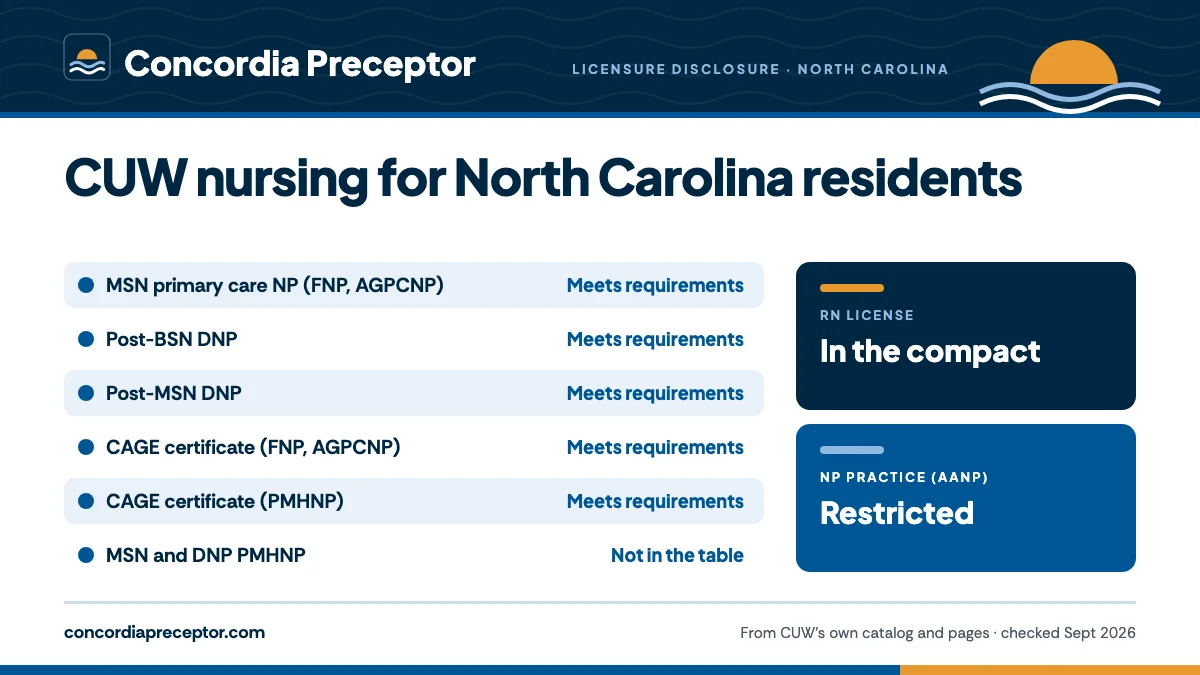
North Carolina on CUW's disclosure page
One answer, "Meets Requirements," appears for North Carolina in all five graduate NP tables, and the RN to BSN table agrees.
| CUW program | CUW's answer for North Carolina |
|---|---|
| MSN - Primary Care Nurse Practitioner (FNP, AGPCNP) | Meets Requirements |
| DNP - Post BSN to DNP Program | Meets Requirements |
| DNP - Post MSN to DNP Program | Meets Requirements |
| CAGE (FNP/AGPCNP) | Meets Requirements |
| CAGE (PMH NP) | Meets Requirements |
| MSN PMHNP and PMHNP DNP | Not in the table |
PMHNP degree students, who have no table, should ask CUW about North Carolina first. Apart from a brief Advanced Health Assessment session on the Mequon campus for FNP and AGPCNP students, the program runs from home. The tables are compared on CUW's licensure disclosures.
What the NC Board of Nursing approves, and what it leaves alone
CUW's NP programs fall in the second row below. Between its education FAQ and its out-of-state rule, the NCBON sorts students into four groups, and only unlicensed pre-licensure students trigger an approval request.
| Student | What the Board says |
|---|---|
| Unlicensed pre-licensure student | 21 NCAC 36 .0233: the North Carolina agency's chief nursing administrator or RN designee requests Board approval 30 or more days ahead, with home-state approval and a preceptor licensed as an RN in North Carolina |
| Post-licensure graduate or doctoral student | Outside the Board's jurisdiction; it neither approves nor disapproves these programs, in state or out |
| Graduate student with no North Carolina or multistate license | Contact the Board's Licensure Department for the requirements before clinicals |
| Student at a SARA-approved college | May be eligible for clinical placements in North Carolina, a SARA state since June 2016 |
Check the SARA row: CUW's 2024 online-programs page reported SARA approval, but the live disclosure page omits it, so ask CUW whether that still holds.
Restricted practice and your preceptor
Restricted is AANP's label for North Carolina. Each NP keeps a physician agreement in place for as long as they practice, and NP licenses are handled by a Joint Subcommittee of two boards, Nursing and Medical. Any NP preceptor you find already has that physician relationship.
CUW's 2014-15 handbook took physicians as preceptors, not only NPs, required that 50 or more program hours be with an NP, and allowed up to two preceptors per semester without approval, so an NP and the physician in the same office could share a semester if CUW's graduate faculty approve both. FNP and AGPCNP hours come in three 250-hour clinicals; PMHNP programs total 500. Dated rules are on preceptor requirements.
Charlotte, Raleigh, Greensboro and Winston-Salem
Charlotte's metro, which also takes in Concord and Gastonia, holds about 2.48 million North Carolinians by the 2025 Census estimates. Raleigh-Cary has about 1.6 million; Greensboro-High Point and Winston-Salem, at roughly 806,000 and 712,000, complete the big four. Systems to research, each for its own student rules: ECU Health, Novant Health, Duke Health, UNC Health and Atrium Health.
Atrium belongs to Advocate Health, the parent of Wisconsin's Aurora Health Care, but Aurora's rotation rules are Aurora's own, so read Atrium's student pages rather than assume anything carries over. CUW names none of these systems as a partner. Part of that Charlotte metro lies in South Carolina, a state CUW's graduate tables also mark as meeting requirements.
Your license for North Carolina clinicals
Wisconsin and North Carolina switched on the NLC the same day, January 19, 2018. Holding a multistate license from a member home state covers North Carolina clinical work; only a nurse holding neither that nor a North Carolina license needs the Board's Licensure Department. The APRN Compact is not law in North Carolina. For the rest, see what CUW expects of your license.
Why CUW students in North Carolina choose us
North Carolina students choose us because we search with restricted practice in mind. Your placement advisor looks for primary care offices where the NP and the collaborating physician are both open to a student, gathers credentials for each when a two-preceptor semester makes sense, and reads every system's student rules around Charlotte, Raleigh, Greensboro or Winston-Salem before outreach. CUW's graduate faculty receive a complete file, early. Tell us where you live and what you study.
Questions CUW students ask
Is North Carolina an eligible state for CUW's online FNP?
Yes. CUW's disclosure gives North Carolina a "Meets Requirements" entry in the MSN primary care NP table, home of the FNP track, and again in each doctoral and certificate table. The 750 FNP clinical hours would be with preceptors you line up and CUW's graduate faculty approve.
Must North Carolina's nursing board sign off on CUW before my clinicals?
Going by the Board's own FAQ, no. The Board describes graduate programs for already-licensed nurses, whatever their home state, as outside its approval role, and 21 NCAC 36 .0233 is written for pre-licensure students without a license. What can still apply to you is licensing, if your license is neither multistate nor issued by North Carolina.
Can a physician precept me in North Carolina?
Physicians (MD or DO) were on the preceptor list in CUW's archived 2014-15 handbook, provided an NP covered 50 or more of your program hours. No current list is published, so graduate faculty decide. Under North Carolina's restricted practice, an NP and the collaborating physician in one office are a natural pair to propose.
Could I train across the line near Charlotte, in South Carolina?
Yes. South Carolina, an NLC member from January 19, 2018, meets in every CUW graduate table. The catalog rule is the same as for North Carolina: confirming eligibility is on you. Read our South Carolina guide and check with CUW before you commit.
Related pages
Last checked 2026-09-26
We check these pages against CUW's own academic catalog, program pages and published nursing documents. Your course faculty and the Graduate Clinical Coordinator have the final word.
CUW asks you to secure your preceptors. We make the search the easy part.
Tell us your CUW track, your city and your next clinical course. We line up preceptors who fit the NURS course, gather the license, board certification and site details CUW's graduate faculty review, and flag early whether the site needs a new clinical contract.
- Preceptors matched to the course: primary care for FNP and AGPCNP, mental health settings for PMHNP, an agency mentor for DNP projects
- Preceptor license, certification, CV and site details ready for CUW's approval
- All three clinical courses planned together, close to home in a state CUW's disclosure lists for your program
Start your placement plan
Track, city and next clinical course is all we need to begin.