South Carolina guide for Concordia University Wisconsin nursing students
For South Carolina nurses eyeing Concordia University Wisconsin's online graduate programs, the disclosure answer is yes: all five graduate NP tables put the state under "Meets Requirements." Two South Carolina quirks follow. CUW's online RN to BSN table lists the state the other way, and the state's preceptor tax credit only rewards teaching students of South Carolina schools.
Get your placement plan
Tell us your CUW program and where you live. A placement advisor replies with the preceptor and site options that fit your course.
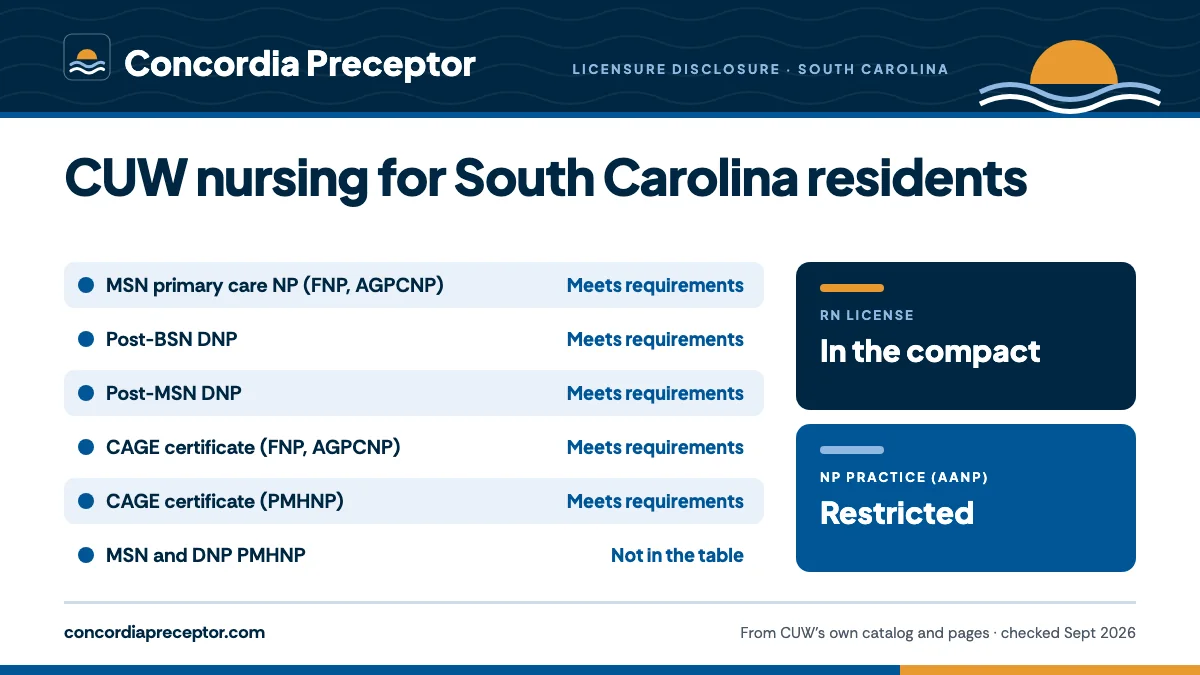
Where South Carolina lands in CUW's tables
South Carolina splits CUW's tables by level: yes for every graduate NP program that has a table, no for the online RN to BSN.
| CUW program | CUW's answer for South Carolina |
|---|---|
| MSN - Primary Care Nurse Practitioner (FNP, AGPCNP) | Meets Requirements |
| DNP - Post BSN to DNP Program | Meets Requirements |
| DNP - Post MSN to DNP Program | Meets Requirements |
| CAGE (FNP/AGPCNP) and CAGE (PMH NP) | Meets Requirements |
| MSN PMHNP and PMHNP DNP | Not in the table |
| RN to BSN Online Nursing Program (BSN Comp) | Does Not Meet Requirements |
RNs weighing CUW's online RN to BSN should ask CUW admissions about South Carolina before applying; PMHNP degree students need the same kind of answer for their track. Every table is laid out in the disclosure explainer.
Restricted practice: what a South Carolina NP works under
AANP puts South Carolina in its restricted group. To perform delegated medical acts, a South Carolina NP needs a physician practice agreement, and caps apply to the controlled substances an NP supplies. CUW's graduate faculty look past the agreement to the NP's license, board certification and years in practice (CUW's dated preceptor standards).
FNP and AGPCNP students owe 750 hours across three 250-hour clinicals, and CUW's archived 2014-15 handbook allowed no more than 400 program hours with any single preceptor, so under that rule the sequence takes at least two preceptors. PMHNP programs require 500 hours.
The preceptor tax credit, and why it skips CUW students
South Carolina's preceptor incentive, an income tax credit for each qualifying rotation with a deduction for rotations past the cap, comes from a 2019 law revised in 2024 (S.C. Code section 12-6-3800). Set its conditions beside a preceptor who teaches you and one fails.
| Condition in the statute | Preceptor of a CUW student |
|---|---|
| Physician, APRN or PA acting as preceptor | Can meet it |
| At least two rotations a year, each 160 hours or more in listed settings | Can meet it |
| Medicaid-participating, with at least 100 Medicaid and Medicare patients combined | Depends on the practice |
| Student enrolled at a South Carolina public or independent institution | Cannot meet it: CUW is a Wisconsin school |
The 2024 revision runs the credit through tax year 2029, though the Department of Revenue's ruling still shows the older 2026 repeal. Be plain with a prospective preceptor: hosting a CUW student earns none of it.
Greenville, Charleston, Columbia and the Charlotte fringe
Greenville-Anderson-Greer is the state's largest metro, at roughly 1,014,000 residents by 2025 Census estimates; Columbia and Charleston-North Charleston are nearly tied, both just below 890,000; and around 454,000 South Carolinians belong to the Charlotte-Concord-Gastonia metro. Systems with their own student terms include McLeod Health, Prisma Health and Roper St. Francis Healthcare, along with Lexington Health (Lexington Medical Center) and MUSC Health, tied to the Medical University of South Carolina. CUW names no partner among them.
On the Charlotte side, North Carolina is a "Meets" state in every CUW graduate table too, while Georgia, the other neighbor, is listed as not meeting in any of them.
The Board, the compact and your license
South Carolina's rule for schools from other states, S.C. Code Regs. 91-6, is written for programs preparing students for initial licensure. Those programs need Board approval before clinicals, full approval at home, on-site faculty licensed in South Carolina or another member state of the compact, a written affiliation agreement, and written notice of changes within 15 days. Neither APRN nor RN-to-BSN programs are mentioned in it, so ask the Graduate Clinical Coordinator whether CUW files anything.
Wisconsin and South Carolina have both been NLC members since January 19, 2018, and South Carolina has not taken up the APRN Compact. CUW's license expectations are set out on RN license for clinicals.
Why CUW students in South Carolina choose us
South Carolina students choose us because we plan for two or more preceptors from the first conversation and tell each of them plainly what the state credit covers. Your placement advisor works primary care practices around Greenville, Columbia, Charleston or the Charlotte area, checks each system's student rules, and gets CUW's graduate faculty a complete file per preceptor, early. Share your city and program.
Questions CUW students ask
Can I study in CUW's online NP programs from South Carolina?
Yes, for every graduate NP program that has a table: the MSN primary care NP (the FNP and AGPCNP tracks), the Post-BSN and Post-MSN DNPs, and both CAGE certificates. The two PMHNP degrees lack a table, and South Carolina appears under "Does Not Meet" only for the online RN to BSN.
Why is CUW's RN to BSN listed as not meeting requirements in South Carolina?
CUW does not explain it. Its nursing tables have no footnotes, and the RN to BSN table follows a state list of its own that differs from the graduate tables. If you are a South Carolina RN interested in that program, ask CUW admissions for the current status before you apply.
Can my preceptor claim South Carolina's tax credit for teaching me?
No. The statute ties each qualifying rotation to a student from a South Carolina public or independent institution, and CUW is in Wisconsin. The same preceptor may still claim the credit for rotations with in-state students, so be clear about which rotations qualify.
Do I need a South Carolina nursing license for clinicals there?
Usually not, because South Carolina is an NLC member and honors the multistate license your home member state issued. Someone licensed in just one state outside the compact should ask the state's Board what applies. Separately, CUW requires your license to stay unencumbered until you finish.
Related pages
Last checked 2026-09-26
We check these pages against CUW's own academic catalog, program pages and published nursing documents. Your course faculty and the Graduate Clinical Coordinator have the final word.
CUW asks you to secure your preceptors. We make the search the easy part.
Tell us your CUW track, your city and your next clinical course. We line up preceptors who fit the NURS course, gather the license, board certification and site details CUW's graduate faculty review, and flag early whether the site needs a new clinical contract.
- Preceptors matched to the course: primary care for FNP and AGPCNP, mental health settings for PMHNP, an agency mentor for DNP projects
- Preceptor license, certification, CV and site details ready for CUW's approval
- All three clinical courses planned together, close to home in a state CUW's disclosure lists for your program
Start your placement plan
Track, city and next clinical course is all we need to begin.