Tennessee and Concordia University Wisconsin's nurse practitioner programs
Concordia University Wisconsin's disclosure puts Tennessee in the "Does Not Meet Requirements" column for all five graduate NP tables, so anyone aiming at a Tennessee NP license should raise it with CUW first. Tennessee adds a live question of its own: a 2026 bill that would stop its Board, for two years, taking new applications from nursing schools headquartered elsewhere.
Get your placement plan
Tell us your CUW program and where you live. A placement advisor replies with the preceptor and site options that fit your course.
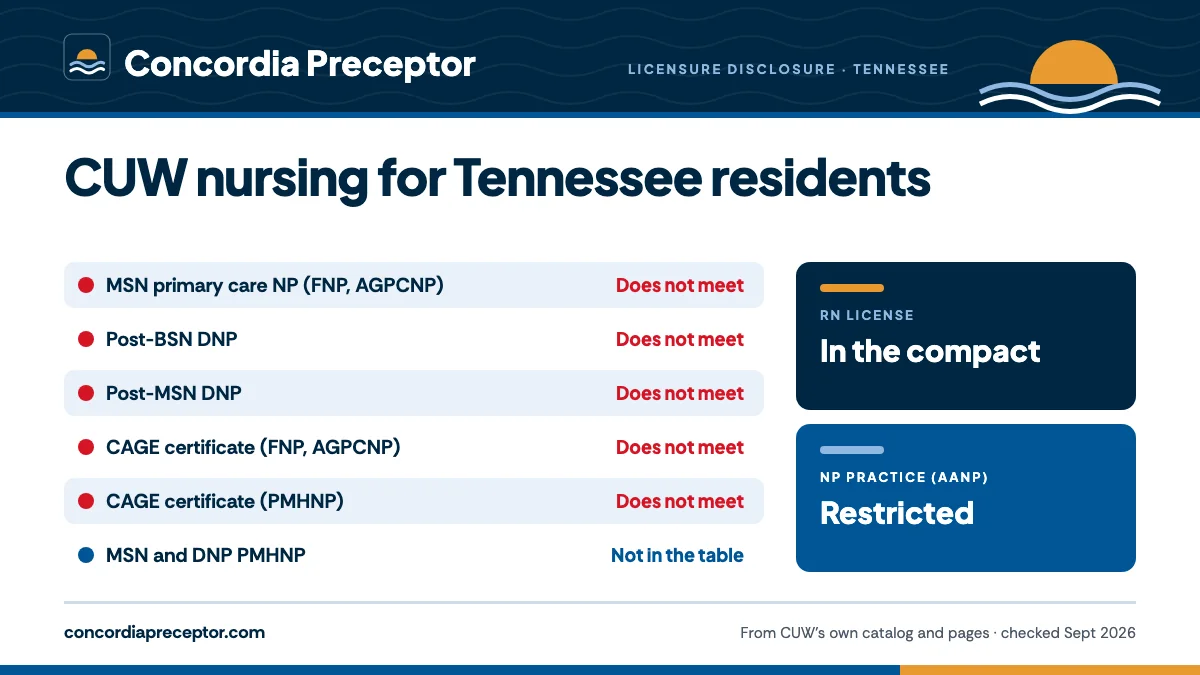
Tennessee's answers in CUW's table
Only the campus BSN tables count Tennessee as meeting; the online RN to BSN agrees with the graduate tables.
| CUW program label | Tennessee |
|---|---|
| Master of Science in Nursing - Primary Care Nurse Practitioner | Does not meet |
| Doctor of Nursing Practice - Post BSN to DNP Program | Does not meet |
| Doctor of Nursing Practice - Post MSN to DNP Program | Does not meet |
| Certificate After Graduate Education in Nursing (CAGE) (FNP/AGPCNP) | Does not meet |
| Certificate After Graduate Education in Nursing (CAGE) (PMH NP) | Does not meet |
| PMHNP MSN and PMHNP DNP | No table, so no Tennessee entry |
The program pages got there first. Three archived CUW pages, the MSN page in 2022 and again in 2024 and the Post-MSN DNP page in 2022, said CUW was not taking new Tennessee students, while the disclosure through May 2024 kept Tennessee as meeting on the MSN and both DNP tables. August 2024 brought the table into line; the licensure disclosure guide tracks the change.
A two-year freeze in the making
Senate Bill 2013, paired with House Bill 1905 and called the Nursing Education Integrity and Oversight Act, tells the Board of Nursing to stop taking or granting applications for two years from any nursing program based outside Tennessee that wants to run, recruit or send clinical students there. It makes no exception for graduate NP programs.
Schools approved beforehand keep their standing, with a catch: state officials, meaning the Board plus the Tennessee Center for Nursing Advancement, may call for their records, including who precepts and how many students go where. The Center is due to recommend, by the end of June 2027, standards for programs from elsewhere that lean on Tennessee preceptors, and the bill's findings fault many such programs for placing students with too little oversight.
Whether it is law yet is unsettled: one secondary report gives April 27, 2026, and no official source in hand confirms it. No existing Board rule demands advance approval for a clinical placement. Get CUW's position from the Graduate Clinical Coordinator before planning Tennessee hours; the catalog rule is on clinicals outside Wisconsin.
Supervision, a preceptor incentive with borders, and the metros
AANP's map shades Tennessee restricted: NPs there practice under a physician's supervision, and prescribing from Schedules II through IV comes with limits, opioid supply among them.
Tennessee does pay preceptors, though its published terms leave CUW students out. A Tennessee Hospital Association program, paid for by state grants and run alongside the state's Center for Health Workforce Development, rewards LPN, RN and APRN preceptors each cycle once they log 70-plus hours of one-on-one teaching and complete a UTHSC preceptor course, where NPs take a dedicated module. Qualifying learners come from accredited Tennessee schools or from programs in seven nearby states, none of them Wisconsin, training in Tennessee.
Four metros carry most of the state: Nashville's, the biggest, then Memphis, Knoxville and Chattanooga. Large systems include Methodist Le Bonheur Healthcare and Erlanger, Covenant Health, Ballad Health and Vanderbilt University Medical Center, and each handles students its own way.
Licenses in Tennessee
Tennessee and Wisconsin opened multistate RN licensing on the same day, January 19, 2018, so an active multistate license from either one is honored in the other. Tennessee is absent from the APRN Compact's short list of adopters, and that compact has not started, so NP licensure stays a state-by-state matter.
CUW requires an unencumbered RN license throughout the MSN, DNP and CAGE programs. How that fits a clinical state's rules is covered on your RN license for CUW clinicals.
Who we help, and how
Tennessee touches eight states, and four meet in every CUW NP table: Virginia, North Carolina, Arkansas and Missouri. Memphis's metro spills west into Arkansas, a Meets state, and south into Mississippi, which is not; Chattanooga's crosses into Georgia, also not.
CUW students choose us when their NP license will sit in one of the Meets states. Your placement advisor starts from that state's row, builds a primary care preceptor search near your future home, puts all three clinical courses in sequence and sends CUW's graduate faculty a complete file the first time. Tell us your program and plans through the contact form.
Questions CUW students ask
Is Tennessee's out-of-state freeze already in force?
The record leaves that open. A secondary source puts its start at April 27, 2026; no official confirmation is on record. If it is in force, programs based elsewhere without prior approval face a two-year wait. Check the Tennessee Board of Nursing's pages, and ask CUW whether it holds any Tennessee approval.
Can the hospital association's incentive pay a preceptor who teaches me?
By the program's own terms, it looks unlikely. It counts learners from accredited Tennessee schools and from programs in seven nearby states whose students train in Tennessee, and Wisconsin is not among them. Fall 2026 hours run from August 1 through December 1. A preceptor who sees an unusual case can ask the association directly.
Can a Tennessee resident enroll in CUW's online AGPCNP?
CUW posts no enrollment restriction by state today, though its archived 2022 and 2024 MSN pages said it was not accepting new Tennessee students. The current disclosure says the MSN primary care NP, which includes the AGPCNP, does not meet Tennessee's requirements. Ask CUW admissions in writing what that means for a Tennessee license.
Who can precept a CUW student in a supervised-practice state like Tennessee?
Tennessee NPs work under physician supervision, and CUW's 2014-15 NP handbook listed physicians as acceptable preceptors too. Current CUW criteria come from the Graduate Clinical Coordinator; see our preceptor requirements page for the dated versions.
Related pages
Last checked 2026-09-26
We check these pages against CUW's own academic catalog, program pages and published nursing documents. Your course faculty and the Graduate Clinical Coordinator have the final word.
CUW asks you to secure your preceptors. We make the search the easy part.
Tell us your CUW track, your city and your next clinical course. We line up preceptors who fit the NURS course, gather the license, board certification and site details CUW's graduate faculty review, and flag early whether the site needs a new clinical contract.
- Preceptors matched to the course: primary care for FNP and AGPCNP, mental health settings for PMHNP, an agency mentor for DNP projects
- Preceptor license, certification, CV and site details ready for CUW's approval
- All three clinical courses planned together, close to home in a state CUW's disclosure lists for your program
Start your placement plan
Track, city and next clinical course is all we need to begin.