Kentucky nurses and Concordia University Wisconsin's NP programs
Concordia University Wisconsin's current disclosure places Kentucky under "Does Not Meet Requirements" for the MSN primary care NP, both DNP programs, both CAGE certificates and the online RN to BSN. Kentucky has been set apart in CUW's sources before, and the Kentucky Board of Nursing leans on licenses rather than program approvals.
Get your placement plan
Tell us your CUW program and where you live. A placement advisor replies with the preceptor and site options that fit your course.
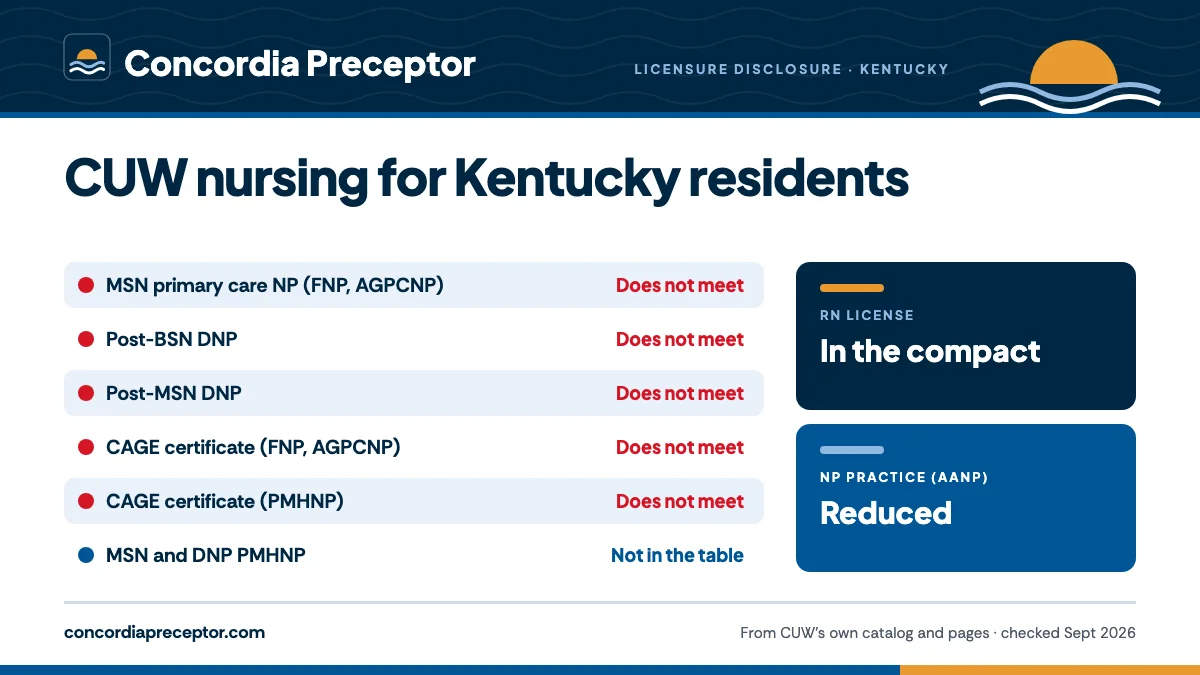
Where Kentucky lands in CUW's disclosure
Each row is a licensure statement, and Kentucky's are uniform: CUW does not present its NP, DNP or certificate programs, or its RN to BSN, as satisfying Kentucky's requirements. The PMHNP MSN and PMHNP DNP never made it onto the page, which is a reason to ask admissions, not a quiet yes. The whole 50-state grid is on our licensure disclosure page.
| CUW program | Kentucky |
|---|---|
| Master of Science in Nursing - Primary Care Nurse Practitioner | Does Not Meet |
| Doctor of Nursing Practice - Post BSN to DNP Program | Does Not Meet |
| Doctor of Nursing Practice - Post MSN to DNP Program | Does Not Meet |
| CAGE (FNP/AGPCNP) | Does Not Meet |
| CAGE (PMH NP) | Does Not Meet |
| MSN PMHNP and PMHNP DNP | Missing from the table |
| RN to BSN Online Nursing Program (BSN Comp) | Does Not Meet |
Kentucky on CUW's program pages before 2024
Kentucky's listing has history behind it. CUW's archived 2022 MSN page, and its 2022 Post-MSN DNP page, each named Kentucky among the states from which new students were not being accepted, and the MSN page captured in 2024 still did. The disclosure of those same years said otherwise: copies from March 2023 and May 2024 put Kentucky under Meets for the MSN and both DNP tables, until the August 2024 revision moved it.
Today the program pages carry no state lists, and the disclosure is the live signal. If your plans hinge on the Kentucky answer, get CUW's current position from admissions in writing.
KBN approves little and licenses a lot
The Kentucky Board of Nursing's program approvals are narrow. It signs off on pre-licensure programs born in Kentucky; a school headquartered elsewhere, KBN says, is not required to seek its approval, and that holds even when the school's only Kentucky footprint is a clinical rotation. Bachelor's completion for RNs is outside KBN's reach altogether, and of graduate programs it concerns itself only with those that end in licensure.
Licenses are a different story. Picture an APRN-track student from an online MSN or DNP program in a Lexington clinic: under KBN's guidance, the preceptor there and any faculty member overseeing that student carry an active, unencumbered Kentucky RN license plus a Kentucky APRN license. A preceptor whose home is in another compact state can skip the Kentucky RN license, never the APRN one. KBN further cites an exemption in KRS 314.101 for clinical rotations by nurses licensed elsewhere, provided the school holds SARA membership or a license from Kentucky's Council on Postsecondary Education.
On the RN side, Kentucky's compact membership dates from January 19, 2018, so a Wisconsin multistate RN license is already valid there; no Kentucky law adopts the APRN Compact. See CUW's license page for what CUW expects of yours.
Reduced practice and Kentucky's large systems
AANP scores Kentucky as reduced practice. Prescribing NPs there maintain two agreements with a physician, covering controlled and non-controlled drugs, unless KBN exempts them, and brand-new licensees face rules on the employer settings open to them in year one. Kentucky's four biggest metros are Louisville, Lexington, Bowling Green and the state's share of greater Cincinnati. Examples of where Kentucky NP students look include Baptist Health, whose footprint crosses into southern Indiana, St. Elizabeth Healthcare, UK HealthCare, and the pair of Norton Healthcare and UofL Health. Student terms vary by system.
Kentucky nurses and our placement desk
Kentucky is ringed by states that answer differently. Indiana, Ohio, Illinois, Missouri and Virginia all sit under Meets in every CUW graduate table, while Tennessee and West Virginia share Kentucky's Does Not Meet. The Louisville metro already spills north into Indiana, and most of the Cincinnati metro lies in Ohio, so for some Kentucky nurses a move to a Meets state is a short one.
At CUW the student finds the preceptor and graduate faculty approve it. If you will live and practice in one of those states, CUW students choose us because we work ahead of the calendar: a preceptor search in your new state fitted to your CUW courses, from the FNP's three 250-hour clinicals to the PMHNP practicums, a complete file for CUW's graduate faculty, and a clear read on each site's contract needs. Send your plans through the contact form.
Questions CUW students ask
Does KBN have to approve CUW before I train in Kentucky?
No approval from KBN is required, the Board says, for a school based in another state, clinical component or not. Its interest is in licenses, preceptors' included. None of that shifts CUW's table, which still lists Kentucky as not meeting for CUW's NP programs, so check with the Graduate Clinical Coordinator before pursuing any Kentucky site.
What license does a Kentucky NP preceptor need for an online program's student?
Two Kentucky credentials, as a rule: an active, unencumbered RN license and an APRN license, both issued by Kentucky. The RN requirement drops away for a preceptor who resides in a different compact state, but the Kentucky APRN license stays. CUW's graduate faculty then apply their own approval, outlined on CUW's preceptor requirements.
Does CUW's RN to BSN work for a Kentucky RN?
CUW's disclosure lists Kentucky under Does Not Meet for the RN to BSN Online Nursing Program too. KBN also notes that bachelor's completion programs fall outside its jurisdiction, while their clinical faculty and preceptors in Kentucky hold a Kentucky RN license if home is a non-compact state. Admissions can say how that affects you.
Is Kentucky part of the APRN Compact?
No. Kentucky's compact membership, dating to 2018, covers RN licenses only. The APRN Compact has no Kentucky enactment, and it cannot operate anywhere until seven states adopt it. Until then, APRN practice in Kentucky requires a Kentucky APRN license, whatever license an NP holds elsewhere.
Related pages
Last checked 2026-09-26
We check these pages against CUW's own academic catalog, program pages and published nursing documents. Your course faculty and the Graduate Clinical Coordinator have the final word.
CUW asks you to secure your preceptors. We make the search the easy part.
Tell us your CUW track, your city and your next clinical course. We line up preceptors who fit the NURS course, gather the license, board certification and site details CUW's graduate faculty review, and flag early whether the site needs a new clinical contract.
- Preceptors matched to the course: primary care for FNP and AGPCNP, mental health settings for PMHNP, an agency mentor for DNP projects
- Preceptor license, certification, CV and site details ready for CUW's approval
- All three clinical courses planned together, close to home in a state CUW's disclosure lists for your program
Start your placement plan
Track, city and next clinical course is all we need to begin.